Physical assessment - Male reproductive system: Nursing
Assessment of the male reproductive system should be completed as part of a comprehensive client assessment, like during a routine physical exam, or as part of a focused exam if the client is experiencing issues like testicular pain. This assessment provides the nurse with information about the client’s reproductive health. Now, let’s review the process of completing an assessment of the male reproductive system.
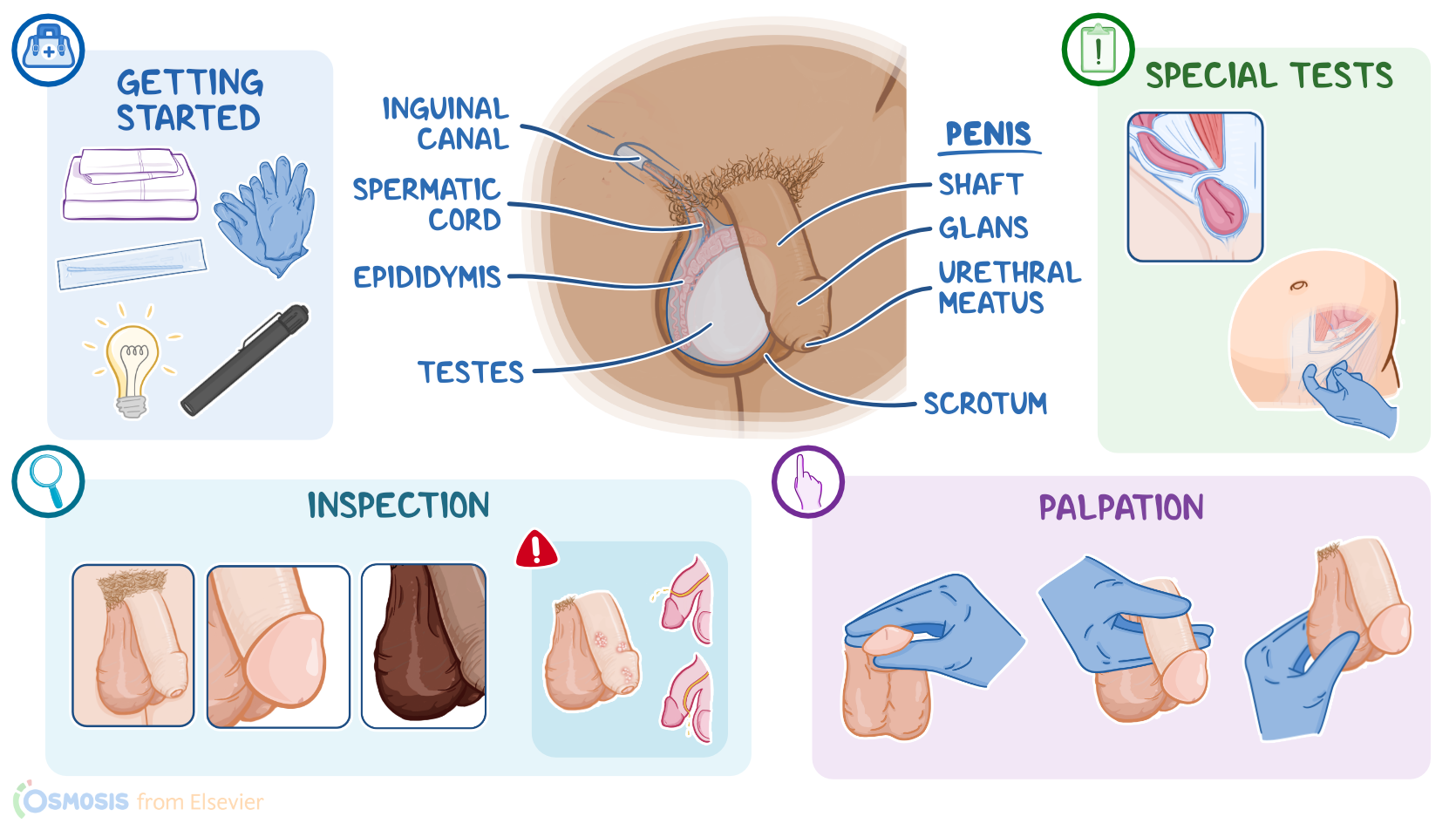
Okay, the supplies you’ll need include drapes, gloves, penlight, sterile swabs in the event a culture needs to be collected, and a good source of light. Then, prepare for the exam by ensuring your client is in a comfortable position, that your hands are warm, and that the temperature in the room is comfortable. Provide privacy by closing the door and curtains, properly draping your client, and only exposing areas of their body as needed to perform your examination.
Now, as the nurse, you may assist the healthcare provider or act as a chaperone, which is often required by facilities to protect clients and clinicians during exams of the reproductive system. During the examination, keep in mind that this process can be emotionally uncomfortable and anxiety-producing for some clients, particularly those who have experienced sexual trauma or who are transgender. Be sure to use the patient’s indicated pronouns and be aware of variations in the genitals for those who have had gender affirming surgeries. It’s also crucial to explain exactly what will happen at each step of the exam. Remember to avoid rushing your assessment, use a gentle touch, and to let your client know that at any time the exam can be stopped or paused if they request it.
Before getting started, explain the procedure to your client and be sure to answer any questions they might have before obtaining verbal consent. Then, perform hand hygiene and collect your supplies.
During this assessment, you will locate the penis, which consists of the shaft, glans, and urethral meatus; scrotum, testes, epididymis, spermatic cord, and inguinal canal.
Methods of assessment include inspection and palpation.
Okay, let’s start with inspection. First, inspect the hair distribution in the genital area, which is typically triangular, and sparse. Inspect it for any evidence of lice or lesions on the surrounding skin. Then, examine the shaft and glans. Look for the presence or absence of the prepuce, sometimes referred to as the foreskin. If your client has undergone circumcision, the prepuce will be absent. If the prepuce is intact, gently retract it or ask your client to do so. It should retract easily, but if it is difficult to retract or if you are unable to retract it, this is an abnormal finding called phimosis. Then, inspect the shaft of the penis, which should have a wrinkled, hairless appearance. The presence of any lesions, growths, or ulcers is unexpected and could indicate conditions like genital warts or herpes simplex virus. Before moving on with your assessment, remember to return the prepuce back to its original position.
Next, you'll inspect the glans, which should appear smooth and shiny, though you might notice a cheesy-like substance called smegma, which is a normal finding. Look for the urethral meatus, which should be positioned centrally. If it is located on the ventral aspect of the penis, this is known as hypospadias; if it is located dorsally, it is called epispadias.
| PHYSICAL ASSESSMENT - MALE REPRODUCTIVE SYSTEM | ||
| KEY POINTS | NOTES | |
| DEFINITION |
| |
| GETTING STARTED |
| |
| ANATOMICAL LANDMARKS |
| |
| METHODS OF ASSESSMENT |
| |
| INSPECTION |
| |
| PALPATION |
| |
| SPECIAL TESTS |
| |
| NURSING IMPLICATIONS |
| |
- "Seidel’s Guide to Physical Examination: An Interprofessional Approach. 10th edition. ISBN: 978-0-323-76183-3 " Elsevier (2022)
- "Ultrasound of scrotal and penile emergency: how, why and when. 24(2):211-226." J Ultrasound (2021)
- "Health assessment for nursing practice (7th ed). ISBN 978-0323661195 " Elsevier (2022)
- "Physical Examination and Health Assessment. 9th edition." Elsevier (2023)
- "Genital Ulcers: Differential Diagnosis and Management. 101(6):355-361. " Am Fam Physician (2020)
- "Inguinal Hernias: Diagnosis and Management. 102(8):487-492 " Am Fam Physician (2020)
- "Health Assessment for Nursing Practice. 7th edition. ISBN: 978-0-323-66119-5 " Elsevier (2021)
No notes for this video yet
Try adding a note below