Physical assessment - Peripheral vascular system: Nursing
Assessment of the peripheral vascular system should be completed as part of a comprehensive client assessment, or as part of a focused exam if the client is experiencing issues that might be related to the function of the peripheral vascular system, like arterial or venous ulcers. Let’s review the process of completing an assessment of the peripheral vascular system.
Okay, the supplies you’ll need for your assessment include a stethoscope with a diaphragm and bell, a skin marker, a doppler ultrasound device, drapes, and a good source of light.
Then, prepare for the exam by ensuring your client is in a comfortable position, that your hands and stethoscope are warm, and that the temperature in the room is comfortable. Provide privacy by closing the door and curtains, properly draping your client, and only exposing areas of their body as needed to perform your examination.
Before getting started, explain the procedure to your client and be sure to answer any questions they might have before obtaining verbal consent. Then, perform hand hygiene and collect your supplies.
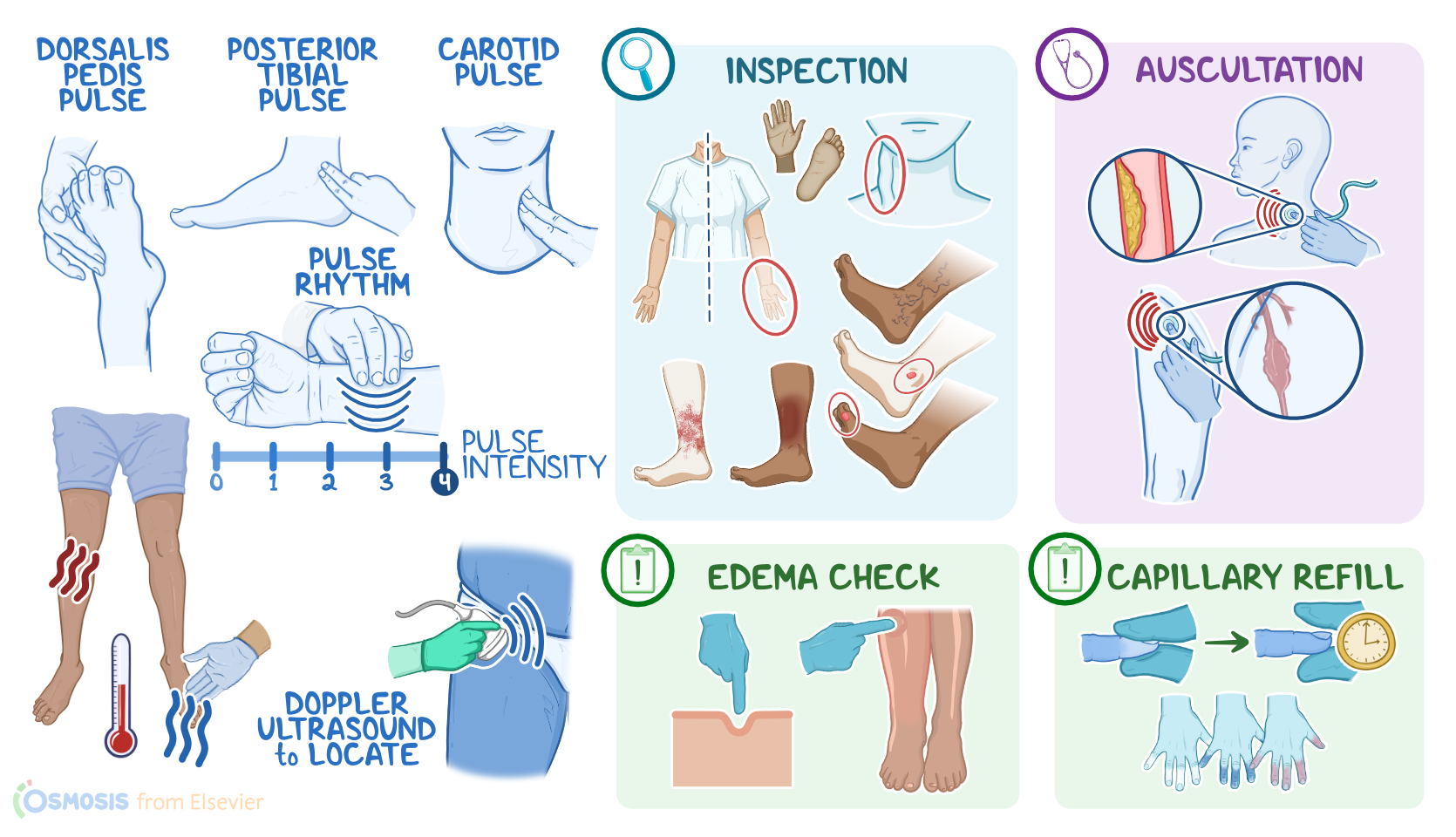
Now, locating the anatomical landmarks of the peripheral vascular system will help guide your assessment. Peripheral pulses that can be palpated include the carotid pulse, located on the neck behind the sternocleidomastoid muscle, or scm, just below the angle of the jaw; the brachial pulse, located in the center of the cubital fossa, medially to the biceps tendon; the radial pulse, found in the wrist along the lateral aspect of the forearm, just below the base of the thumb; the femoral pulse, located below the inguinal ligament, between the pubic and hip bones; the popliteal pulse, located behind the knees; the dorsalis pedis pulse, found on the dorsal aspect of the foot; and the posterior tibial pulse, located just behind the medial malleolus.
Alright, methods of assessment for the peripheral vascular system include inspection, palpation, and auscultation.
Let’s start with inspection. During your assessment, remember to look for symmetry between the right and left sides, since an abnormal finding might be present in one side and not the other.
Look for signs of adequate perfusion by observing the color of your client's extremities. Pallor, which may indicate poor arterial perfusion, will present as a pale color in clients with light skin; in clients with dark skin, pallor may present as a more ashen or gray color; while in clients with brown skin, pallor may have yellowish undertones. Another method to assess for pallor in darker skin tones is to inspect the palmar surfaces which might appear more pale.
A dark, ruddy discoloration might indicate a vascular disorder like venous insufficiency; and an erythematous or red appearance could indicate a localized infection.
Next, look for obvious signs of peripheral vascular dysfunction like varicose veins, which are enlarged, tortuous veins most often found in the lower extremities; venous ulcerations, which typically present at the medial malleolus; or arterial ulcers, that are commonly found on the toes.
Finally, inspect the jugular veins on the neck for any signs of jugular venous distention, or JVD, as this could indicate fluid volume overload, associated with problems like heart or liver failure.
Next, move on to palpation. Assess the temperature of the upper and lower extremities, by using the back of your hands. Normally, the temperature of the skin should be warm and relatively consistent in the upper and lower extremities.
If there are localized areas where the skin is cool to the touch, this can be an indication of impaired perfusion. On the other hand, if the skin feels unusually warm, an infection might be present.
| PHYSICAL ASSESSMENT - PERIPHERAL VASCULAR SYSTEM | ||
| KEY POINTS | NOTES | |
| DEFINITION |
| |
| GETTING STARTED |
| |
| ANATOMICAL LANDMARKS |
| |
| METHODS OF ASSESSMENT |
| |
| INSPECTION |
| |
| PALPATION |
| |
| AUSCULTATION |
| |
| NURSING IMPLICATIONS |
| |
No notes for this video yet
Try adding a note below