Pleural effusion: Nursing
Introduction0:00–0:13
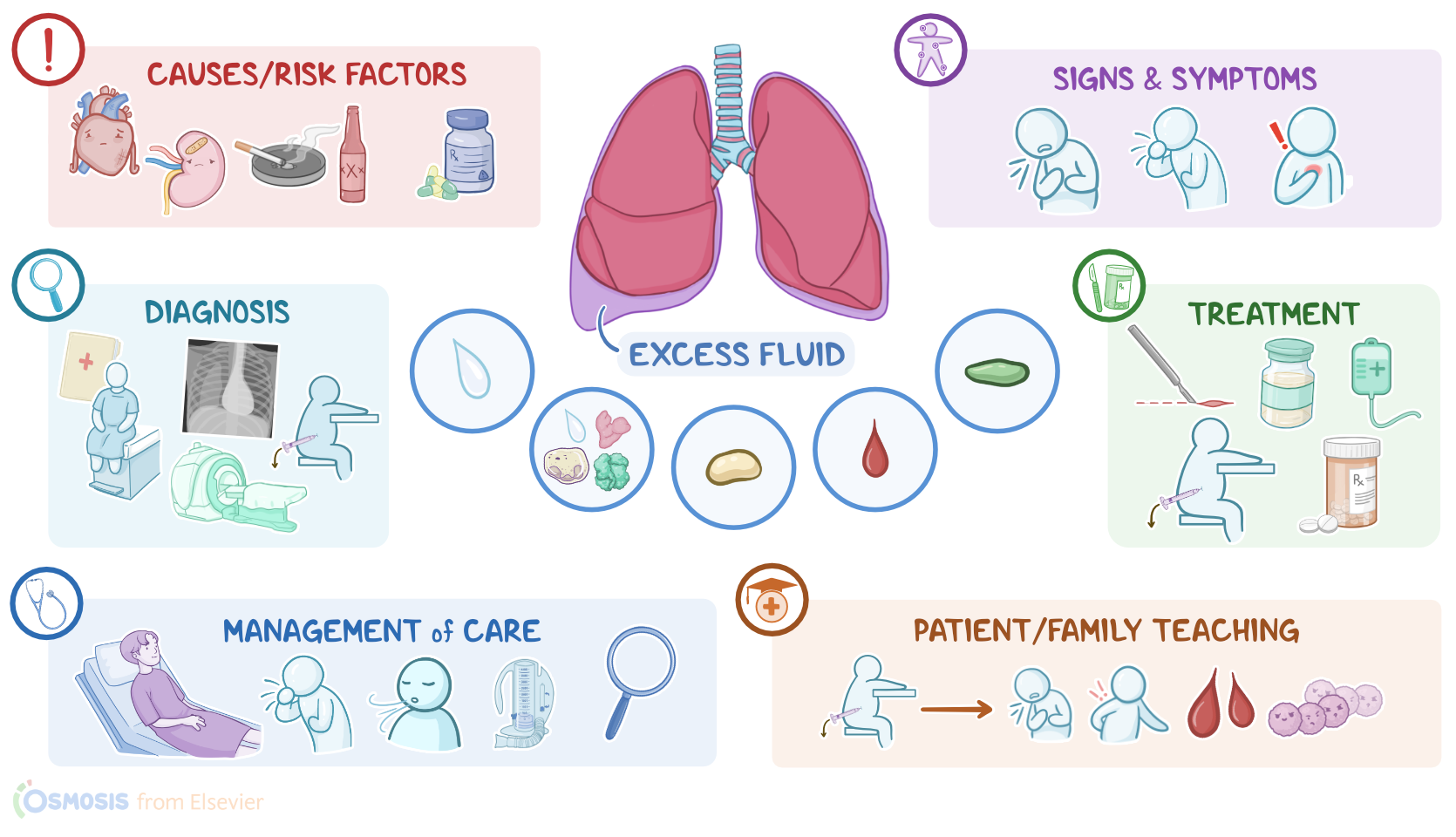
Pleural effusion is a condition in which excess fluid accumulates in the space between the visceral layer and parietal layer of the pleura, called the pleural space.
Normally, this space contains 20 to 25 milliliters of fluid that provides lubrication, allowing the two pleural layers to slide over each other during breathing.
Physiology0:13–0:33
This pleural fluid forms as a filtrate from pleural blood vessels. At the same time, it is drained into the lymphatic vessels, and this allows for regular renewal of the fluid.Now, pleural effusion is typically caused by increased production or impaired drainage of the pleural fluid.
Causes & risk factors0:33–2:58
Depending on the cause, the excess fluid in pleural effusion can be protein-poor, called transudate, or protein-rich, called exudate.
Transudate, also called hydrothorax when it involves the pleural space, forms when too much fluid starts to move from the pulmonary capillaries into the pleural space, either because of increased hydrostatic pressure or decreased oncotic pressure within the pulmonary capillaries.
So increased hydrostatic pressure occurs usually in the context of heart failure, where the heart can’t pump blood effectively, so it backs up into the pulmonary vessels, leading to pulmonary hypertension; ultimately, the high pressure forces fluid out of the pulmonary capillaries and into the pleural space.
On the other hand, decreased oncotic pressure can be caused by cirrhosis, which leads to decreased hepatic production of plasma proteins like albumin; or nephrotic syndrome, where renal filtration of blood is impaired, so the proteins are lost in urine.
On the other hand, exudate forms when there’s increased permeability of the pulmonary capillaries, which allows fluid, immune cells, and large proteins, along with lactate dehydrogenase or LDH, to leak out of the capillaries and into the pleural space.
This can be caused by trauma, malignancy, such as lung cancer, inflammatory conditions like pancreatitis, and systemic lupus erythematosus, or an infection like pneumonia.
Additionally, in some cases, the fluid could be purulent, meaning it contains pus, which is called an empyema or pyothorax, and is usually caused by bacterial infection like pneumonia; or the fluid could be sanguineous, meaning it contains blood, called a hemothorax, and it’s usually caused by blunt chest trauma, as well as malignancy, or pulmonary embolism; or it could contain lymph, which is called a chylothorax, and it can be caused by lymphatic system injury from trauma or medical procedures.
So, risk factors for pleural effusion include underlying heart, lung, kidney, or liver conditions, as well as exposure to tobacco smoke, alcohol, and the use of certain medications, such as immunosuppressants.Now, the excess fluid building up in the pleural space puts pressure on the lungs and its surrounding structures, like the trachea for example, which may cause impaired ventilation or oxygenation.
Pathology2:58–3:20
In addition, impaired drainage of pleural fluid causes this fluid to stagnate, which allows bacteria to grow and cause infections.
Clinical manifestations3:20–3:45
Now, a small pleural effusion typically causes no clinical manifestations. With larger pleural effusions, though, clients may present with dyspnea, dry cough, and sharp pain that comes with inspiration.
During auscultation, there are reduced or absent breath sounds on the affected side. On percussion, there is dullness due to the presence of fluid within the pleural space.The diagnosis of pleural effusion starts with the client’s history and physical assessment, followed by a chest X-ray or CT scan to visualize the effusion.
Diagnosis3:45–5:08
A large effusion might also show a collapsed lung. Diagnostic thoracentesis is frequently also done, which is a procedure that involves the collection of fluid from the pleural space to determine its composition and find out its cause.
The main difference is that exudative effusions are rich in protein or LDH, while transudative effusions aren’t. So to definitively determine if the fluid is exudative or transudative, the Light’s criteria can be used.
Pleural fluid is considered exudative if any one of following are met: a pleural fluid total protein to serum total protein ratio more than 0.5, a pleural fluid lactate dehydrogenase, or LDH, to serum LDH ratio more than 0.6, or a pleural fluid LDH more than two-thirds of the upper limit of normal serum LDH.
It’s very important to not miss an exudative effusion, so the criteria are designed to be overly sensitive. Now if none of the Light’s criteria apply, it’s a transudative effusion.
In that case, it’s okay to treat the underlying cause, and no further tests are needed. Alright, now the treatment for larger effusions that cause respiratory signs and symptoms consists of removing the pleural effusion fluid by therapeutic thoracentesis or chest tube insertion.
Treatment5:08–5:53
Chronic or recurrent pleural effusions may require advanced surgical interventions, like chemical pleurodesis, which is a procedure that binds the visceral and parietal pleura using chemical agents, in addition to video assisted thoracoscopic surgery, or VATS for short, and thoracotomy.
Additional management might be needed to address the underlying cause of the effusion, when possible. So clients with heart failure might be managed with diuretics; infections like pneumonia are typically treated with antibiotics, and malignancies might need chemotherapy.
Management and care5:53–7:48
Alright, let’s look at some of the nursing care you’ll provide to a client with pleural effusion. The priority goals of care are to improve respiration and oxygenation, and to monitor for complications after a thoracentesis.Begin by promoting your client’s lung expansion by elevating the head of bed at least 30 degrees.
Encourage coughing and deep breathing and use of an incentive spirometer. Then, closely monitor your client’s respiratory status, including rate, rhythm, SpO2, and depth of their respirations and work of breathing.
Also, auscultate their lung fields, and note adventitious or diminished sounds. In addition, assess skin color and nail beds, check for circumoral cyanosis, and administer supplemental oxygen if needed.
Report to the healthcare provider right away if your assessments reveal an increased work of breathing, cyanosis, or oxygen saturation below the established range, and prepare to assist with a thoracentesis.Now, before the procedure, reinforce the healthcare provider’s explanation of the procedure, and confirm informed consent is obtained.
After a thoracentesis, be sure to evaluate the puncture site for bleeding, swelling, and tenderness. Assess your client’s pain level, and administer the prescribed pain medications as needed.
Keep a close eye on their vital signs, respiratory effort, and oxygen saturation. Lastly, monitor your client closely for complications from the procedure, and report to the healthcare provider if they develop clinical manifestations of pneumothorax, including a sudden onset tachypnea, dyspnea, or uneven chest excursion.
Administer supplemental oxygen and prepare to assist with chest tube insertion. Okay, let’s move on to client and family teaching.
Begin by explaining that pleural effusion is an accumulation of fluid around the outside of the lungs, and that the fluid is making it harder for them to breathe.
General client and family teaching7:48–8:21
Let them know that the extra fluid will be drained and then analyzed to confirm the cause. Lastly, after the procedure, reassure your client that they will be monitored closely for continued respiratory problems, as well as pain, bleeding, or infection.Alright, as a quick recap… A pleural effusion occurs when excess fluid accumulates between the visceral and parietal membranes of the pleura, called the pleural space.
Transudative effusions are caused by an imbalance of hydrostatic and oncotic pressure in the pulmonary capillaries, leading to fluid shifting into the pleural space.
Review8:21–9:42
On the other hand, exudative effusions are caused by inflammatory disorders that cause increased capillary permeability, causing fluid rich in protein and LDH to leak into the pleural space.
Additionally, the fluid could be purulent, called an empyema or pyothorax; it could be sanguineous, called a hemothorax; or it could contain lymph, which is called a chylothorax.
Clinical manifestations include trouble breathing, dry cough, and sharp chest pain with inspiration. Diagnosis is made through a history and physical assessment, along with chest X-ray or CT scan.
Treatment for large effusions involves removing the excess fluid, through thoracentesis or sometimes chest tube insertion; as well as addressing the underlying cause, when possible.
The priority goals of care are to improve respiration and oxygenation, and to monitor the client for complications after a thoracentesis.
Client and family teaching focuses on what to expect during and after a thoracentesis. and oxygenation and to monitor the client for complications after thoracentesis Kline and family teaching focuses on what to expect during and after a thoracentesis.
| PLEURAL EFFUSION | ||
| KEY POINTS | NOTES | |
| DEFINITION |
| |
| PHYSIOLOGY |
| |
| CAUSES AND RISK FACTORS |
| |
| PATHOPHYSIOLOGY |
| |
| SIGNS AND SYMPTOMS |
| |
| DIAGNOSIS |
| |
| TREATMENT |
| |
| MANAGEMENT OF CARE |
| |
| PATIENT AND FAMILY TEACHING |
| |
No notes for this video yet
Try adding a note below