Rheumatoid arthritis (RA): Nursing process (ADPIE)
Client Report0:00–0:27
Clara Reed is a 44 year old female client who presents to the rheumatology clinic after being referred by her primary care physician.
For the past several weeks, she's been having pain, stiffness and swelling in both hands, along with stiffness in her body that is worse in the morning.
She has also been feeling fatigued, and her appetite has decreased. Alright, so rheumatoid arthritis is a chronic autoimmune inflammatory disorder that mostly affects the joints, but can also involve other organ systems like the skin and lungs.
Pathology0:27–7:18
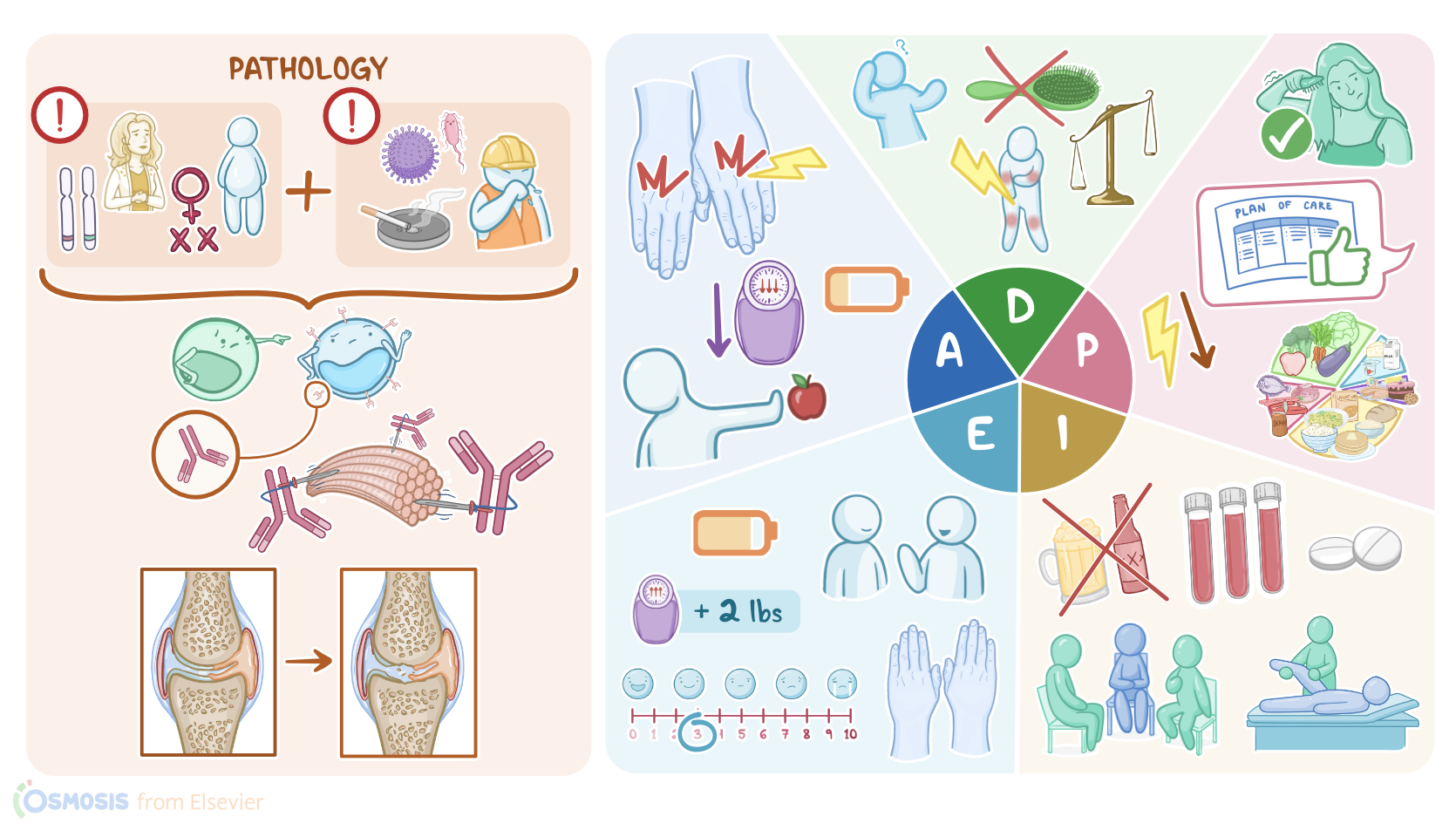
This condition is typically triggered by an interaction between genetic and environmental factors. Rheumatoid arthritis tends to run in families, and it's been associated with the HLADR4 gene.
Other risk factors include being female, middle-aged, and obese. Finally, environmental factors like infections, smoking, and exposure to asbestos and silica are also linked to the disease.
A person with the HLADR4 gene might develop rheumatoid arthritis after getting exposed to something in the environment, like cigarette smoke or a specific pathogen.
These environmental factors can cause modification of the proteins in our body and turn them into antigens that trigger the immune system to produce specific autoantibodies against them.
The first antibody is called rheumatoid factor or RF and targets modified IgG antibodies, whereas the second antibody is called anticyclic citrullinated peptide antibody, or anti-CCP and targets citrullinated proteins like citrullinated collagen 2.
Next, these antibodies and immune cells enter the circulation and reach joints. Here, immune cells release inflammatory cytokines that induce inflammation and stimulate synovial cells to proliferate.
Increased number of synovial and immune cells in the joint creates a panus, which is a thick synovial membrane with granulation tissue.
Over time, the cytokines released in the panus start to damage the articular cartilage, leaving the underlying bone exposed.
As a result, bones start to directly rub against one another, eventually causing bone erosion. Meanwhile, the antibodies that enter the joint space bind to their targets and form immune complexes that accumulate in the synovial fluid, activating the complement system and inducing further destruction of the joint.
Now, rheumatoid arthritis is a symmetric and progressive condition associated with articular and extra-articular manifestations.
Articular manifestations include pain, swelling, and loss of mobility in the affected joints. Also, there's no redness or warmth because the inflammatory process is gradual, but there's morning stiffness that typically improves after 30 minutes of movement.
Most commonly, rheumatoid arthritis affects the proximal interphalangeal and the metacarpophalangeal joints of the hand.
Distal interphalangeal joints are rarely involved because they have very little synovium. In the feet, the metatarsopphalangeal joints are usually affected, which causes a person to bear more weight on the heels and hyperextend the toes.
Other joints that can be involved are the shoulders, elbows, wrists, knees and ankles. Hip involvement can occur later in the disease, and it's characterized by pain in the groin, thigh or lower back.
Finally, if rheumatoid arthritis affects the C1, C2 joint, which is the only synovial joint in the spine, it can cause quadriplegia, which is the loss of use of all extremities.
On the flip side, extra-articular symptoms include fever, fatigue, weakness, and a loss of appetite that can eventually lead to weight loss.
Rheumatoid arthritis can also lead to vasculitis and the formation of atherromatous plaques, which can break off and cause myocardial infarction or stroke.
In fact, cardiovascular disease is the main cause of mortality in individuals with rheumatoid arthritis. In skeletal muscle, inflammation can lead to muscle breakdown, and in the skin, inflammation can cause the formation of rheumatoid nodules over bony prominences.
Rheumatoid arthritis is also associated with carpal tunnel syndrome, which refers to the compression of the median nerve on its way through the wrist, through a narrow passageway called the carpal tunnel.
In the lungs, clients might develop pulmonary fibrosis or scarring of the lung tissue and pleural effusion, which is an accumulation of fluid in the pleural space.
Finally, the destruction of bones and skeletal system increases the risk of osteoporosis. Diagnosis is based on clinical examination and blood tests, which typically reveal low red blood cell count in combination with elevated erythrocyte sedimentation rate, or ESR and C-reactive protein, often referred to as CRP.
Moreover, these findings are commonly seen in conditions associated with chronic inflammation. Additionally, these clients should be tested for rheumatoid factor and anticyclic citrullinated peptide antibodies.
Imaging studies such as X-ray can reveal decreased bone density around affected joints, soft tissue swelling, narrowing of the joint space, and bony erosions.
In some cases, arthrocentesis can be performed to evaluate the synovial fluid, to make sure there's no evidence of crystals like in gout, which is another form of arthritis.
There's no cure for clients with rheumatoid arthritis, but there are ways to keep the condition under control. The first line treatment includes medications called disease modifying anti-rheumatic drugs, or DMARDs for short, which can be non-biological or biological.
Non-biological DMARDs like methotrexate and hydroxychloroquine are considered as the first line treatment. But if they fail to keep the disease under control, clients should be started on biological DMARDs, which primarily include medications called TNF alpha inhibitors, like adalimumab and infliximab.
Additionally, clients can take glucocorticoids or non-steroidal anti-inflammatory drugs to reduce pain and inflammation.
Finally, since they have an increased cardiovascular risk, clients with rheumatoid arthritis should take preventative measures like exercise and smoking cessation.
OK, let's get back to assess your client, Clara. You begin by asking her about her symptoms.
Assessment7:18–9:27
She tells you that she has been having pain in both hands, specifically in her knuckles, which makes it difficult for her to perform simple tasks like getting dressed, fixing her hair, even turning a doorknob.
In the mornings, she says that she is very stiff, but it gets better after moving around for about 30 minutes. She says she gets fatigued in the afternoons and usually has no appetite for her evening meal.
She has lost weight without trying. When asked about her family history, she tells you that both her cousin and her aunt have been diagnosed with rheumatoid arthritis.
She is worried about what is happening to her body, but she is ready to learn how to best manage her symptoms. Next, you begin your physical assessment.
Clara is 5 ft 5 inches tall and weighs 110 lbs. Her temperature is 99 °F, or 37.2 °C.
Heart sounds are normal with a rate of 88 BPM. Lung sounds are clear bilaterally and respirations are 14 breaths per minute.
BP is 122/80 millimeters of mercury. SPO2 is 98% on room air.
And pain is 6 out of 10. When you palpate her hands, you note that her joints are swollen and tender to the touch.
You review her lab work, which shows RBCs 4 million per cubic millimeter, hemoglobin, 12 g per deciliter, hematocrit, 36%.
ESR 25 millimeters per hour. CRP 12 mg per liter.
Rheumatoid factor, 25 international units per milliliter. An anti-CCP 59 EU per milliliter.
You document your assessment findings before leaving the room and update the rheumatologist on your assessment findings.
Diagnosis9:27–9:51
Based on your assessment findings, you developed the following nursing diagnoses, chronic pain related to joint inflammation, imbalanced nutrition, less than body requirements related to lack of appetite and unintentional weight loss.
Activity intolerance related to chronic pain and fatigue, and readiness for enhanced coping related to a new diagnosis. Next, you collaborate with Clara and the healthcare team to start planning goals for her care.
Planning9:51–10:23
By her follow-up visit in 8 weeks, Clara will report a decrease in pain. She will have met with a registered dietitian to formulate a plan to increase her nutritional intake and maintain a healthy weight.
She will report increased tolerance for activity and increased ability to do activities of daily living. And she will verbalize an understanding of rheumatoid arthritis management and demonstrate effective coping strategies.
OK, now you are ready to implement your interventions. The rheumatologist diagnosed Clara with rheumatoid arthritis and prescribed the NSAID ibuprofen for management of pain and inflammation.
Implementation10:23–12:02
The DMARD methotrexate is also prescribed to manage her disease, and a folic acid supplement is prescribed to help reduce the effects of methotrexate on the liver and gastrointestinal system.
Lastly, you stress the importance of contacting the rheumatology office should she experience new or bothersome symptoms, like an upset stomach, unusual fatigue, or easy bruising.
Next, you create a health promotion teaching plan, which includes lifestyle modifications such as taking rest periods throughout the day to reduce fatigue.
To help her maintain a healthy diet, you schedule an appointment with a registered dietitian to develop a diet plan to support her overall health and maintain a healthy weight.
To support her joint function, flexibility and muscle strength, you refer her to physical therapy. You provide her with information about a rheumatoid arthritis support group that meets nearby and let her know about a local class for those who have been newly diagnosed with the condition.
Lastly, you remind her that if she experiences new and unexpected symptoms, she should contact the rheumatology office right away.
Eight weeks later, Clara returns for her follow-up appointment. She tells you that she is less fatigued overall, and her pain and swelling in her joints is less.
Evaluation12:02–12:44
Her current pain rating is 3 out of 10. She tells you she meets weekly with a physical therapist who has helped with flexibility and strength.
Her appetite has improved, and with the help of the dietitian, she is eating a balanced diet and has gained 2 lbs. Clara has made friends in her support group, and they have helped her feel more optimistic about her diagnosis.
You document your assessment findings and we'll continue to reassess and reevaluate Clara's response to interventions. All right, as a quick recap, your client Clara presented to the rheumatology clinic with pain in her hands, morning stiffness, and fatigue.
Summary12:44–13:41
She was diagnosed with rheumatoid arthritis, which is a chronic inflammatory disorder that most commonly affects the joints.
Your assessment revealed swollen and painful joints in her hands and unintentional weight loss. You developed nursing diagnoses to address her chronic pain, imbalanced nutrition, activity intolerance, and readiness for enhanced coping.
The goals you identified when planning care included decreased pain, adequate nutrition, and ability to tolerate activity, and effective coping strategies.
Along with the interdisciplinary team, you implement actions to help her achieve these goals and will continue to evaluate and adapt her plan of care as needed to achieve positive outcomes.
| RHEUMATOID ARTHRITIS | ||
| KEY POINTS | NOTES | |
| PATIENT REPORT |
| |
| PATHOPHYSIOLOGY |
| |
| DIAGNOSIS AND TREATMENT |
| |
| ASSESSMENT |
| |
| NURSING DIAGNOSES |
| |
| PLANNING |
| |
| IMPLEMENTATION |
| |
| EVALUATION |
| |
- "Global, regional, and national burden of rheumatoid arthritis, 1990-2020, and projections to 2050: a systematic analysis of the Global Burden of Disease Study 2021" Lancet Rheumatol (2023)
- "Update on the Pathomechanism, Diagnosis, and Treatment Options for Rheumatoid Arthritis" Cells (2020)
- "Harrison’s Principles of Internal Medicine, 21st edition" McGraw Hill / Medical (2022)
- "Robbins & Kumar Basic Pathology, 11th edition" Elsevier (2022)
- "Pathogenesis of rheumatoid arthritis: one year in review 2022" Clin Exp Rheumatol (2022)
- "Management of Rheumatoid Arthritis: An Overview" Cells (2021)
- "The etiology of rheumatoid arthritis" J Autoimmun (2020)
No notes for this video yet
Try adding a note below