Definitions & Key takeaways

Strabismus is a common condition characterized by misalignment of the eyes due to a lack of eye-muscle coordination. Strabismus can present occasionally or constantly and is commonly referred to as crossed eyes or squint.

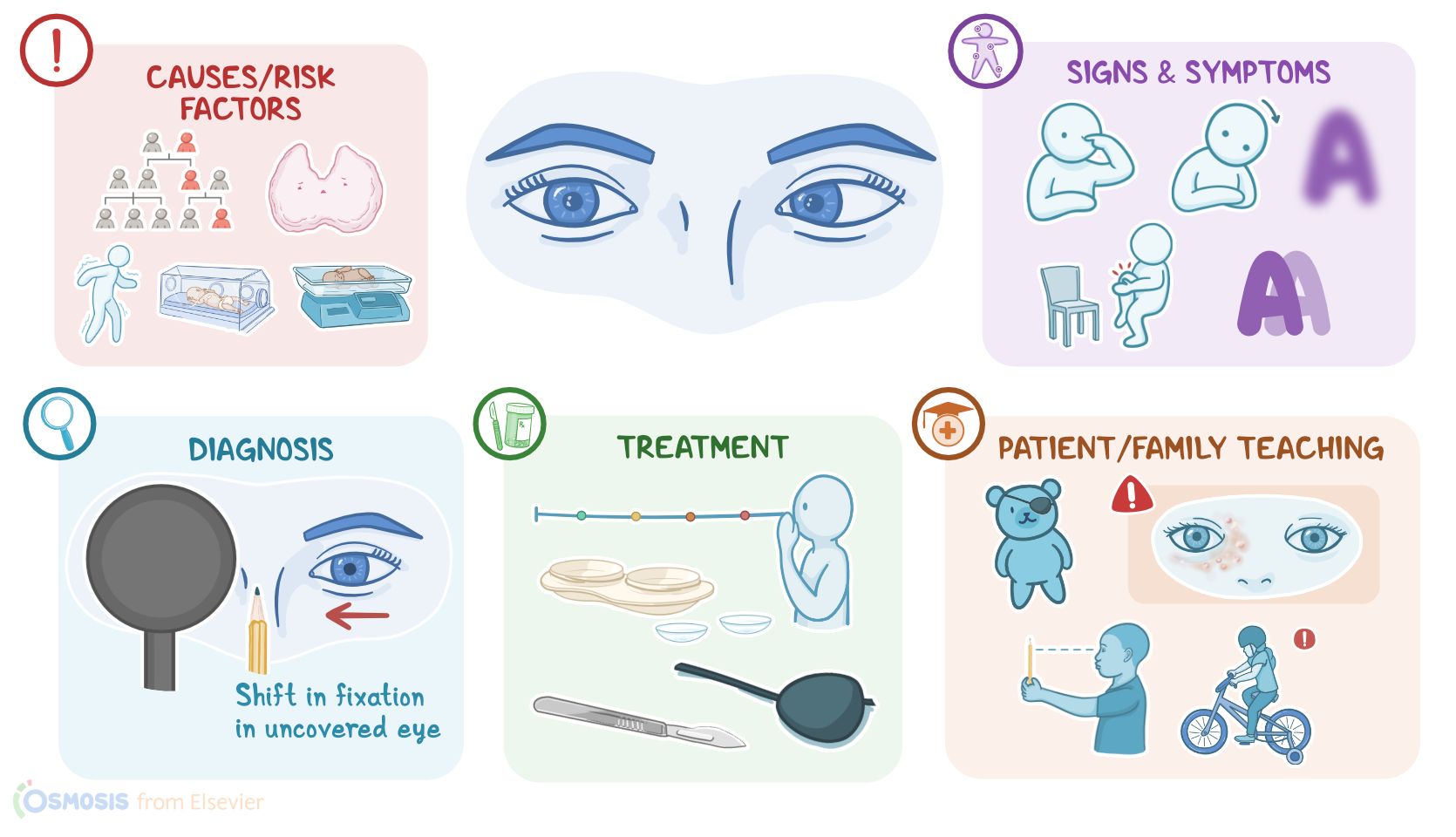
Strabismus is caused by a variety of factors, such as conditions affecting cranial nerves III, IV, and VI, or the muscles controlling the eye, or other problems in the brain. Risk factors include family history, neuromuscular disorders, prematurity, and low birth weight. Symptoms of strabismus include uncoordinated eye movements and eyes that don't aim in the same direction, and there may also be blurred vision, tired eyes, headaches, squinting, head tilting, or a tendency to bump into objects.

Treatment for strabismus usually involves glasses, visual training exercises, and surgery. Nursing management includes providing supportive care during treatment and monitoring for adherence to the treatment plan. Client and family education emphasizes treatment adherence and when to contact the healthcare provider.

Chapters:

Introduction0:00–0:18

Strabismus is a common condition characterized by misalignment of the eyes due to a lack of eye muscle coordination. Strabismus can present occasionally or constantly, and is commonly referred to as crossed eyes or squint.

Physiology0:18–1:25

Let’s start with some basic anatomy and physiology. Eye movement is controlled by the six extraocular muscles, which include four rectus muscles and two oblique muscles.
The rectus muscles are the superior rectus, which moves the eye upwards; the inferior rectus, which moves the eye downwards; the medial rectus, which moves the eye medially; and the lateral rectus, which moves the eye laterally.
The last two are the superior and inferior oblique muscles, which control the rotation of the eyeball. These extraocular muscles are innervated by cranial nerves that arise directly from the brain.
More specifically, the abducens nerve, or cranial nerve VI, innervates the lateral rectus muscle; the trochlear nerve, or cranial nerve IV, innervates the superior oblique; and lastly, the oculomotor nerve, or cranial nerve III, innervates the rest of the extraocular muscles.
Typically, control of eye movement should have developed completely by 4 months of age. Now, strabismus can be caused by problems involving the brain centers controlling eye movements, the cranial nerves that supply the muscles, or less commonly, the muscles themselves.

Causes & risk factors1:25–2:26

This includes cranial nerve palsy, which is characterized by impaired function leading to weakness or even paralysis of the innervated muscle; as well as cerebral palsy, head trauma, or strokes.
Strabismus can also be caused by sensory deviation due to eye conditions like refractive errors, cataract, retinal detachment, or retinoblastoma.
Less frequently, strabismus has congenital causes, such as Down syndrome. Finally, when the cause is unknown, strabismus can also be idiopathic.
These conditions can also be considered risk factors for strabismus, along with family history, thyroid disease, neuromuscular disorders, prematurity, and low birth weight.

Pathology2:26–3:01

Alright, now regardless of the underlying cause, the pathology of strabismus is characterized by misalignment of one eye, as well as a lack of eye coordination, which means that both eyes are unable to focus on one object at the same time.
Now, to avoid double vision, also called diplopia, the brain ignores the images received from the misaligned eye, and may only focus on the stronger eye.
Over time, this may cause the misaligned eye to get progressively weaker, which causes visual deficits and amblyopia.The typical clinical manifestations of strabismus include uncoordinated eye movements, as well as eyes that don’t aim in the same direction.

Clinical manifestations3:01–4:11

Strabismus can be classified according to the direction of the misaligned eye into four categories: exotropia, in which the misaligned eye turns outward; esotropia, in which the misaligned eye turns inwards; hypertropia, in which the misaligned eye turns upwards; and hypotropia in which the misaligned eye turns downwards.
Additionally, clients often have diplopia, blurred vision, tired eyes, and headaches; in addition to squinting or closing one eye, or tilting the head to focus on a single object.
Some clients can also report bumping into objects due to reduced sense of depth. Also, clients can have intermittent strabismus, where the eyes are misaligned only part of the time.
When the eye muscles are tired, like at the end of the day or during an illness, it may become more pronounced.The diagnosis of strabismus starts with the client's history and physical assessment.

Diagnosis4:11–5:16

Ideally, a child’s ocular alignment should be assessed between 4 to 6 months of age to identify strabismus and other ophthalmic problems so they can be treated early.
Diagnostic tests include a corneal light reflex test is done by holding a penlight 1 to 2 feet from the child’s face while they are looking at a small toy or picture.
If the reflection of the light is symmetrically centered on the cornea in each eye, no strabismus is present. If the light reflex is misaligned in 1 eye, then strabismus is likely.
The cover test can also be done, by asking the client to fix their eyes on a single object, then covering one eye while observing the other eye’s movement; the test is repeated on the opposite eye.
Ocular alignment is normal if no movement is detected in the uncovered eye; and strabismus is confirmed if there’s a shift in fixation of the uncovered eye.

Treatment5:16–5:56

The treatment of strabismus includes non-surgical and surgical options. Non-surgical options involve corrective lenses and occlusion therapy, which is when the stronger eye is covered to force the brain to receive images from the misaligned eye, making it stronger.
Visual training exercises that help the brain and eyes work effectively together can also be tried. On the other hand, surgical options include eye muscle surgery to align the weaker eye, and this is typically done to clients before the age of two.
If strabismus isn’t treated, amblyopia may develop, and the child’s visual quality of life can be adversely affected.Alright, now let’s look at the nursing care you’ll provide for a client with strabismus.

Management and care5:56–6:49

Nursing goals include providing supportive care during treatment and monitoring for adherence to the treatment plan. To begin, assess the affected eye to ensure it’s clean and there are no signs of irritation.
Then, as you cover the stronger eye with the prescribed eye patch, talk to the child in simple, easy to understand language about what you are doing and why.
Ensure the child feels comfortable and provide reassurance. Then, stay with them for several minutes after application as the brain adjusts to having the stronger eye covered.
Be sure to monitor for regular intervals to ensure they are following the prescribed treatment plan and that the area around the eye is intact and free of irritation.Now, moving on to client and family education.

General client and family teaching6:49–8:59

Begin by explaining how strabismus affects normal visual development and can lead to other serious eye problems like amblyopia, and that patching the eye that is stronger can help strengthen the weaker eye.
Reassure the child’s caregivers that the patching is a temporary measure. If your client is a toddler, let the caregiver know that most children don’t have problems wearing an eye patch; but if needed, suggest they try things like putting an eye patch on a doll or stuffed animal, using decorative patches, providing a small reward when the child wears the patch for the prescribed amount of time, fun ideas like making it a “pirate patch” to help motivate them.
If the child is in school, remind them to explain the treatment plan to the teacher and school nurse.Review the current treatment plan and provide the healthcare provider’s written instructions for the number of hours each day the eye should be covered, and teach them to apply the patch and secure it.
Instruct them to monitor the skin around the eye for irritation, and if it occurs, let them know that leaving the patch off at night or changing the shape of the patch and changing its position on the eye can help.
If the irritation does not resolve, advise them to contact the healthcare provider. During treatment, be sure to encourage them to use caution when participating in certain activities like playing on the playground or riding a bike.
If the child is prescribed eye strengthening exercises, be sure to review them with the caregiver so they can confidently do them at home with their child.
Lastly, be sure to emphasize the importance of following-up regularly for scheduled eye exam appointments to monitor vision progression.Finally, stress the importance of keeping their follow-up appointments, and advise them that if they notice that their child’s vision isn’t getting better, or that it seems to be getting worse, they should let their healthcare provider know.

Review8:59–10:28

Alright, as a quick recap…. Strabismus is a common condition where the eyes are intermittently or continuously misaligned due to a lack of eye muscle coordination.
The cause of strabismus may stem from a problem in the brain, cranial nerves III, IV, and VI, or in the muscles controlling the eye.
Depending on the direction of the misaligned eye, strabismus can be categorized by exotropia, esotropia, hypertropia or hypotropia.
Risk factors include family history, neuromuscular disorders, prematurity, and low birth weight. Clinical manifestations include uncoordinated eye movements and eyes that don’t aim in the same direction.
In addition clients may have blurred vision, tired eyes, headaches, squinting, head tilting, or a tendency to bump into objects.
Diagnosis starts with the client’s history and physical assessment, followed by testing like a corneal light reflex test or a cover test.
Assessing ocular alignment should be done between 4 and 6 months of age to identify strabismus early. Treatment includes corrective lenses, occlusive therapy, visual training exercises, or eye muscle surgery.
Nursing management includes providing supportive care during treatment and monitoring for adherence to the treatment plan; while client and family education emphasizes treatment adherence and when
Strabismus: Video, Causes, and Symptoms | Osmosis