Tonsillitis: Nursing process (ADPIE)
Definitions & Key takeaways
Tonsillitis is a common condition in which the tonsils, two small glands located in the back of the throat, become inflamed and swollen due to a viral or bacterial infection. Symptoms can include sore throat, difficulty swallowing, fever, swollen lymph nodes, and sometimes white patches on the tonsils. Treatment for tonsillitis depends on the underlying cause and severity of the symptoms, but may include rest, pain relievers, antibiotics, or, in some cases, surgery to remove the tonsils.
Client Report0:00–0:21
Mason Taylor is a 22 year old male college student who presents to the college health clinic with a two-week history of a sore throat and a subsequent decrease in oral intake due to pain with swallowing.
He reports a very painful sore throat, fatigue, and feeling feverish. Tonsillitis is an inflammation of the palatine tonsils, which are two lymphoid organs located in the oropharynx.
Pathology0:21–5:21
Tonsillitis is sometimes accompanied by adenoiditis, which refers to inflammation of adenoid tonsils in the nasopharynx, as well as pharyngitis, which is an inflammation of the throat or pharynx.
Tonsillitis is most often caused by a viral infection. Common viruses that cause tonsillitis include rhinovirus, adenovirus, and respiratory syncytial virus, or RSV.
Other important viral causes of tonsillitis include coronaviruses, human immunodeficiency virus, or HIV, and Epstein-Barr virus or EBV, which causes infectious mononucleosis.
On the flip side, one of the most common causes of tonsillitis is bacterial infection from Group A streptococcus. This is why bacterial tonsillitis is commonly referred to as strep throat.
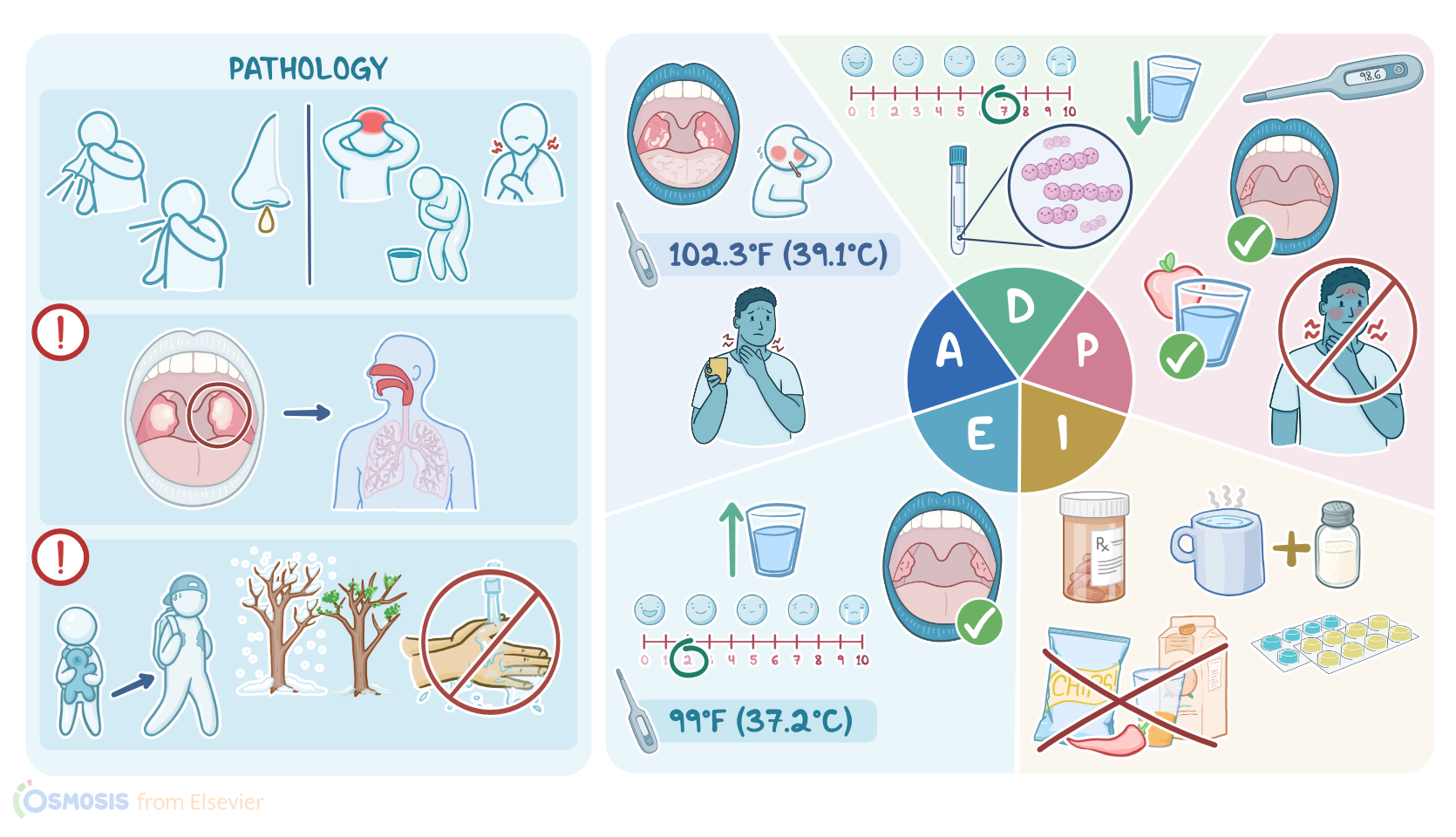
Now, the main risk factor for tonsillitis is being between the age of 5 and 15 years of age. Other risk factors include being in crowded environments where pathogens can be transmitted from person to person and not practicing good hand hygiene.
In addition, tonsillitis occurs more commonly during winter and early spring. Finally, clients who don't get properly treated for bacterial tonsillitis, like those who don't complete an antibiotic course, are more likely to develop it again later.
Now symptoms of tonsillitis depend on the underlying cause. Symptoms of viral tonsillitis include a low grade fever, cough, rhinorrhea, or runny nose, and sneezing.
On the other hand, bacterial tonsillitis tends to present with more severe symptoms such as a high grade fever or sore throat, as well as dysphagia or difficulty swallowing, and odenophagia or painful swallowing.
Some clients may also experience headache, nausea, and vomiting. Now, if not treated, clients with Group A streptococcus tonsillitis are at risk of complications.
If the infection spreads to nearby tissues, it can result in suppurative complications in which there's a buildup of pus in a localized area.
Suppurative complications include peritonsillar abscess, where tonsillar infection turns into a pocket of pus around the tonsils, and parapharyngeal abscess, where the infection spreads to the space around the pharynx.
What's worse, peritonsillar and parapharyngeal abscess may put the client at risk of upper airway obstruction, which can be life-threatening.
On the flip side, non-suppurative complications include rheumatic fever, which occurs due to antibodies that are made against streptococcal proteins.
So once the infection is resolved, these antibodies can mistakenly attack the heart valves, joints, skin, and brain. Recurrent episodes of rheumatic fever may eventually lead to rheumatic heart disease in which the heart valves are permanently damaged.
Another non-suppurative complication is post-streptococcal glomerulonephritis, where the immune system attacks the glomeruli in the kidneys, leading to hematuria or blood in the urine, as well as a decline in kidney function, resulting in decreased urine output, hypertension, and edema.
Diagnosis of tonsillitis starts with examining the throat, which typically shows enlarged and erythematous tonsils. In some cases, the tonsils may be covered with a whitish exudate.
Clients may also have cervical lymphadenopathy, which is when lymph nodes in the neck area are enlarged. Next, a rapid strep antigen test, or RST for short, can be performed to look for bacterial antigens in a throat swab.
However, RST can give false positive results since these bacteria can normally live in a person's throat without causing infection or disease.
So a definitive diagnosis requires a culture from the throat swab. Now, treatment of tonsillitis depends on the underlying cause.
For viral tonsillitis, the treatment is typically supportive, which involves adequate hydration and pain medications like acetaminophen.
For bacterial tonsillitis, the standard therapy includes the antibiotic penicillin. Clients who are allergic to penicillin may take cephalosporin such as ceftriaxone or macrolides such as azithromycin.
Finally, for clients who experience recurrent tonsillitis, generally defined as 7 or more episodes in a year, or if the enlarged tonsils cause difficulty breathing, the tonsils can be surgically removed via tonsillectomy.
Assessment5:21–6:32
OK, let's get back and assess our client, Mason. His vital signs are heart rate 90 BPM and regular, BP 104/77 millimeters of mercury, temporal temperature 102.3 °F or 39.1 °C, respiratory rate 18 breaths per minute with clear lung sounds bilaterally, and SPO2 96% on room air.
When asked to open his mouth, he struggles to open it fully. As you visualize his throat, you observe a bilateral tonsillar enlargement and that his tonsils are covered with a whitish exudate.
He states he's been having difficulty swallowing food or beverages due to the pain. He rates his pain while swallowing at 7 out of 10, and he says it is also painful to speak.
His mucous membranes appear dry and tacky. You note the results of an RST swab test is positive for Group A streptococcal infection.
You document your assessment findings and confer with the Advanced Practice registered nurse or APRN. Based on the assessment data you collected, your nursing diagnoses include infection related to positive RST, acute pain related to tonsillar inflammation, risk for deficient fluid volume related to decreased oral intake due to painful swallowing.
Diagnosis6:32–6:49
Now that you've gathered assessment data and created some nursing diagnoses, you make a plan to achieve some important treatment goals.
Planning6:49–7:20
By his follow-up appointment in 3 days, Mason's infection will have improved, as evidenced by a decrease in his temperature and decreased inflammation of his tonsils.
Mason will also report a decrease in pain while swallowing and speaking, rated at 4 out of 10 or below, and he will maintain adequate oral intake.
Implementation7:20–8:30
Next, you implement the plan of care. The APRN prescribed the antibiotic penicillin and the analgesic acetaminophen.
You teach him to take these medications as directed and to complete the full course of antibiotics even after he starts to feel better.
You advise him to stay home from classes until he has completed at least 24 hours of antibiotic treatment and remind him to take measures to prevent the spread of infection to others by practicing cough etiquette and frequent hand hygiene.
Next, you encourage oral intake, emphasizing drinking cool, non-citrus liquids and eating soft foods while avoiding hot, spicy, or coarse food such as chips or crackers, which could increase pain.
To provide comfort to the inflamed tissues, you recommend gargling with warm salt water, made by mixing about 1/4 teaspoon of table salt in about 8 ounces or 250 mL of warm water, along with the use of lozenges.
Finally, you teach Mason to seek emergency care if his symptoms worsen in any way or if his symptoms return after they resolve.
Mason returns to the clinic three days later. So let's evaluate his progress.
Evaluation8:30–9:14
His temporal temperature is currently 99.0 °F, or 37.2 °C. The tonsillar swelling has decreased, and the whitish exudate has resolved.
He reports his pain has decreased to 2 out of 10 while swallowing. He has increased his oral intake, and his mucous membranes now appear moist.
You are glad to see Mason has started to improve and you document his responses to your interventions. Before he leaves the clinic, you remind Mason to follow up at the clinic if his symptoms don't continue to improve, so adjustments can be made to his plan of care as needed.
All right, as a quick recap, your client Mason presented to the college health clinic with bacterial tonsillitis, which is an inflammation of the palatine tonsils.
Summary9:14–9:55
Your assessment revealed that Mason was experiencing a sore throat with inflamed tonsils, difficult and painful swallowing, dry mucous membranes, and fever.
Your nursing diagnoses were infection, acute pain, and risk for deficient fluid volume. You planned goals for Mason, implemented interventions to resolve infection, decrease pain, and improve oral intake, and evaluated that Mason is well on his way to meet the goals of his plan of care.
| TONSILLITIS | ||
| KEY POINTS | NOTES | |
| PATIENT REPORT |
| |
| PATHOPHYSIOLOGY |
| |
| DIAGNOSIS AND TREATMENT |
| |
| ASSESSMENT |
| |
| NURSING DIAGNOSES |
| |
| PLANNING |
| |
| IMPLEMENTATION |
| |
| EVALUATION |
| |
- "Twenty-year observational study of pediatric tonsillitis and tonsillectomy" Archives of Disease in Childhood (2022)
- "Helicobacter pylori, laryngopharyngeal reflux and chronic tonsillitis" American Journal of Otolaryngology (2023)
- "Complications of peritonsillar abscess" Annals of Clinical Microbiology and Antimicrobials (2020)
- "Harrison’s Principles of Internal Medicine, 21st edition" McGraw Hill / Medical (2022)
- "Adenoid hypertrophy in children: a narrative review of pathogenesis and clinical relevance" BMJ Pediatric Open (2023)
- "Current indications for tonsillectomy and adenoidectomy" Journal of the American Board of Family Medicine (2020)
- "Robbins & Kumar Basic Pathology, 11th edition" Elsevier (2022)
No notes for this video yet
Try adding a note below