Vital Signs - Temperature: Nursing skills

Last updated: August 30, 2022

Vital Signs - Temperature: Nursing skills

NSG1201

NSG1201

Leg ulcers: Clinical
Venous thromboembolism (VTE): Nursing process (ADPIE)
Wound healing
Peripheral venous disease (PVD): Nursing process (ADPIE)
Peripheral arterial disease (PAD): Nursing process (ADPIE)
Pharmacodynamics: Nursing pharmacology
Pharmacokinetics - Elimination: Nursing pharmacology
Vital signs - Pain: Nursing skills
Analgesics: Nursing pharmacology
Antacids: Nursing pharmacology
Antibiotics - Cephalosporins: Nursing pharmacology
Antibiotics - Cyclic lipopeptides: Nursing pharmacology
Antibiotics - Glycopeptides: Nursing pharmacology
Antibiotics - Lincosamides: Nursing pharmacology
Antibiotics - Macrolides: Nursing pharmacology
Antibiotics - Metronidazole: Nursing pharmacology
Antibiotics - Oxazolidinones: Nursing pharmacology
Antibiotics - Penicillins: Nursing pharmacology
Antibiotics - Polymyxins: Nursing pharmacology
Antibiotics - Tetracyclines and glycylcyclines: Nursing pharmacology
Antibiotics - Trimethoprim and sulfonamides: Nursing pharmacology
Anticoagulants - Direct thrombin and factor Xa inhibitors: Nursing pharmacology
Anticoagulants - Heparin: Nursing pharmacology
Anticoagulants - Warfarin: Nursing pharmacology
Antidepressants - SSRIs and SNRIs: Nursing pharmacology
Antidepressants - Tricyclic antidepressants (TCAs) and monoamine oxidase inhibitors (MAOIs): Nursing pharmacology
Antiemetics: Nursing pharmacology
Antiepileptics: Nursing pharmacology
Antihistamines: Nursing pharmacology
Antihyperlipidemics - Statins: Nursing pharmacology
Antimetabolites: Nursing pharmacology
Antiplatelet agents: Nursing pharmacology
Antipsychotics: Nursing pharmacology
Antirejection immunosuppressants: Nursing pharmacology
Antiretrovirals for HIV/AIDS - CCR5 antagonists, fusion inhibitors, and attachment inhibitors: Nursing pharmacology
Antiretrovirals for HIV/AIDS - Integrase strand transfer inhibitors: Nursing pharmacology
Antiretrovirals for HIV/AIDS - NRTIs and NNRTIs: Nursing pharmacology
Antiretrovirals for HIV/AIDS - Protease inhibitors: Nursing pharmacology
Antivirals for herpesviruses: Nursing pharmacology
Antivirals for influenza: Nursing pharmacology
Anxiolytics and sedative-hypnotics: Nursing pharmacology
Beta-adrenergic blockers: Nursing pharmacology
Biologic agents: Nursing pharmacology
Blood products: Nursing pharmacology
Calcium-channel blockers: Nursing pharmacology
Cardiac glycosides: Nursing pharmacology
Chloramphenicol: Nursing pharmacology
Debridement agents: Nursing pharmacology
Direct-acting vasodilators: Nursing pharmacology
Disease-modifying therapy for multiple sclerosis: Nursing pharmacology
Diuretics - Osmotic and carbonic anhydrase inhibitors: Nursing pharmacology
Diuretics - Thiazide, thiazide-like, loop, and potassium-sparing diuretics: Nursing pharmacology
Eye anesthetics: Nursing pharmacology
Gallstone-dissolving agents: Nursing pharmacology
Gastric mucosal protective agents: Nursing pharmacology
Glucocorticoids and mineralocorticoids: Nursing pharmacology
Hematopoietic growth factors: Nursing pharmacology
Hemostatics: Nursing pharmacology
Histamine H2 antagonists: Nursing pharmacology
Hormones and hormone modulators for cancer: Nursing pharmacology
Immunoglobulins: Nursing pharmacology
Immunomodulators: Nursing pharmacology
Immunosuppressants for autoimmune diseases: Nursing pharmacology
Corticosteroids - Inhaled: Nursing pharmacology
Insulin: Nursing pharmacology
Iron preparations: Nursing pharmacology
Keratolytics: Nursing pharmacology
Laxatives: Nursing pharmacology
Leukotriene modifiers: Nursing pharmacology
Lung surfactants and antenatal corticosteroids: Nursing pharmacology
Medications affecting the parathyroid glands: Nursing pharmacology
Medications for antidiuretic hormone (ADH) disorders: Nursing pharmacology
Medications for thyroid disorders: Nursing pharmacology
Medications to control airway secretions: Nursing pharmacology
Medications for Alzheimer disease: Nursing pharmacology
Medications for growth hormone disorders: Nursing pharmacology
Medications for acne vulgaris: Nursing pharmacology
Medications for hepatic encephalopathy: Nursing pharmacology
Medications for migraines: Nursing pharmacology
Mydriatics and cycloplegics: Nursing pharmacology
Nitrates: Nursing pharmacology
Non-biologic disease-modifying antirheumatic drug (DMARD) therapy: Nursing pharmacology
Non-insulin injectable antidiabetic drugs - GLP-1 agonists and amylinomimetics: Nursing pharmacology
Ophthalmic anti-inflammatories and anti-infectives: Nursing pharmacology
Oral antidiabetic medications - Alpha-glucosidase inhibitors: Nursing pharmacology
Oral antidiabetic medications - Biguanides and thiazolidinediones: Nursing pharmacology
Oral antidiabetic medications - DPP-4 inhibitors: Nursing pharmacology
Oral antidiabetic medications - Sodium-glucose co-transporter-2 (SGLT-2) inhibitors: Nursing pharmacology
Oral antidiabetic medications - Sulfonylureas and meglitinides: Nursing pharmacology
Other antineoplastics: Nursing pharmacology
Oxygen therapy: Nursing pharmacology
Oxytocin: Nursing pharmacology
Pancreatic enzyme replacements: Nursing pharmacology
Pharmacokinetics - Distribution: Nursing pharmacology
Pharmacokinetics - Metabolism: Nursing pharmacology
Phytonadione (Vitamin K1): Nursing pharmacology
Plant extracts for chemotherapy: Nursing pharmacology
Platinum-based agents: Nursing pharmacology
Prostaglandins: Nursing pharmacology
Proton pump inhibitors (PPIs): Nursing pharmacology
Respiratory stimulants: Nursing pharmacology
Rho(D) immune globulin: Nursing pharmacology
Sympathomimetic medications: Nursing pharmacology
Thrombolytics: Nursing pharmacology
Tocolytics: Nursing pharmacology
Antibiotics - Topical: Nursing pharmacology
Antifungals - Topical: Nursing pharmacology
Corticosteroids - Topical: Nursing pharmacology
Treatment for Helicobacter pylori: Nursing pharmacology
Antispasmodics (GU): Nursing pharmacology
Cholinergic therapy (GU): Nursing pharmacology
Vaccines: Nursing pharmacology
Pharmacokinetics - Absorption: Nursing pharmacology
Pressure injury: Nursing process (ADPIE)
Emergency care: Falls
Diabetic ketoacidosis (DKA): Nursing process (ADPIE)
Inflammatory process: Nursing
Nutrition - Oral: Nursing skills
Core measures: Nursing
Standards and methods of documentation: Nursing
Physical assessment - Abdomen: Nursing
Physical assessment - Overview: Nursing
Vital signs - Blood pressure (BP): Nursing skills
Vital signs - Oxygen saturation (SpO2): Nursing skills
Vital signs - Respirations: Nursing skills
Vital signs - Pulse: Nursing skills
Vital Signs - Temperature: Nursing skills
Comprehensive Assessment
Mobility - Ambulation: Nursing skills

Notes

VITAL SIGNS - TEMPERATURE

KEY POINTS
NOTES
INTRODUCTION
  • Temperature
    • Oral cavity
    • Rectum
    • Axilla
    • Tympanic
    • Temporal

DEFINITIONS
  • Hypothalamus
    • Keeps core body temperature constant
  • Febrile
    • Thermostat raised
  • Hyperthermia
    • Thermostat set correctly but body cannot get rid of heat 
  • Hypothermia
    • Body temperature too low

ORAL TEMPERATURE PROCEDURE
  • Adults
    • 97.6-99.6 F (36.5-37.5 C)
  • Children
    • 97-99 F (36-37 C)
  • Not the most accurate method
  • Avoid if recently eating, drinking, smoking or chewing gum
  • Avoid if likely to bite probe
  • Hold thermometer tightly in mouth
  • Gather supplies
  • Ask about eating, drinking, smoking, or chewing gum
  • Inform about procedure
  • Answer questions
  • Practice hand hygiene
  • Apply probe sheath
  • Switch on
  • Insert thermometer into posterior sublingual pocket
  • Keep lips closed
  • Wait 20-30 seconds
  • Dispose of probe
  • Practice hand hygiene
  • Prepare thermometer for next patient

RECTAL THERMOMETER PROCEDURE
  • Ideal for those that are comatose, confused, critically ill, unable to close mouth
  • Most accurate method
  • Adults
    • 98.6-100 F (37-38.1 C)
  • Children
    • 98-100 F (37-38 C)
  • Can be uncomfortable
  • More risky
  • Avoid in those with hemorrhoids, anal lesions, heart conditions, or recent rectal surgery
  • Gather supplies
  • Practice hand hygiene
  • Inform about procedure
  • Answer questions
  • Assist to Sims' position
  • Ensure privacy 
  • Lock bed wheels
  • Raise bed to comfortable working height 
  • Attach red rectal probe
  • Turn on
  • Apply lubricant to thermometer
  • Separate buttocks
  • Insert probe 3 cm in direction of umbilicus
  • Stop if resistance felt
  • Hold for 20-30 seconds
  • Remove thermometer
  • Clean buttocks
  • Cover patient
  • Discard sheath
  • Practice hand hygiene
  • Return side rails
  • Lower bed
  • Assist to position of comfort
  • Prepare thermometer for next use

TYMPANIC PROCEDURE
  • Fairly accurate if done correctly
  • Adults
    • 98.6 F (37 C)
  • Children
    • 98-100 F (37-38 C)
  • Gather supplies 
  • Inform patient about procedure
  • Answer questions
  • Practice hand hygiene
  • Assess for hearing aid or excessive earwax
  • Apply probe sheath
  • Slide thermometer into ear canal 
  • Pull pinna back and up for adults or down and back for children
  • Aim probe towards nose
  • Dispose of probe sheath
  • Practice hand hygiene
  • Ensure thermometer ready for next use

AXILLARY PROCEDURE
  • Safest but least accurate
  • Adults
    • 96.6-98.6 F (36-37 C)
  • Children
    • 96-98 F (35-36 C)
  • Gather supplies
  • Inform patient about procedure
  • Answer questions
  • Inquire about recent bathing, deodorant, or antiperspirant
  • Practice hand hygiene
  • Attach probe sheath
  • Center probe in axilla and fold arm over chest
  • Discard probe sheath
  • Practice hand hygiene
  • Ensure thermometer ready for next use

TEMPORAL PROCEDURE
  • Easy, more accurate than oral or axillary 
  • Affected by hair and sweat
  • Adults
    • 98.6 F (37 C)
  • Children
    • 98-100 F (37-38 C)
  • Gather supplies
  • Inform patient of procedure
  • Answer questions
  • Practice hand hygiene
  • Brush hair away from forehead
  • Place sensor on forehead, hold down scan button, slide sensor across forehead
  • Practice hand hygiene 
  • Ensure thermometer ready for next use

INFRARED THERMOMETERS
  • Contactless
  • Good for those with transmittable conditions or on isolation 
  • Accurate substitute for oral temperature
  • Inform patient about procedure
  • Answer questions
  • Practice hand hygiene
  • Position thermometer 5 cm from forehead
  • Practice hand hygiene
  • Ensure thermometer ready for next use

NURSING IMPLICATIONS
  • Identify abnormal temperatures
  • Review patient's baseline temperature
  • Document date, time, temperature reading, and method

Transcript

Watch video only

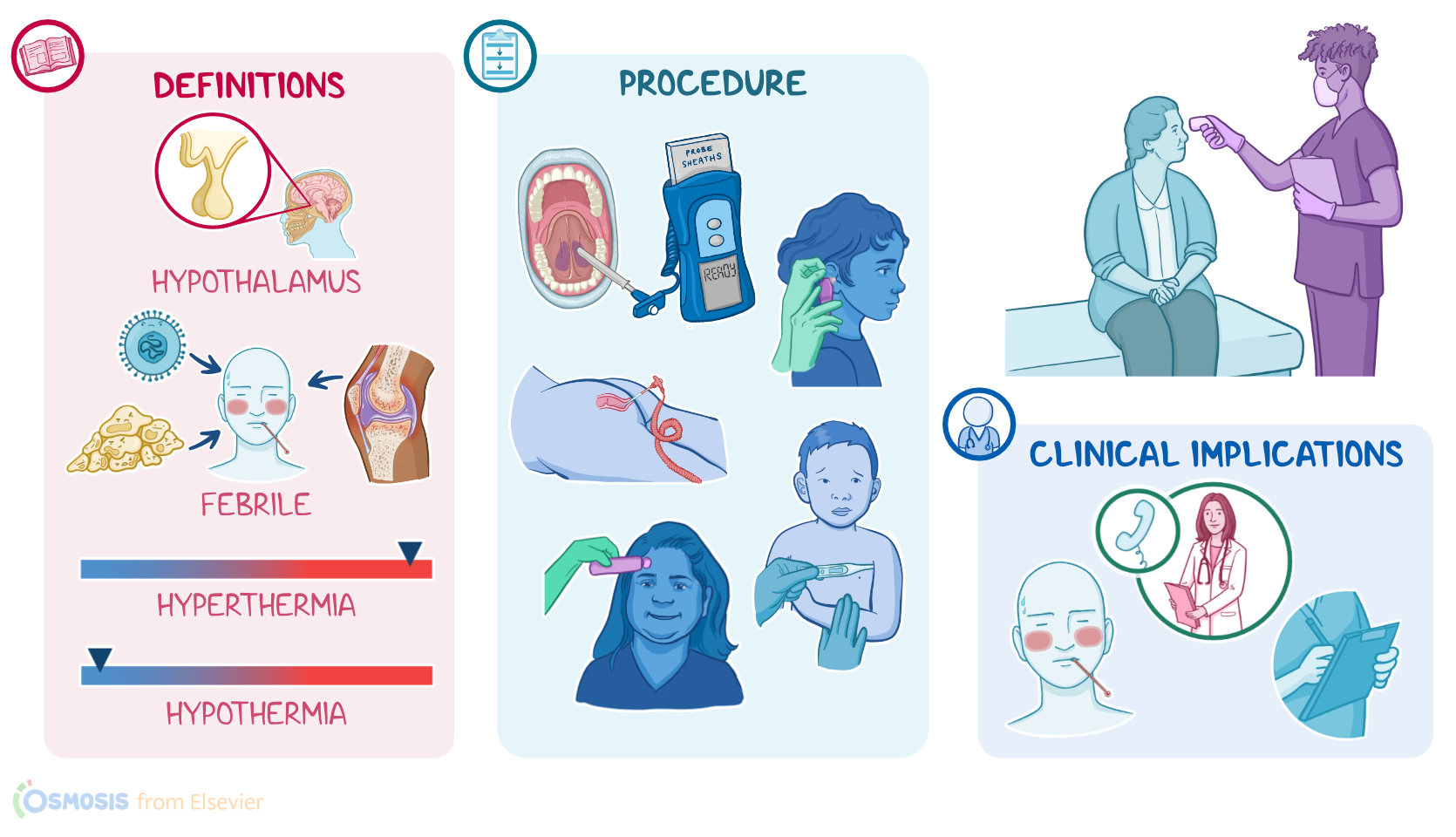
Now, as a nurse you will need to measure your client’s temperature. There are several areas of the body where you can do that, including the oral cavity; the rectum; the axilla, or armpit; the tympanic membrane, or eardrum; and the temporal artery on the forehead. Before we discuss how to measure your client’s temperature, we need to cover some definitions. Our body is always generating heat through metabolism, and a part of the brain, called the hypothalamus, tries to keep the core body temperature constant like a thermostat. When we are febrile, meaning we've got a fever, the thermostat is raised higher, and this can be due to an infection, inflammation, or cancer. However, body temperature could also be high in hyperthermia, where the thermostat is set at the right temperature, but the body simply can’t get rid of the heat. This can be due to an extremely hot environment, excessive exercise, and reduced sweat production. In contrast, hypothermia is when body temperature gets too low, and it might be due to exposure to cold for a prolonged period of time, either accidentally or in preparation for a medical procedure.

Starting with an oral temperature: This is an easy and relatively comfortable method. A normal oral temperature is between 97.6 to 99.6 degrees Fahrenheit, or 36.5 to 37.5 degrees Celsius, for adults, and 97 to 99 degrees Fahrenheit, or 36 to 37 degrees Celsius, for children. But because the mouth is a large space open to the outside environment, this is not a very accurate way to obtain a temperature because the temperature can change significantly. So, don’t take an oral temperature if the client has been eating, drinking, smoking, or chewing gum in the past 15 minutes. Oxygen therapy with a face mask can also interfere with the results. In addition, it's important to hold the thermometer tightly in their mouth, so you should avoid this method for clients who are unable to do this, like those who have undergone a jaw or mouth injury or surgery, or have trouble breathing through their nose. It should also be avoided for clients who might bite the thermometer, like those who are likely to have a seizure and children under five. To start, gather the supplies you’ll need, including an electronic thermometer, a blue oral probe, and a probe sheath. So, first, ask the client if they have eaten, drank, smoked, or chewed gum in the past 15 minutes. If they have, wait 15 to 30 minutes before proceeding. Inform the client about the procedure before beginning and answer any client questions related to the procedure. Next, remember to practice hand hygiene and slide a probe sheath over the temperature probe. Then, switch it on and wait until you see a ready sign on the screen.

Now, the next step is to ask the client to open their mouth before inserting the thermometer into one of their posterior sublingual pockets at the base of the tongue, not in front of it. Ask them to keep their lips closed and breathe through their nose. You typically need to wait for 20-30 seconds. Most electronic thermometers also chime when they're done. Next, ask the client to open their mouth and take the thermometer away. The temperature will be visible on the screen. You can then push the button on the probe to detach the probe sheath and discard it in the appropriate manner. Finally, practice hand hygiene and make sure the thermometer is ready to be used again by putting away the probe, switching the thermometer off, and connecting it back with its charger. Now, if the client is comatose, confused, critically ill, in shock, or unable to close their mouth, obtaining a rectal temperature would give the most accurate measurement. The rectal temperature is normally 0.7° to 1° F, or 0.4° to 0.5° C, higher than the oral temperature. This means it should be between 98.6 to 100.6 degrees Fahrenheit, or 37 to 38.1 degrees Celsius, for adults, and 98 to 100 degrees Fahrenheit, or 37 to 38 degrees Celsius, for children. However, this method is often uncomfortable, both physically and emotionally, and it’s also riskier than the other methods. It should be avoided in clients with hemorrhoids, diarrhea, lesions around the anus, or those who have recently had surgery involving this region. Furthermore, the thermometer can stimulate the vagus nerve found inside the rectum, which could trigger a reflex that slows down the heart rate and lowers blood pressure, so clients with heart conditions should also avoid this procedure. Okay, to take a client’s rectal temperature, start by gathering the supplies you’ll need, including gloves, paper towels, tissues, a lubricant jelly, an electronic thermometer, a red rectal probe, and a probe sheath. Next, practice hand hygiene, inform the client about the procedure and answer any client questions.

Then, help the client roll over into Sims' position with the upper leg bent, and adjust the linens and the clothing to expose the area of the buttocks. Through all this, make sure to respect the client’s privacy. Then, check that the wheels on the bed are locked. Raise the bed to a comfortable working height. Then, for the electronic thermometer, attach the red rectal probe stem to the thermometer, slide the sheath over the probe, switch it on, and check for a ready sign on the screen.Next, leave the thermometer on a clean paper towel on the over-bed table. Place some of the lubricant on the paper towel and then apply plenty of it on the tip of the thermometer to help it get inserted more smoothly. Lower the side railings on the side you’re working on. Wear gloves and, with one hand, separate their buttocks. Ask them to breathe slowly and relax. Now, insert the lubricated probe about 3 cm, or a little over an inch, deep in the direction of the umbilicus. Make sure to stop and don’t force it if you feel resistance. Hold the electronic thermometer for 20-30 seconds or until it chimes.

Then, remove the thermometer, use a tissue to clean the area of the buttocks, and readjust the linens as well as the client’s clothing. After removing the sheath with a tissue and discarding both the tissue and the sheath, note the temperature on the screen of the electronic thermometer. You can then remove your gloves and practice hand hygiene. Return the side rails to the raised position, adjust the height and head of the bed, help the client move back into a comfortable position, and make sure that the wheels are locked. Finally, the thermometer needs to get ready for its next use, so, for an electronic thermometer, switch it off, put away the probe, and put it on charge. Okay, now, let’s focus on the ears. The tympanic membrane thermometer, or TMT, measures the temperature from a patient’s eardrum. It’s almost as accurate as rectal temperature if done properly, but accuracy might be affected by ear infections, like otitis media or a buildup of cerumen, or earwax. A normal tympanic membrane temperature is 98.6 degrees Fahrenheit, or 37 degrees Celsius, for adults and 98 to 100 degrees Fahrenheit, or 37 to 38 degrees Celsius, for children. So, to take a tympanic membrane temperature you’ll need a tympanic thermometer and a tympanic probe sheath.

First, inform the client about the procedure before beginning and answer any client questions related to the procedure. Next, practice hand hygiene and check if the client is using a hearing aid; if they do, slowly take it away and wait for a couple of minutes before proceeding. Also, if there is too much earwax, use a warm, moist washcloth to carefully wipe the ear canal. Now you’re ready to slide a probe sheath over the thermometer’s probe before holding the thermometer with your dominant hand. Place the probe tip in their ear canal, pulling the pinna back and up for an adult or straight back for a child. Applying gentle pressure, aim the probe towards the client’s nose so that the beam gets to the tympanic membrane. Make sure you’re not blocking the canal. Press the scan button and remove the thermometer when you hear the chime: usually after 1 second. Then, take the thermometer away and read the temperature on the screen. You can then push the button on the side to detach the probe sheath and discard it in the appropriate manner. Finally, practice hand hygiene and make sure the thermometer is ready to be used again by switching it off and connecting it back with its charger if needed.