Hygiene - Gastric and intestinal tube care: Nursing skills
Introduction0:00–0:37
There are many reasons why a client might encounter problems with eating or drinking. It could be due to difficulties with chewing, swallowing or digestion as a result of trauma, surgery or various medical conditions.
Several alternative methods of providing nutrients and fluids are available. This might include delivery of fluid and nutrition through a surgically implanted tube, like a gastrostomy or jejunostomy tube.
As the nurse, you will be responsible for the care and maintenance of these tubes. There are several types of tubes that your client may have.
Types of Tubes0:37–1:24
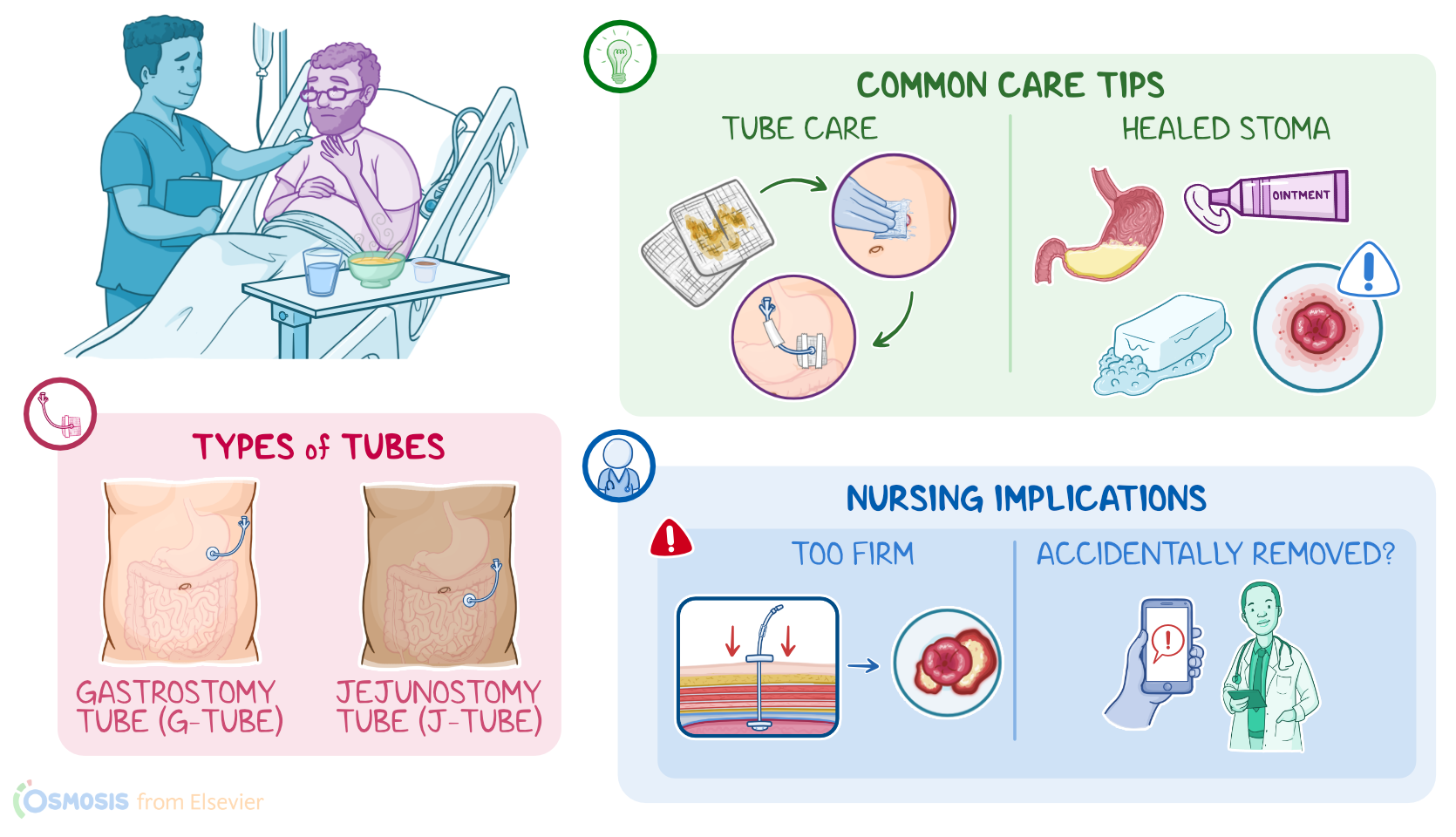
Some tubes are inserted through a surgical opening or stoma in the abdominal wall and into the stomach, known as a gastrostomy tube or G tube.
A common type of gastrostomy tube is the percutaneous endoscopic gastrostomy tube or peg tube. For short here, an endoscope or a tube with a light camera and guidewire is inserted through the mouth and into the stomach.
Then a guidewire is used to place the peg tube through an opening in the abdominal wall, creating a path directly into the stomach from the outside tubes can also be inserted into a part of the small intestine called the Jejunum, which is known as a jejunostomy tube or J tube.
So after a tube is surgically placed and while the incision site is healing, the dressing should be changed regularly using aseptic technique to prevent infection.
Tube Care1:24–3:02
Once the stoma has healed, clients no longer need the area to be dressed. But skin care is still very important since drainage or leakage from the tube often contains gastric secretion like stomach acid, which can be very harmful to the skin surrounding the stoma to help keep skin healthy, cleansing with warm soap and water.
On a regular basis is recommended. A barrier cream or ointment can be used to help protect the skin from exposure to harmful digestive fluids.
As the nurse make sure you check the site daily for signs of irritation or infection like pain redness and purulent discharge.
Now, for some types of feeding tubes like peg tubes, the tube will need to be periodically advanced about 2 to 3 centimeters back into the abdomen to prevent the internal mechanism of the tube called the bumper from embedding in the lining of the stomach.
Consult your clients treatment plan to determine how often this process needs to occur. Since it can vary from daily to weekly based on the clients needs.
Nursing Implications3:02–4:06
The external port of the tube is placing on the skin of the abdominal wall. If the port is pressed too firmly to the skin, it can cause a pressure ulcer to develop.
If you notice signs of skin breakdown occurring, contact the provider when applying a clean dressing, be sure to place it above the tube's external bumper, do not place it beneath.
As this can increase the tension on the tube and cause tissue breakdown. Be careful not to pull or tug at the tube to try to relieve tension.
Since this can lead to displacement or accidental removal. If the tube is accidentally removed, it is critical.
All right, is a quick recap. There are many reasons why a client might encounter problems with eating or drinking.
Review4:06–4:50
An alternative method of providing nutrients and fluids is through a surgically implanted tube like a gastrostomy or a jejunostomy tube.
Stoma comes in contact with stomach contents. It is important to protect the skin from breakdown and infection.
| HYGIENE - GASTRIC AND INTESTINAL TUBE CARE | ||
| KEY POINTS | NOTES | |
| DEFINITION |
| |
| TYPES OF TUBES |
| |
| COMMON CARE TIPS |
| |
No notes for this video yet
Try adding a note below