Case study - Bipolar disorder: Nursing
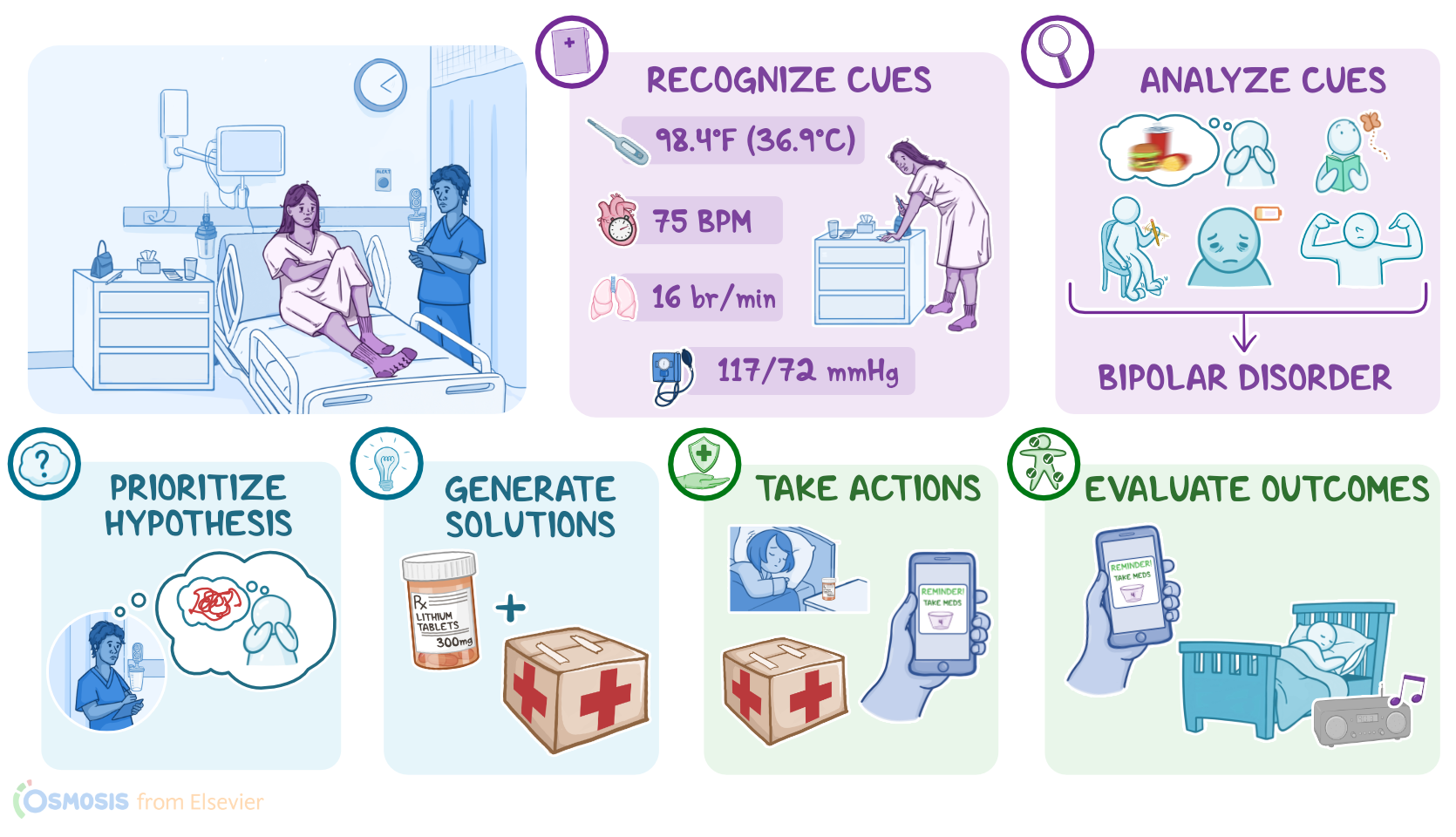
Nurse Nikil works on an inpatient psychiatric unit and is caring for Octavia, a 28-year-old with a history of bipolar I disorder, who was recently admitted for a manic episode. In collaboration with the registered nurse, RN Andre, Nurse Nikil goes through the steps of the Clinical Judgment Measurement Model to make clinical decisions about Octavia’s care by recognizing and analyzing cues, prioritizing hypotheses, generating solutions, taking action, and evaluating outcomes.
First, Nurse Nikil recognizes important cues, including Octavia’s vital signs, which are temperature 98.4 F or 36.9 C, heart rate 75 beats per minute, respirations 16 breaths per minute, and blood pressure 117/72 mmHg.
Upon entering her room, Nurse Nikil notes Octavia is pacing back and forth, stopping intermittently to rearrange the items on her bedside table.
Nurse Nikil: Hi Octavia, I see you’re cleaning your room. Could you pause for a moment and speak with me?
Octavia: Oh sure, I totally have time for you. Don’t you see I’m doing something important? I really need to get my room cleaned so I can start writing. I have an amazing idea for a best-selling book about a forest like the one I grew up next to. My mom would know the name. I should call her. Do you have her number?
Next, Nurse Nikil analyzes these cues. They review the electronic health record, or EHR, and note that prior to her hospitalization, Octavia had not been taking her lithium as prescribed. The nursing report from the night shift also indicated that Octavia hasn't slept for the past two nights.
Nurse Nikil recognizes patients with bipolar I disorder experience extremes in emotions, moving from manic to depressive moods.
The patient may have symptoms, like racing thoughts, hyperactivity, distractibility, insomnia, and feeling an inflated sense of self.
They understand that in patients experiencing mania, sleep disturbances can lead to exhaustion which can perpetuate manic or hypomanic episodes.
They also know that medications like lithium are prescribed to help with mood stabilization.
Nurse Nikil recognizes that Octavia needs management of her manic episode to promote effective sleep.
Now, using the information they've gathered, along with Octavia’s medical history, Nurse Nikil reports their findings to RN Andre, and together they choose a priority hypothesis of insomnia.
Then, Nurse Nikil collaborates with RN Andre to generate solutions to address Octavia’s insomnia that will include pharmacologic and nonpharmacologic interventions; and they establish the expected outcome that after intervening, Octavia will demonstrate two sleep promotion strategies by the end of the shift.
Next, Nurse Nikil and RN Andre take action to implement these solutions. They check the EHR and see that Octavia is prescribed a dose of lithium, then they re-enter Octavia’s room.
Nurse Nikil: Hi Octavia, I have your lithium for you.
Octavia: Fine, but I’m kind of busy right now. Can you just put it on the table, and I’ll take it later?
| CASE STUDY - BIPOLAR DISORDER | ||
| KEY POINTS | MY NOTES | |
| INTRODUCTION |
| |
| RECOGNIZING AND ANALYZING CUES |
| |
| PRIORITIZING HYPOTHESES, GENERATING SOLUTIONS, AND TAKING ACTION |
| |
| EVALUATING OUTCOMES |
| |
- "Foundations of mental health care. (8th ed.)" Elsevier (2023)
Aún no hay notas para este video
Intenta agregar una nota a continuación