Case study - Constipation: Nursing
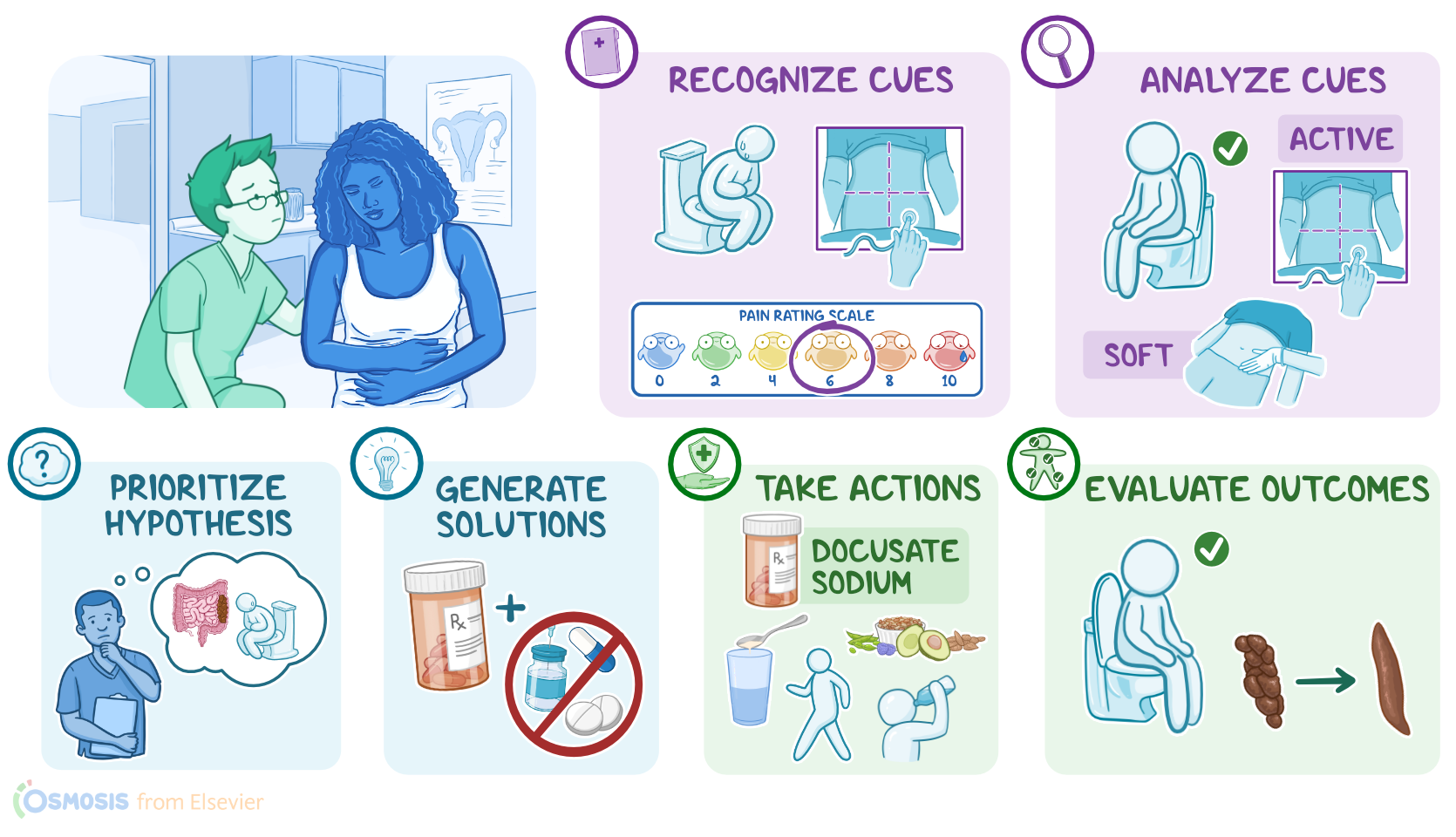
Nurse Thomas works at a primary care clinic and is caring for Donna, a 55-year-old female with a history of constipation, who’s being seen for abdominal discomfort. After settling Donna in her room, Nurse Thomas goes through the steps of the Clinical Judgment Measurement Model to make clinical decisions about Donna’s care by recognizing and analyzing cues, prioritizing hypotheses, generating solutions, taking action, and evaluating outcomes.
Nurse Thomas recognizes important cues such as Donna’s abdominal pain, which she describes as cramping with constant aching and rates as a 6 out of 10 on a pain scale. While gathering Donna’s health history, Nurse Thomas learns that although she typically has a bowel movement every two to three days, her last bowel movement was five days ago. She states it was hard, lumpy, difficult to pass, and there was a small amount of blood on the toilet paper after wiping.
Donna reports she’s been managing occasional constipation for years, and it’s gotten worse since she started working from home. Nurse Thomas learns Donna usually drinks sodas throughout the day and typically eats a cheeseburger on a white bun for lunch. He performs an abdominal assessment by visually inspecting Donna’s abdomen, auscultating all four quadrants, and palpating her abdomen. His findings include mild abdominal distension, hypoactive bowel sounds, and a firm, elongated mass in her lower left quadrant. Results of a digital rectal exam by the health care provider reveals normal anal sphincter tone, and an absence of rectal pain, fissures, or hemorrhoids.
Next, Nurse Thomas analyzes these cues. He knows bowel elimination should produce regular, soft, easy-to-pass bowel movements, and that other expected assessment findings include active bowel sounds in each quadrant, and a soft abdomen.
Okay, so using Donna’s medical history and the information he’s gathered, Nurse Thomas chooses a priority hypothesis of constipation. Then, he generates solutions to address Donna’s constipation and establishes the expected outcome that after intervening, Donna will report having at least one soft, easy to pass bowel movement every two days.
Nurse Thomas then takes action to implement these solutions. He gathers information on medications prescribed by the health care provider and educational materials about preventing constipation, and re-enters Donna’s room.
Nurse Thomas: I’d like to discuss two medications your healthcare provider prescribed and offer suggestions on how to prevent constipation.
Donna: Okay. What kind of medication?
Nurse Thomas: The first medication is a stool softener, called docusate sodium; it’s a pill you'll take daily to soften stool so it’s easier to pass. The second medication is a laxative called polyethylene glycol. It’s a powder you’ll mix into a beverage once per day until you have a bowel movement, usually within 1 to 3 days.
Donna: Okay, that sounds easy, but what if this doesn’t work?
Nurse Thomas: If you don’t have a bowel movement within 4 days, or if you’re only having small amounts of watery stool, then call us right away, it could mean your constipation is worsening.
Donna: Okay.
Nurse Thomas: Now, let’s talk about lifestyle changes to help prevent constipation. First, I’d like to give you a list of high fiber foods. Can you choose three high-fiber foods you’d be willing to incorporate into your diet?
Donna: Well, I like fruit, and I’ll work on adding raw vegetables and beans into my meals, too.
| CASE STUDY - CONSTIPATION | ||
| KEY POINTS | NOTES | |
| INTRODUCTION |
| |
| RECOGNIZING AND ANALYZING CUES |
| |
| PRIORITIZING HYPOTHESES, GENERATING SOLUTIONS, AND TAKING ACTIONS |
| |
| EVALUATING OUTCOMES |
| |
- "Fundamentals of nursing (11th ed.)" Elsevier (2023)
- "Fundamentals of nursing: Active learning for collaborative practice (3rd ed.)" Elsevier (2022)
Aún no hay notas para este video
Intenta agregar una nota a continuación