Congenital heart defects - Acyanotic: Nursing
Revisores de contenido
Colaboradores/as
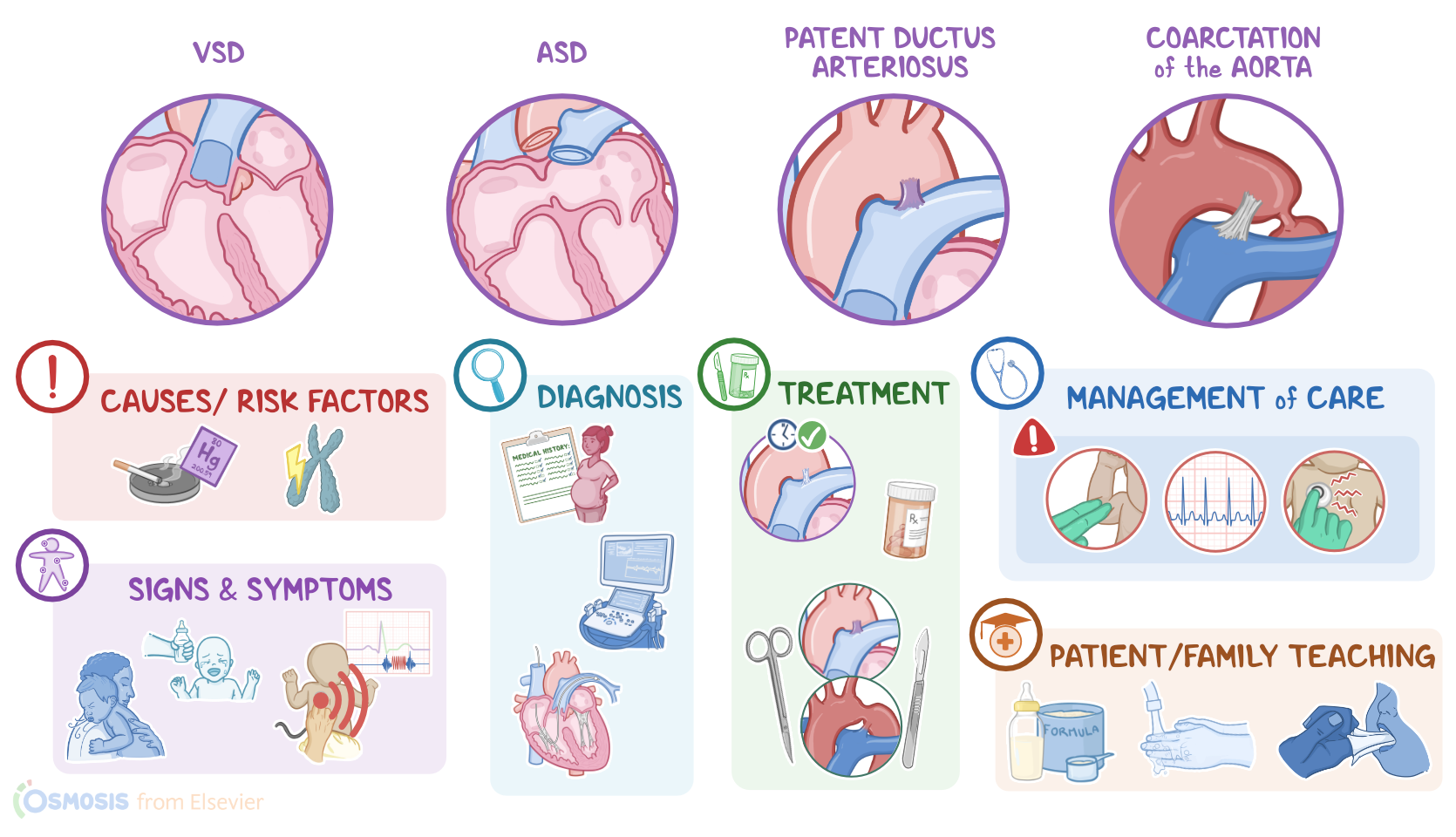
Congenital heart defects are cardiac conditions and anomalies that are present at birth. These are usually divided into two categories; aycanotic or cyanotic, based on the presence or absence of cyanosis, which means bluish discoloration of the skin. Congenital heart defects that don’t cause cyanosis are known as acyanotic heart defects. The main types of acyanotic heart defects are ventricular septal defect, or VSD for short, which is the most common one, in addition to atrial septal defect, or ASD, patent ductus arteriosus, or PDA, and coarctation of the aorta.
Now, let’s quickly recap the anatomy and physiology of fetal circulation. During fetal life, the lungs are filled with fluid and have high vascular resistance, so they don’t participate in gas exchange. Instead, the placenta serves as the organ of gas exchange, as well as delivering nutrients and removing metabolic wastes from the fetus.
So, oxygenated blood flows from the uterine arteries into the placenta, where oxygen passes through the capillaries and into the umbilical vein.
Then, part of the blood reaches the fetal liver, whereas about half of it bypasses the liver by a shunt called the ductus venosus, which diverts the oxygenated blood into the inferior vena cava, which has deoxygenated blood from the lower body.
Then, this blood flows into the right atrium and further mixes with deoxygenated fetal blood coming from the brain and upper body through the superior vena cava. Most of this mixed blood then moves through a small flap called the foramen ovale directly into the left atrium, into the left ventricle, and through the ascending aorta into the systemic circulation, supplying oxygen to the brain and upper body, as well as the lower body.
| CONGENITAL HEART DEFECTS - ACYANOTIC | ||
| KEY POINTS | NOTES | |
| DEFINITION |
| |
| PHYSIOLOGY |
| |
| CAUSES AND RISK FACTORS |
| |
| PATHOPHYSIOLOGY |
| |
| SIGNS AND SYMPTOMS |
| |
| DIAGNOSIS |
| |
| TREATMENT |
| |
| MANAGEMENT OF CARE |
| |
| PATIENT AND FAMILY TEACHING |
| |
Aún no hay notas para este video
Intenta agregar una nota a continuación