
Antiemetics · What Are They, How Do They Work, What Are They Used For, and More

Published: Sep 15, 2025
Author: Lahav Constantini, MD
Editor: Antonella Melani, MD
Editor: Nimmit Vyas, PharmD
Editor: Józia McGowan, DO, FACOI, FNAOME
Illustrator: Jillian Dunbar
7-day free trial

Go deeper with Osmosis

Osmosis is a learning platform with videos, questions, and AI tools to help you master topics like this.

4.8 · 12,000+ reviews
Watch quick, visual videos
Practice with Qbank-style questions
Use AI to explain, quiz, and review
Study anytime with the mobile app
Start free trial

No credit card · Cancel anytime

What are antiemetic drugs?

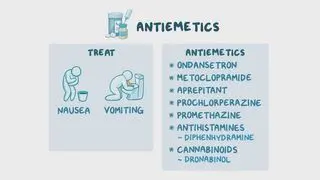
Antiemetic drugs are medications used to treat nausea and vomiting. These two symptoms are very common and can be caused by many different conditions, therapies, procedures, and medications, such as opioids. Though vomiting is considered to be a protective reflex of the body to expel toxic substances in the stomach and gut, antiemetic drugs are often necessary to suppress vomiting, especially if there’s severe dehydration. 

Learn deeper with Osmosis

Master this topic faster with videos, questions, and AI.

Used by 8M+ healthcare learners.

Start free trial

No credit card · Cancel anytime

How do antiemetics work?

Antiemetics work on the neural pathways by blocking specific receptors that respond to neurotransmitter molecules, such as serotonin, dopamine, and histamine. Most of these are central receptors found in the vomiting center of the brainstem, while peripheral receptors are found in the vagus nerve. When the gastrointestinal tract senses a threat, it sends information to the peripheral receptors, which in turn convey the information to the central receptors in the vomiting center. In response, the vomiting center triggers nausea and vomiting by stimulating the gastrointestinal tract, abdominal muscles, and diaphragm. 

What are the side effects of antiemetic drugs?

Antiemetics are generally well-tolerated, but can have potential side effects, such as constipation or diarrhea, headache, fatigue, malaise, dizziness, lightheadedness, blurred visiondry mouth, or photosensitivity 

Consulting a health care provider, such as a family physician, before taking over the counter antiemetics or prescription drugs is vital, especially if taking any other medications at the same time due to potential additive effects.  

How are antiemetic drugs used?

Antiemetic drugs are taken to treat nausea and vomiting, and can be administered as tablets, sublingual (i.e., under the tongue), oral solutions, suppositories, transdermal patches, or intravenous injections. Nausea and vomiting can be symptoms of various conditions, such as motion sickness, upper abdominal irritation, food poisoning, and gastroenteritis. Nausea and vomiting are also common side effects of many drugs including opioid analgesics, anesthetics, and chemotherapy. Finally, nausea and vomiting are often experienced in pregnancy-related morning sickness or hyperemesis gravidarum. However, antiemetic medications should not be taken during pregnancy without first consulting with a health care provider, who might prescribe them after weighing the risks and benefits.  

What are examples of antiemetics?

There are a few classes of antiemetic medications, which are categorized based on the predominant receptor they act on. Choosing the most appropriate class is key to optimize effectiveness and minimize side effects 
 
5-HT3 Receptor Antagonists 
Serotonin (5-HT3) receptor antagonists, such as ondansetron, granisetron, and palonosetron are medications that work on central serotonin receptors in the vomiting center, as well as the peripheral serotonin receptors in the vagus nerve5-HT3 receptor antagonists are indicated for use against vomiting caused by acute gastroenteritis or postoperative nausea. It’s also the first-line antiemetic class for radiotherapy- and chemotherapy-induced nausea and vomiting. 
 
Dopamine Antagonists 
Dopamine antagonists, such as metoclopramide, domperidone, and chlorpromazine, are medications that work on central dopamine receptors in the vomiting center. They are amongst the most commonly used antiemetics, and their use is helpful as a prokinetic to increase GI motility in gastroparesis. On top of that, they’re also indicated for postoperative nausea and motion sickness 
 
Antihistamines (H1 Blockers) and Antimuscarinics (M1 Blockers/Anticholinergics) 
H1 blockers, such as meclizine, cyclizine, promethazine, and diphenhydramine, and M1 blockers  like scopolamine, are often used to treat and prevent nausea and vomiting induced by vestibular disturbances like vertigo or motion. Scopolamine is predominantly used to prevent motion sickness, and can come in a transdermal patch, making it easier to administer, especially for people with swallowing problems. The transdermal patch is also useful for maintaining a steady release of the medication and lowering the risk of side effects. Antihistamines can be used in pregnancy, however, as a downside, they generally cause drowsiness. 
 
Neurokinin-1 (NK-1) Receptor Antagonists 
NK-1 receptor antagonists like aprepitant and rolapitant are a relatively new medication class that can be used as antiemetics, especially for suppressing radiotherapy- and chemotherapy-induced nausea and vomiting, as well as to prevent nausea and vomiting after surgery. NK-1 receptor antagonists should not be taken while pregnant or breastfeeding. 
 
Cannabinoid Receptor-1 (CB-1) Agonists 
CB-1 receptor agonists like dronabinol and nabilone work on the central nervous system especially for those where other antiemetic modalities have failed for chemotherapy-related nausea. 
 
Adjunct Medications  
Adjunct medications include glucocorticoids like dexamethasone; benzodiazepines like lorazepam; and the antipsychotic olanzapine, which assist in chemotherapy-induced emesis. All come with their own set of side effects and are typically not used as first-line treatments 

What are the most important facts to know about antiemetics?

Antiemetics are medications aimed at preventing or treating nausea and vomiting, which are common symptoms that may be tied to numerous different causes. For instance, motion sickness, gastroenteritis, and pregnancy can all commonly lead to nausea. There are many classes of antiemetic medications, so they should be appropriately prescribed or recommended by a healthcare professional, taking into consideration the risks and benefits, underlying cause, symptom severity, and possible side effects. Side effects typically include headache, fatigue, dizzinessdry mouth, and constipation or diarrhea.  

Key Takeaways

Definition 

Medications used to treat nausea and vomiting.  

Mechanism of Action 

- Block neurotransmitter receptors 

- Central receptors→ vomiting center (brainstem) 

- Peripheral receptors → vagus nerve  

Side Effects 

- Constipation  

- Diarrhea 

- Headache 

- Fatigue 

- Malaise 

- Dizziness 

- Lightheadedness 

- Blurred vision  

- Dry mouth  

- Photosensitivity 

Uses 

- Motion sickness 

- Upper abdominal irritation  

- Food poisoning  

- Gastroenteritis  

- Medication side effects (opioids, anesthetics → postoperative nausea, chemotherapy)  

- Hyperemesis gravidarum  

Students say Osmosis is 100% worth it

Because Osmosis saves them time. Lowers stress. And actually helps them remember when it counts.

I used Osmosis to prepare for my first medical school licensing exam! Super helpful and interactive for people who may not do great with just pages of text info!

Cecilia Ruiz

Cecilia Ruiz

MD student

Sayan Misra

I have used Osmosis for about four years. Best thing I have ever used for my medical studies.

Sayan Misra

Sayan Misra

Med student

Osmosis videos are superior because they define simple concepts, tell a story with a clear progression, and provide context.

Jay Pate

Jay Pate

Dental student

References


Flake ZA, Linn BS, Hornecker JR. Practical selection of antiemetics in the ambulatory setting. Am Fam Physician. 2015;91(5):293-296. https://pubmed.ncbi.nlm.nih.gov/25822385/ 


Hesketh PJ, Bohlke K, Lyman GH, et al. Antiemetics: American Society of Clinical Oncology clinical practice guideline update. J Clin Oncol. 2017;35(28):3240-3261. doi:10.1200/JCO.2017.74.4789 


Herrstedt J, Clark-Snow R, Ruhlmann CH, et al; participants of the MASCC/ESMO Consensus Conference 2022. 2023 MASCC and ESMO guideline update for the prevention of chemotherapy- and radiotherapy-induced nausea and vomiting. ESMO Open. 2024;9(2):102195. doi:10.1016/j.esmoop.2023.102195 


Kopf PG, Prozialeck W. Gastrointestinal disorders and their treatment. In: Wecker L, Ingram SL, eds. Brody’s Human Pharmacology. 7th ed. Philadelphia, PA: Elsevier; 2025:677-687. doi:10.1016/B978-0-323-84673-8.00072-9


Niño-Serna LF, Acosta-Reyes J, Veroniki AA, Florez ID. Antiemetics in children with acute gastroenteritis: A meta-analysis. Pediatrics. 2020;145(4):e20193260. doi:10.1542/peds.2019-3260


Post RE, Dickerson LM. Dizziness: approach to evaluation and management. Am Fam Physician. 2017;95(3):154-162.


Romano C, Dipasquale V, Scarpignato C. Antiemetic drug use in children: What the clinician needs to know. J Pediatr Gastroenterol Nutr. 2019;68(4):466-471. doi:10.1097/MPG.0000000000002225


Stevens CW. Pharmacological treatment of gastrointestinal disorders. In: Stevens CW, ed. Brenner and Stevens’ Pharmacology. 6th ed. Philadelphia, PA: Elsevier; 2023:325-337. doi:10.1016/B978-0-323-75898-7.00028-6