
Bulbar Palsy · What Is It, Causes, Diagnosis, Treatments, and More

Published: Aug 21, 2025
Author: Alyssa Haag, MD
Editor: Ahaana Singh
Editor: Lisa Miklush, PhD, RN, CNS
Editor: Kelsey LaFayette, DNP, ARNP, FNP-C
Editor: Anna Hernández, MD
Illustrator: Jillian Dunbar
7-day free trial

Go deeper with Osmosis

Osmosis is a learning platform with videos, questions, and AI tools to help you master topics like this.

4.8 · 12,000+ reviews
Watch quick, visual videos
Practice with Qbank-style questions
Use AI to explain, quiz, and review
Study anytime with the mobile app
Start free trial

No credit card · Cancel anytime

What is bulbar palsy?

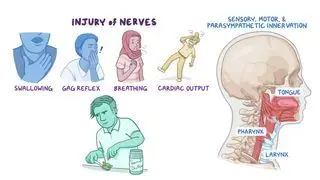
Bulbar palsy refers to a set of signs and symptoms that result from damage to the cranial nerves responsible for controlling the muscles involved in speech, swallowing, and facial movement. The affected cranial nerves are a set of nerves that arise from the bulbar region of the brainstem and include cranial nerves IX (glossopharyngeal), X (vagus), XI (accessory), and XII (hypoglossal).  

Bulbar palsy can be classified as progressive or non-progressive depending on whether the condition worsens over time or remains stable. Progressive bulbar palsy is more common and refers to the escalation of symptoms over time. It is often associated with neurodegenerative disorders like amyotrophic lateral sclerosis, or ALS. Non-progressive bulbar palsy, on the other hand, refers to bulbar palsy that does not worsen; it’s considered very uncommon and is often the result of structural brain damage from trauma, stroke, or congenital disorders rather than a degenerative condition. 

Bulbar palsy is sometimes confused with pseudobulbar palsy, which is the result of damage to the upper motor neurons in the corticobulbar tract, a neural pathway that connects the brain’s motor cortex to the brainstemWhile the two conditions share many of the same symptoms, pseudobulbar palsy is often characterized by the atypical expression of emotion displayed by unusual outbursts of laughing or cryingcalled emotional lability. Meanwhile, with bulbar palsy, an individual’s emotions usually remain unaffected. Other differentiating signs and symptoms of pseudobulbar palsy include spasticity in facial muscles, resulting in difficulty expressing emotions, and exaggerated reflexes, such as an increased jaw jerk reflex and gag reflex 

Learn deeper with Osmosis

Master this topic faster with videos, questions, and AI.

Used by 8M+ healthcare learners.

Start free trial

No credit card · Cancel anytime

What causes bulbar palsy?

One of the most common causes of bulbar palsy includes brainstem strokes and tumors. The brainstem is the part of the brain where the cranial nerves arise from and where all motor control signals are transmitted. Thus, damage to the brainstem—from strokes, tumors, or other causes—can damage various cranial nerves and disrupt motor control. 

Other common causes of bulbar palsy include neurodegenerative diseases, most commonly amyotrophic lateral sclerosisautoimmune diseases like Guillain–Barré syndrome; and genetic causes such as Kennedy disease. Amyotrophic lateral sclerosis is a rare neurological disorder characterized by a gradual deterioration and death of both upper and lower motor neurons. Progressive bulbar palsy is a specific form of ALS where degeneration occurs primarily in the brainstem, affecting speech and swallowing first. 

Guillain–Barré syndrome causes the immune system to attack the myelin sheath or axons of peripheral nerves, leading to loss of sensation and muscle weakness in various parts of the body. Symptoms typically start in the legs and move upwards, but in some cases, they can affect the cranial nerves, leading to bulbar palsy.  

Finally, Kennedy disease is a lower motor neuron disease that can affect transmission signals between the brain and the spinal cord, resulting in both limb and bulbar muscle dysfunction. 

Is bulbar palsy hereditary?

Yes, some cases of bulbar palsy can be hereditary, even though it’s not the most common presentation. For example, Kennedy disease is a rare, X-linked recessive neuromuscular disorder that primarily affects males. It’s caused by a mutation in the androgen receptor (AR) gene located on the X chromosome. Since males only have one X chromosome, they are typically affected, whereas females are usually asymptomatic carriers and may show only mild symptoms. 

Other forms of hereditary bulbar palsy include Brown–Vialetto–Van Laere (BVVL) and Fazio–Londe syndromes. BVVL is an autosomal recessive disorder, which means that both parents may be carriers for the disease without expressing the condition themselves but can pass on the expressive form of the disease to their child. Fazio–Londo syndrome presents similarly and is inherited in a similar manner to BVVL. 

What are the signs and symptoms of bulbar palsy?

Signs and symptoms of bulbar palsy depend on the cranial nerve that is damaged. For example, cranial nerve IX (glossopharyngeal nerve) is involved in salivation, swallowing, and the gag reflex. If cranial nerve IX is injured, it can lead to difficulty swallowing and a reduced gag reflex.  

Common signs and symptoms of damage to the other bulbar cranial nerves include difficulty chewing, nasal regurgitation, slurred speech, aspiration of secretions, impaired speech, and difficulty articulating words.  

Other clinical signs associated with bulbar palsy include a nasal speech that lacks in modulation (e.g., difficulty controlling or adjusting one’s speech), difficulty pronouncing certain consonants, wasting of the tongue, drooling, and weakness of the jaw and facial muscles. Additionally, individuals typically have a normal or absent jaw jerk (i.e., upward jerk of the jaw upon striking the chin) and an absent gag reflex. 

How is bulbar palsy diagnosed?

History and physical examination can diagnose bulbar palsy, as it’s a symptom rather than a disease. However, additional tests are typically required to diagnose the underlying cause. Electrophysiology tests, including electromyography (EMG) and nerve conduction studies may be performed to help distinguish ALS from other neuromuscular diseases like myasthenia gravis or Guillain-Barré syndrome. An analysis of an individual’s cerebral spinal fluid (i.e., the fluid that surrounds the brain and spinal cord) may be conducted to rule out multiple sclerosiswhich can sometimes present in a similar manner to bulbar palsy. Magnetic resonance imaging (MRI) of the brain may also be performed to diagnose a stroke or tumor affecting the brainstem. Finally, autoimmune and genetic testing may be needed if a specific neuromuscular disease is suspected. 

How is bulbar palsy treated?

Treatment of bulbar palsy depends on its specific cause, as bulbar palsy itself is a symptom rather than a disease. With ALS, treatment may include disease-modifying agents, including riluzole and edaravone, which can help slow progression of disease. Alternatively, Guillain-Barré syndrome may be treated with medications that suppress the immune system, like corticosteroids and intravenous immunoglobulins. 

In addition to specific treatment, all individuals with bulbar palsy can benefit from supportive measures to improve their quality of life. For example, individuals with difficulty swallowing may use modified dietary textures (e.g., thickened liquids, pureed foods) and postural techniques to reduce the risk of choking and aspiration pneumonia. In severe cases or with progressive conditions like ALS, nutritional support with a feeding tube may be indicated. 

If bulbar weakness leads to respiratory failure, individuals may be recommended non-invasive ventilation to reduce breathing effort or a tracheostomy (i.e., breathing tube), depending on the severity of the condition.  

Other supportive treatments may include speech therapy and medications to reduce excessive drooling, such as anticholinergics (e.g., glycopyrrolate, scopolamine patches), as well as muscle relaxants and physical therapy to improve spasticity 

Is bulbar palsy fatal?

Bulbar palsy can be fatal in progressive cases. Death from progressive bulbar palsy often occurs 1 to 3 years from the start of the disorder, however, it is often attributed to the development of complications, most commonly aspiration pneumonia. Aspiration pneumonia happens when someone accidentally breathes in food, drinks, or even gastric contents. It tends to occur in people with impaired gag and cough reflexes, such as those with bulbar palsy.  

Extensive bulbar damage may also damage the respiratory center in the brainstem, which is involved in signaling and controlling breathing. This can lead to a life-threatening inability to breathe properly. Additionally, progressive bulbar palsy may advance to ALS and prognosis is usually poor. With ALS, death of motor neurons interferes with an individual’s ability to breathe and can ultimately be fatal.  

What are the most important facts to know about bulbar palsy?

Bulbar palsy is a group of symptoms that occur due to damage to the lower cranial nerves responsible for controlling the muscles involved in speech, swallowing, and facial movement. Clinical features of bulbar palsy range from difficulty swallowing and a lack of gag reflex to the inability to articulate words and excessive drooling. Bulbar palsy is most commonly caused by brainstem stroke or tumors, autoimmune diseases, genetic diseases, and neurodegenerative disorders. Treatment primarily focuses on the management of the underlying condition and related symptoms with supportive therapy. 

Key Takeaways

Definition 

A set of signs and symptoms that result from damage to the cranial nerves originating from the bulbar region of the brainstem, responsible for controlling muscles involved in speech, swallowing, and facial movement. The cranial nerves involved are IX (glossopharyngeal), X (vagus), XI (accessory), and XII (hypoglossal).   

Causes 

- Can be progressive or non-progressive  

- Most common causes:  

     - Brainstem strokes 

     - Tumors  

- Other causes:  

     - Neurodegenerative diseases 

     - Amyotrophic lateral sclerosis  

     - Autoimmune diseases 

     - Guillan-Barré syndrome  

     - Genetic diseases (hereditary) 

     - Kennedy disease 

     - Brown–Vialetto–Van Laere syndrome  

     - Fazio-Londe syndrome 

Signs and Symptoms 

- Difficulty swallowing  

- Reduced gag reflex  

- Difficulty chewing  

- Nasal regurgitation  

- Slurred speech  

- Aspiration of secretions 

- Impaired speech 

- Difficulty articulating words  

- Nasal speech lacking modulation  

- Drooling 

- Weakness of jaw and facial muscles  

Diagnosis 

- Medical history  

- Physical examination  

- Electrophysiology tests  

- EMG 

- Nerve conduction studies  

- CSF analysis (rule out multiple sclerosis 

- MRI of the brain  

- Autoimmune genetic testing  

Treatment 

- Address underlying cause  

- ALS: disease-modifying agents 

- Guillain-Barré syndrome: immunosuppressants  

- Supportive measures  

- Modified dietary textures  

- Postural techniques  

- Nutritional support with feeding tube  

- Ventilatory support  

- Speech therapy  

- Medications to reduce drooling 

- Muscle relaxants and physical therapy  

Fatality  

- Progressive bulbar palsy: death often within 1 to 3 years from onset  

- Extensive bulbar damage involving respiratory center → life-threatening inability to breathe  

- May progress to ALS 

Students say Osmosis is 100% worth it

Because Osmosis saves them time. Lowers stress. And actually helps them remember when it counts.

I used Osmosis to prepare for my first medical school licensing exam! Super helpful and interactive for people who may not do great with just pages of text info!

Cecilia Ruiz

Cecilia Ruiz

MD student

Sayan Misra

I have used Osmosis for about four years. Best thing I have ever used for my medical studies.

Sayan Misra

Sayan Misra

Med student

Osmosis videos are superior because they define simple concepts, tell a story with a clear progression, and provide context.

Jay Pate

Jay Pate

Dental student

References


Bamaga AK, Maamari RN, Culican SM, Shinawi M, Golumbek PT. Child neurology: Brown-Vialetto-Van Laere syndrome: Dramatic visual recovery after delayed riboflavin therapy. Neurology. 2018;91(20):938-941. doi:10.1212/WNL.0000000000006498  


Cao Q, Chu H, Fu X, Yao J, Xiao Z, Lu Z. Case report: Acute bulbar palsy plus syndrome: A Guillain-Barré syndrome variant more prone to be a subtype than overlap of distinct subtypes. Front Neurol. 2020;11:566480. doi:10.3389/fneur.2020.566480 


Manzano R, Sorarú G, Grunseich C, et al. Beyond motor neurons: Expanding the clinical spectrum in Kennedy’s disease. J Neurol Neurosurg Psychiatry. 2018;89(8):808-812. doi:10.1136/jnnp-2017-316961 


Riva N, Domi T, Pozzi L, et al. Update on recent advances in amyotrophic lateral sclerosis. J Neurol. 2024;271(7):4693-4723. doi:10.1007/s00415-024-12435-9 


Yunusova Y, Plowman EK, Green JR, Barnett C, Bede P. Clinical measures of bulbar dysfunction in ALS. Front Neurol. 2019;10:106. doi:10.3389/fneur.2019.00106