Internal Hernia · What Is It, Rupture, Causes, Symptoms, Diagnosis, Treatment, and More
Published: Mar 04, 2025
Author: Georgina Tiarks•
Editor: Lisa Miklush, PhD, RN, CNS•
Editor: Ahaana Singh
Illustrator: Jillian Dunbar
7-day free trial
Go deeper with Osmosis
Osmosis is a learning platform with videos, questions, and AI tools to help you master topics like this.
Watch quick, visual videos
Practice with Qbank-style questions
Use AI to explain, quiz, and review
Study anytime with the mobile app
Try Osmosis Free
No credit card required
What is an internal hernia?
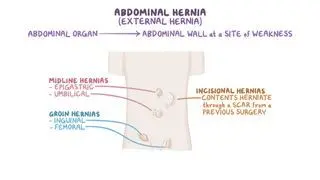
An internal hernia refers to the protrusion of internal organs through a weak abdominal tissue wall. Internal hernias most commonly involve the intestinal bowel loops and cannot be visualized externally. External hernias, in contrast, can be seen on the outside of the body, often as a bulge under the skin.
There are eight main types of internal hernias, categorized depending on where the hernia occurs. These include paraduodenal hernias: a congenital disorder resulting in herniation near the first part of the small intestine (e.g. duodenum); foramen of Winslow hernia: the movement of the intestines into a channel that divides two parts of the abdomen; pericecal hernia: a defect in a tissue attached to the large intestine; sigmoid-mesocolon hernia: herniation through tissue attached to the last portion of the large intestine; transmesenteric hernia: a hernia impacting layers of tissue in the abdomen; transomental hernia: a hernia affecting the tissue covering abdominal organs; and supravesical and pelvic hernias: hernias that most commonly involve the tissue that attaches the uterus to the pelvis.
Learn deeper with Osmosis
Master this topic faster with videos, questions, and AI.
Used by 8M+ healthcare learners.
Try Osmosis Free
No credit card required
Can a hernia rupture internally?
Yes, although it is rare, an internal hernia can rupture internally. A spontaneous rupture can be caused by coughing, lifting weights, straining with defecation, or under other circumstances that increase intra-abdominal pressure. A rupture requires immediate medical attention to prevent further damage to the internal contents of the abdomen.
What causes an internal hernia?
Internal hernias can occur when there is a weakness in a tissue wall that allows internal contents to push up against it and create a bulge in the lining. This weakness can occasionally be due to birth defects that impact the abdominal wall, causing an individual to be more prone to developing an internal hernia. Additionally, internal hernias can be acquired after trauma, inflammation, or surgery to the abdomen. Surgeries that may result in an internal hernia include liver transplants and gastric bypass surgery (a weight loss procedure that creates a small pouch within the stomach).
In addition, raised intra-abdominal pressure can increase the risk of developing an internal hernia. Circumstances that raise the pressure inside of the abdominal cavity include pregnancy, chronic cough, fluid buildup, heavy lifting, and straining while defecating.
What are the symptoms of an internal hernia?
The symptoms of an internal hernia vary based on the type and severity of the hernia. In mild cases, individuals may not have any symptoms at all. In more severe cases, an individual may experience mild abdominal discomfort or severe abdominal pain. Individuals may also experience vomiting, nausea, constipation, and abdominal tenderness.
How do you diagnose an internal hernia?
In order to diagnose an internal hernia a thorough medical history and physical examination will likely be performed. Since internal hernias are not visible externally, they may require imaging studies in order to be visualized. Computerized tomography (CT) scans are frequently used to diagnose an internal hernia, but an X-ray can also be used when a CT scan is unavailable. In some cases, a laparoscopy, which is a minimally invasive surgical procedure, may be required to determine the severity of the hernia.
It is important to promptly diagnose internal hernias due to the increased risk of developing a small bowel obstruction—which refers to a blockage of the small intestine—that can result in life-threatening complications if left untreated. In some cases, internal hernias can also result in other complications, such as the loss of blood supply to surrounding tissues (strangulation) or bladder compression.How do you treat an internal hernia?
Treatment of internal hernias largely depends on the severity. In some cases, an internal hernia can resolve itself with conservative management strategies, including increased fluid intake and adequate bowel rest by restricting food consumption. In other situations, however, surgery may be required. Surgical intervention could be either open or laparoscopic depending on the severity of the hernia.
What are the most important facts to know about an internal hernia?
Internal hernias are characterized by internal organs, often intestinal bowel loops, protruding through the abdominal tissue wall. This is caused by a weakness of an abdominal structure, often as a result of either a birth defect, injury, inflammation, or surgery. Symptoms vary depending on severity. Some individuals experience no symptoms while others may have severe abdominal pain. Diagnosis involves a thorough medical history review, physical examination, and sometimes, imaging studies. In some cases, surgery may be required to repair the damaged wall.
Related topics
Students say Osmosis is 100% worth it
Because Osmosis saves them time. Lowers stress. And actually helps them remember when it counts.
I used Osmosis to prepare for my first medical school licensing exam! Super helpful and interactive for people who may not do great with just pages of text info!"

Cecilia Ruiz
MD student

I have used Osmosis for about four years. Best thing I have ever used for my medical studies."

Sayan Misra
Med student
Osmosis videos are superior because they define simple concepts, tell a story with a clear progression, and provide context."

Jay Pate
Dental student