
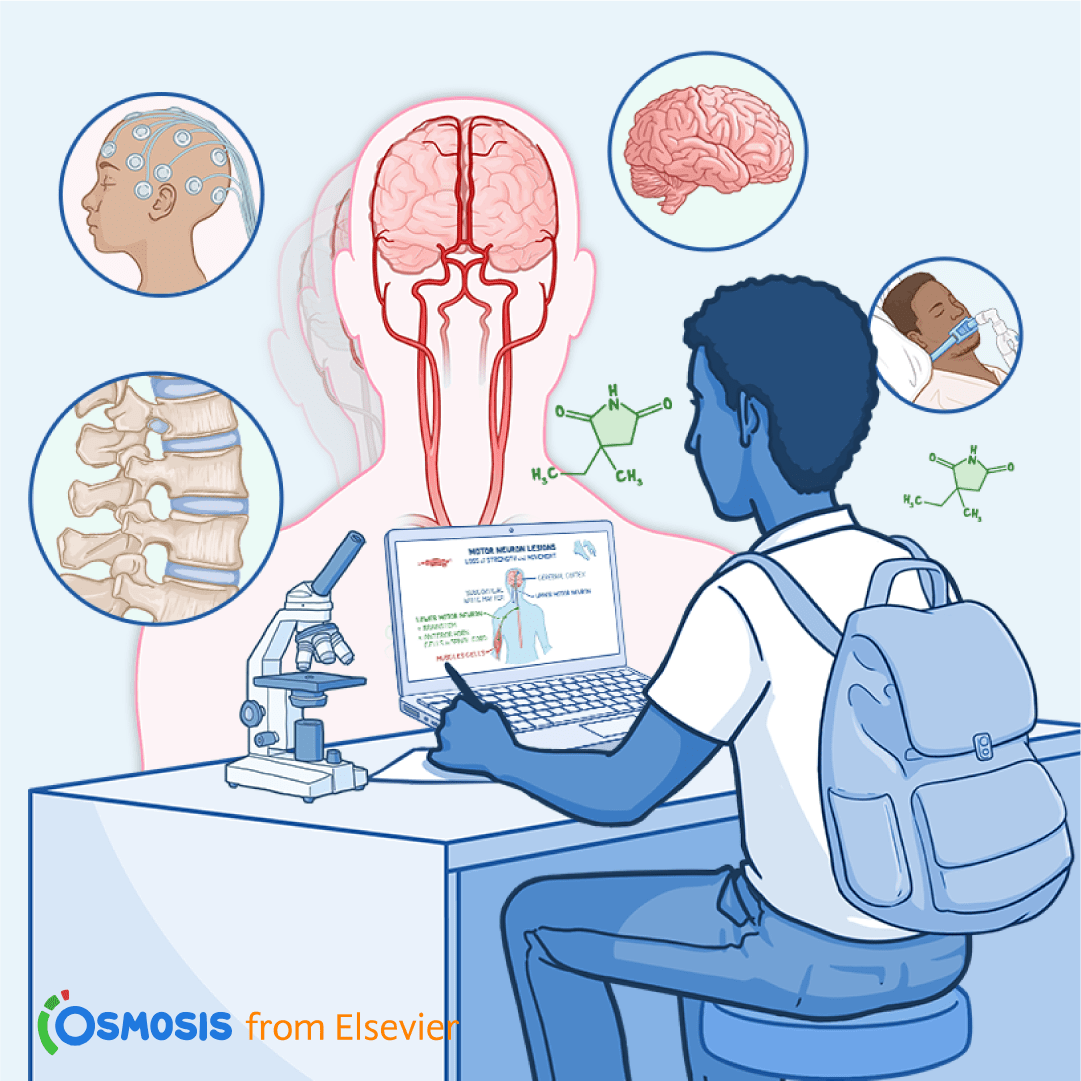
Many medical students dread the Neurology shelf exam more than almost any other. Between the intimidating vocabulary, the dense pathways, and neurology’s reputation for being impossible to fully “master,” it’s easy to fall into the trap of thinking you need to memorize every tract, every eponymous syndrome, and every rare channelopathy to pass. That anxiety alone drives a lot of wasted, inefficient studying.
Here’s the good news: you don’t need to be a neurologist to score well on this shelf. Most students overcomplicate their preparation by trying to learn neurology the way a specialist would, rather than the way the exam actually tests their knowledge. This article will walk you through efficient study tactics that let you focus your limited time where it counts, so you can study less, retain more, and walk into the exam with confidence instead of dread.
Why the Neurology Shelf Exam Seems So Difficult
Neurology has a reputation problem, and it starts with the material itself. The nervous system is dense, interconnected, and unforgiving of gaps in your understanding. Unlike a lot of other organ systems, you often can’t answer a neurology question correctly without first localizing the lesion. That extra step of reasoning, “where in the nervous system does this problem live?” can feel like an entirely separate skill you have to learn on top of the actual diseases.
The clerkship itself doesn’t always help. Neurology rotations vary widely between inpatient consults, outpatient clinics, and stroke or epilepsy services, and what you see on the wards may not map cleanly onto what’s tested. You might spend a week doing detailed cranial nerve exams on inpatients with subtle findings, only to find the shelf asking you to identify a straightforward case of Guillain-Barré syndrome. Clinical exposure and exam content often diverge, and it’s easy to mistake time spent in clinic for time spent preparing for the test.
On top of that, neurology terminology is intimidating. Words like “internuclear ophthalmoplegia” and “dysdiadochokinesia” can make students feel like they need a medical dictionary just to read the questions, let alone answer them. This vocabulary barrier convinces many students that neurology is harder than it needs to be.
The Biggest Mistakes Students Make When Studying for Neurology
The most common mistake is treating neurology as a memorization exercise rather than a reasoning exercise. Students often try to memorize long lists of syndromes, tracts, and reflexes without practicing applying them to a clinical vignette. You can know every layer of the brainstem and still miss a question if you haven’t practiced localizing a lesion from a symptom pattern.
Another common trap is chasing rare and fascinating diagnoses instead of mastering the basics. Neurology is full of interesting zebras: Kluver-Bucy syndrome, CADASIL, and various rare channelopathies that make for great trivia but are unlikely to show up more than once, if at all. Meanwhile, students who haven’t nailed down the difference between an ischemic and hemorrhagic stroke, or the basic workup for a first-time seizure, are leaving easy points on the table.
Students also frequently over-invest in imaging minutiae. While understanding when to order a CT versus an MRI matters, obsessing over subtle MRI sequence differences or memorizing every possible finding on diffusion-weighted imaging is rarely worth the time. The exam cares far more about your clinical reasoning than your radiology fellowship-level image interpretation.
Finally, passive review is a major time sink. Rereading neuroanatomy diagrams or highlighting a textbook chapter on multiple sclerosis feels productive, but it doesn’t build the pattern recognition the shelf actually rewards. If you’re not testing yourself, you’re not preparing efficiently.
The Mindset Shift: What the Neurology Shelf Is Actually Testing
The Neurology shelf tests your ability to localize a lesion, generate a focused differential, and choose the most appropriate next step in workup or management. It doesn’t test whether you can draw the internal capsule from memory or recite every branch of the brachial plexus.
Almost every question follows the same underlying skeleton: a clinical presentation that points to a lesion location, a differential built from that localization, and a decision about what to do next. Once you internalize this pattern, a huge portion of the exam becomes predictable. A patient with facial droop, arm weakness, and slurred speech isn’t testing your knowledge of obscure syndromes; it’s testing whether you can recognize a middle cerebral artery stroke and know what to do in the next sixty minutes.
This is the same underlying skill tested on every shelf exam: recognize the presentation, generate a reasonable differential, and prioritize the next best step. Neurology applies it to the nervous system, adding localization as another layer of reasoning. Once you accept that the exam rewards applied thinking over raw recall, your study plan becomes much more efficient.
What You Actually Need to Know to Score Well
The following categories make up the bulk of the Neurology shelf exam. Given your limited study time, this is where it should go:
- Stroke: This is arguably the single highest-yield topic on the exam. Know how to distinguish ischemic stroke from hemorrhagic stroke, the time windows and contraindications for thrombolytics and thrombectomy, and how to localize a stroke based on the vascular territory involved. Risk factor modification and secondary prevention also show up often.
- Seizures and epilepsy: Understand the different seizure types, how to work up a first-time seizure, and the management of status epilepticus. You should also know the basics of first-line antiseizure drugs and when driving restrictions or counseling become relevant.
- Headache: Learn to distinguish primary headache syndromes like migraine, tension-type, and cluster headache from secondary causes. Red flag features that suggest a dangerous secondary headache, like a thunderclap headache pointing to subarachnoid hemorrhage, are especially high-yield.
- Neuromuscular disease: Know the classic presentations of myasthenia gravis, Guillain-Barré syndrome, and ALS, along with the basic distinction between upper- and lower-motor-neuron findings. This distinction shows up constantly and is one of the most efficient concepts you can master.
- Demyelinating and neurodegenerative disease: Multiple sclerosis is consistently tested, especially its relapsing-remitting presentation and diagnostic criteria. Parkinson disease and the major categories of dementia, including Alzheimer, vascular, and Lewy body dementia, also show up regularly.
- Neurologic emergencies: Increased intracranial pressure, herniation syndromes, spinal cord compression, and meningitis or encephalitis round out the high-yield emergency topics. You should be comfortable recognizing these presentations quickly and knowing the immediate next steps.

What You Don’t Need to Master
You don’t need to memorize the entire brainstem cross-section at every level, nor do you need to know every rare hereditary neuropathy by name. Detailed genetics of neuromuscular diseases, the fine points of nerve conduction study interpretation, and obscure channelopathies are rarely tested and shouldn’t take priority over core content.
Similarly, you don’t need to be able to draw every cranial nerve pathway from memory. Understanding each cranial nerve’s function and recognizing a deficit in a vignette is far more valuable than sketching its exact anatomical course. The same goes for detailed pharmacologic mechanisms of every antiseizure drug: knowing when to use one class over another matters more than reciting receptor-level mechanisms.
Rare syndromes and eponyms, like Foster Kennedy syndrome or Wallenberg syndrome, occasionally appear but are low-yield relative to the time it takes to master them. Only spend time here once you’ve fully solidified the core, high-yield topics above.
A High-Yield, Time-Efficient Study Strategy
Practice questions should be the backbone of your Neurology shelf preparation. They train you to localize lesions and reason through vignettes far more effectively than passive review. Use a question bank, like the Osmosis Qbank, and approach every question with the same framework: where is the lesion, what’s the differential, and what’s the next best step?
Build illness scripts rather than isolated flashcards. For each major diagnosis, connect the classic presentation, key distinguishing features, workup, and management into a single mental model. This mirrors how the exam presents information and makes recall far more automatic during the test.
Study in short, focused blocks rather than long, unfocused sessions. Twenty to thirty minutes of concentrated question review beats two hours of distracted reading. If your rotation includes inpatient consults or a stroke service, use your patients as study triggers. Saw a patient with a suspected TIA today? Review TIA and stroke workup that evening. Tying your studying to real clinical encounters is one of the most effective ways to make the material stick.
A practical approach to pacing is to divide your total question goal by the number of rotation days, minus five to seven, to set a manageable daily target with a built-in buffer for inevitable rough days. And just as importantly, know when to stop. If you’re rereading the same vignette without absorbing it, close the question bank and rest. Fatigue erodes the pattern recognition this exam depends on far more than an extra thirty minutes of studying ever helps.
How to Balance Shelf Studying with a Neurology Rotation
Neurology rotations vary in intensity by service, but the same principle applies regardless of your schedule: consistency beats intensity. Some days will allow for a solid study session; others won’t allow for much at all. That’s normal, and it’s not a sign you’re falling behind.
Use downtime between patients or after clinic to review high-yield topics in short bursts. If you have a lighter outpatient day, spend extra time on a topic you feel shaky on rather than one you’ve already mastered. On heavier consult or stroke-service days, stick to light review, or give yourself permission to rest entirely.
Prioritize sleep as part of your study strategy, not separate from it. Neurology tests pattern recognition and reasoning, both of which suffer significantly when you’re running on too little sleep. A well-rested student who reviewed for twenty minutes will consistently outperform an exhausted student who crammed the night before. If you take only one piece of advice from this article, let it be this: protecting your rest protects your score.
What Scoring Well on the Neurology Shelf Actually Looks Like
Scoring well on the Neurology shelf doesn’t mean knowing every syndrome in the textbook. It means confidently localizing common presentations, generating a focused and reasonable differential, and identifying the most appropriate next step in workup or management. It means recognizing classic stroke, seizure, or neuromuscular presentations quickly, even when the question phrases them in an unfamiliar way.
It also means being honest about what a strong score actually requires. You don’t need to answer every question correctly. Most students who perform well have mastered the core, high-yield topics rather than spreading themselves thin across every rare condition the field has to offer. The students who struggle are usually the ones who tried to learn too much, not the ones who didn’t study enough.
A strong performance comes from finishing the exam confident that you focused on the material that mattered, without sacrificing your sleep or sanity to get there.
Key Points for Preparing for Your Neurology Shelf Exam
The Neurology shelf rewards localization and clinical reasoning, not exhaustive memorization. You likely don’t need to study more; you need to study smarter, prioritizing the high-yield topics that consistently appear on the exam and letting go of the rare zebras. It’s normal to feel some fatigue by exam day, but aim for tired and prepared, not burned out and overwhelmed. This approach won’t just help you on the Neurology shelf; it builds the diagnostic reasoning skills that carry you through every rotation and exam that follows.
Key Takeaways
- The Neurology shelf emphasizes lesion localization and clinical reasoning over memorization of anatomy and rare syndromes.
- High-yield topics include stroke, seizures, headache, neuromuscular disease, demyelinating and neurodegenerative disorders, and neurologic emergencies.
- Common mistakes include memorizing rare conditions, over-focusing on imaging detail, and passively reviewing material instead of practicing questions.
- Practice questions built around a “localize, differentiate, manage” framework are the most effective way to prepare.
- Consistent, focused study paired with adequate sleep leads to stronger performance than long, exhausted study sessions.

Get your free trial now to discover why millions of clinicians and caregivers love learning by Osmosis.
Leave a Reply