
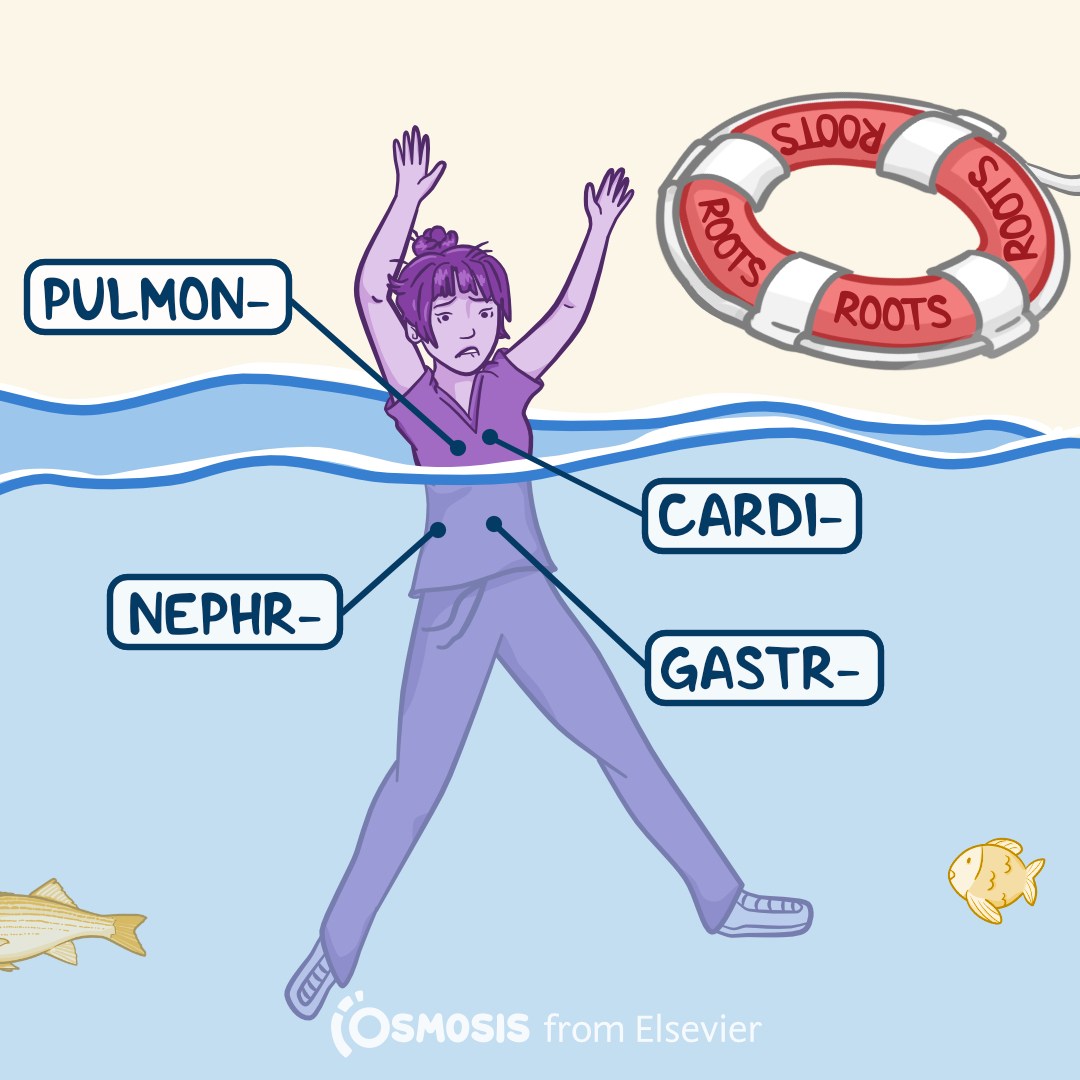
If your first week of anatomy felt like being dropped into a foreign country without a phrasebook, you’re not alone. The volume of information is huge, and the terms probably look nothing like anything you’ve learned before. It’s completely understandable that so many first-year medical students feel like terminology is standing between them and their next academic step!
Happily, you don’t need to memorize every term; you need to learn how to decode them. A small set of high-frequency word parts, directional terms, and naming patterns will unlock most of medical vocabulary for you.
This guide is written for first- and second-year MD and DO students, whether your course is lecture-heavy, atlas-driven, or built around cadaver lab. You’ll find clear priorities, a routine that fits into a real schedule, and a heads-up on the mistakes that waste the most time and energy.
- For a handy reference guide to terminology, bookmark our Medical Terminology Made Easy blog.
- For strategies that go beyond terminology, check out How to Study Anatomy.
Anatomy Terminology at-a-Glance
Before we dive in, here’s the quick version:
- What makes anatomy tough: A flood of unfamiliar terms in the first few weeks (timing varies by school), most built from word parts no one has ever taught you.
- What to focus on first: Directional terms, the most common roots, prefixes, and suffixes, and the basic logic behind how structure names are built.
- What to skip: Memorizing terms one at a time. It works for a handful of words, but it falls apart under the volume of a full anatomy course.
- How much time to spend: Once you have a system, one to three hours a day is realistic. Steady decoding practice beats all-nighters that leave you tired, anxious, and still shaky on tomorrow’s list.
Why Anatomy Feels Like Learning Another Language
That feeling has a real explanation: anatomy is built on classical languages. Most structure names come from Latin, like mandible, vertebrae, femur, tibia, and scapula. Many condition and procedure terms come from Greek, like hemorrhage, dermatitis, rhinoplasty, nephrectomy, and osteotomy. The international standard, Terminologia Anatomica, lists more than 7,100 Latin terms alone. No wonder it feels like learning two languages at once.
The encouraging part is that decoding really does work. In a Mayo Clinic study, first-year students scored higher on anatomy exams after a gross anatomy course that deliberately taught Latin and Greek etymologies. A later study also linked knowledge of classical languages to stronger performance on anatomy assessments. Students who break terms into meaningful pieces tend to remember more and recall them faster under pressure.
Fortunately, you don’t have to become a Latin or Greek scholar to get those benefits. A small, high-frequency set of word parts shows up again and again across every region of the body. Once those are solid, new terms stop feeling random and start feeling like combinations you can already half-read. That’s the difference between grinding through vocabulary and learning it efficiently.

What to Prioritize
Let’s start with one clear rule: don’t try to learn every root. Start with the ones you will see every single week.
Know It Cold
These items need to be automatic. Anatomical directional terms come first. They include superior and inferior, anterior and posterior, medial and lateral, proximal and distal, superficial and deep. These appear in nearly every description, every practical, and every clinical note you write.
Next are the most common anatomy suffixes and prefixes. For example, -itis, -ectomy, -algia, -osis, hyper-, hypo-, sub-, peri-, endo-. Then the anatomy word roots for the major organs and systems: cardi-, hepat-, nephr-, pulmon-, gastr-, neuro-, osteo-, myo-. These form the backbone of anatomy terminology that shows up across every region of the body. When these are automatic, the rest of the terminology becomes so much easier.
Know It Well
The next layer includes roots for muscles, bones, vessels, and nerves. For example, myo-, osteo-, angi-, neur-, arteri-, ven-. Learn how structure names are typically built—usually a core name plus a descriptor for location, shape, size, number, or function. There’s a pattern. For example, a muscle might be named for its shape (deltoid), its attachments (sternocleidomastoid), or its action (flexor digitorum).
Get comfortable with the Latin plurals so they don’t trip you up when it comes to exams: vertebra and vertebrae, foramen and foramina, ganglion and ganglia, criterion and criteria. These are high-yield because they are tested early and often, and small spelling or plural errors can cost you easy marks.
Recognize It
Some terms can’t be decoded from roots. Anatomical eponyms (named after people) and most drug names fall into this category. Fallopian tube, Circle of Willis, Parkinson’s disease, and most pharmaceutical names don’t break cleanly into classical roots.
Treat them as exceptions. Learn each with a quick visual, story, or location hook rather than forcing an etymology that does not exist. Trying to decode everything is a common trap, so knowing what you can’t decode saves time and frustration.
What You Can Let Go (For Now)
You don’t need to know Latin grammar or declensions. You also don’t need to know every rare root that appears once in an obscure footnote. Memorizing the full origin story of every term is a time waster that rarely improves exam performance. Likewise, copying the entire prefix and suffix list may feel productive, but it’s almost entirely passive.
Perfect classical pronunciation is unnecessary. Clear and consistent is enough for lab, practicals, and later clinical work. Free that mental bandwidth for the high-frequency material that actually shows up week after week.
A Decoding Routine That Fits Real Life
Here are five, simple and powerful steps for decoding new terms:
- Break it: Split the term into root, prefix, and suffix. Write the pieces down if it helps. The physical act of separating the parts already improves retention.
- Guess it: Make a best guess at the meaning before you look anything up. This forces active retrieval and makes the later confirmation more memorable.
- Check it: Confirm with your atlas, course glossary, lecture notes, or instructor. Accuracy matters more than speed at this stage.
- Attach it: Find the structure in lab or on an image and say the name out loud while looking at it or touching it. Motor and visual memory lock the term in place far better than silent reading.
- Space it: Put the word on a flashcard and review it on a spaced schedule. This is how to break down medical terms efficiently and memorize anatomy terms that actually stick beyond the next quiz.
This routine turns passive reading into active decoding. It builds the habit of learning anatomy vocabulary without drowning in endless lists. Run it on every new term that appears in lecture or lab for two solid weeks and watch how quickly the language starts to feel familiar instead of foreign.
Worked Example
Here’s a worked example using the five steps, so you can see the process in action rather than just reading about it. Let’s use sternocleidomastoid.
- Break it down: sterno- (sternum), cleido- (clavicle), and mastoid (the mastoid process of the temporal bone).
- Guess the meaning: a muscle that attaches to the sternum, the clavicle, and the mastoid process.
- Check it against your atlas or course notes.
- Attach it by finding the muscle in lab or on a labeled image, then say the full name out loud while tracing its path.
- Space it by putting the individual word parts on flashcards and reviewing them on a spaced schedule.
The name itself tells you where the muscle attaches; providing helpful context that makes anatomy terminology less mysterious once you start looking for it. Keep a focused set of anatomy terminology flashcards built around word parts rather than whole terms, and use the Osmosis Study Schedule to plan your study period before those reviews so nothing falls through the cracks between blocks.

Common Anatomy Language Mistakes (and What to Do Instead)
Here are some common mistakes and how to avoid them:
- Memorizing terms one at a time: It doesn’t scale because the volume is too high and the retention curve is too steep. Instead, learn the word parts first and decode new terms from them. That’s the core of effectively memorizing anatomy terms.
- Copying giant prefix and suffix lists: Copying feels productive, but it is almost entirely passive. Although the lists look impressive in a notebook, they usually fade from your memory in days. Learn only the ones from this week’s region, in the context of the structures you’re already studying. The context is what makes it stick.
- Trying to decode eponyms and drug names: Roots don’t explain them. They’re exceptions by design, so treat them as such and learn each with a quick, memorable hook, such as location, story, or visual, rather than forcing an etymology that doesn’t exist.
- Ignoring plurals and spelling: This is an easy way to see marks disappear on practicals and written exams. Put the plural form on the back of every relevant flashcard so both forms are learned together. Small errors relating to plurals or spelling are frustrating because they’re avoidable.
- Reading terms but never saying them: Terms you’ve never spoken are harder to retrieve under time pressure. Say them out loud in lab, in the library, while reviewing images, or even walking between buildings. The motor memory and auditory feedback help more than most students realize.
- Leaning only on mnemonics: Anatomy mnemonics are handy for stubborn lists and high-volume sequences, but they don’t build the underlying understanding that lets you handle new terms. Try roots and decoding first. Use mnemonics as a backup for items that still resist after you’ve applied the word-part approach.
- Falling down the etymology rabbit hole: This is a classic time-waster. Anatomy etymology is useful only when it is fast and high-yield. If a root doesn’t click in about thirty seconds, move on. Deep historical dives feel scholarly but rarely improve exam scores or lab performance. Keep your focus practical.
What to Do Differently
Before the next block starts, ask yourself one question: What’s one thing about anatomy vocabulary you wish you’d known before your first block, and what finally made the terms stick? For most students, the answer is some version of “I wish I’d stopped trying to memorize everything in isolation and started decoding instead.” The shift from isolated terms to reusable word parts is usually the moment your retention improves and anxiety drops. Build that habit early and the rest of the year gets measurably easier.
Next Steps
You don’t have to memorize anatomy’s language term by term. Instead, learn how it is built. Once the high-frequency roots, prefixes, suffixes, and anatomical directional terms are solid, new structures stop being foreign and start becoming familiar. Latin and Greek roots in medical terminology become tools instead of obstacles. The language of the body becomes manageable the moment you stop treating every term as unique and start treating it as a system you already half understand.
Pair this approach with solid first-year medical student anatomy tips focused on consistency rather than perfection. Medical Terminology Made Easy and the Medical Terminology Flashcards on Osmosis are a great help. If you want additional memory tools for the stubborn lists that remain, the Top 10 Helpful Medical Mnemonics is a useful study reference.
And remember, anatomy terminology stops being really difficult once you give yourself a reliable way to learn it. You’ve got this!
Key Takeaways
- Learning common Latin and Greek roots, prefixes, and suffixes helps medical students decode unfamiliar anatomy terminology rather than memorizing every term individually.
- Prioritizing anatomical directional terms, frequently used word parts, and common naming patterns builds a foundation for understanding more complex medical vocabulary.
- Breaking medical terms into meaningful components, predicting their definitions, and verifying them against trusted resources encourages active learning and retention.
- Combining terminology review with anatomical images, lab experiences, flashcards, and spaced repetition reinforces understanding and long-term recall.
- Avoiding inefficient strategies, such as copying extensive vocabulary lists, overusing mnemonics, and memorizing terms without context, can make anatomy studying more manageable and sustainable.
References
- https://www.osmosis.org/blog/how-to-study-anatomy-effectively-proven-strategies-for-faster-learning
- http://terminologia-anatomica.org/en
- https://pubmed.ncbi.nlm.nih.gov/16617443/
- https://pubmed.ncbi.nlm.nih.gov/29396874/
- https://www.osmosis.org/features/study-schedule
- https://www.osmosis.org/blog/medical-terminology-made-easy-100-essential-terms-for-healthcare-students
- https://www.osmosis.org/blog/medical-terminology-flashcards-on-osmosis-what-you-need-to-know
- https://www.osmosis.org/blog/the-top-10-helpful-medical-mnemonics-from-osmosis
- https://pubmed.ncbi.nlm.nih.gov/21265031/
- https://mayoclinic.elsevierpure.com/en/publications/latin-and-greek-in-gross-anatomy
- https://ijms.pitt.edu/IJMS/article/view/1935
- https://news.mcmaster.ca/?p=14225
- https://doi.org/10.1002/ca.23056
- https://www.ama-assn.org/medical-students/succeed-medical-school/5-tips-survive-first-year-anatomy-lessons-medical-school
- https://durhamcollege.ca/mydc/wp-content/uploads/sites/8/Understanding-Anatomy-Physiology-Terminology.pdf

Get your Osmosis from Elsevier free trial now to discover why millions of clinicians and caregivers love learning by Osmosis!
Leave a Reply