Candidiasis: Nursing process (ADPIE)
Client Report0:00–0:28
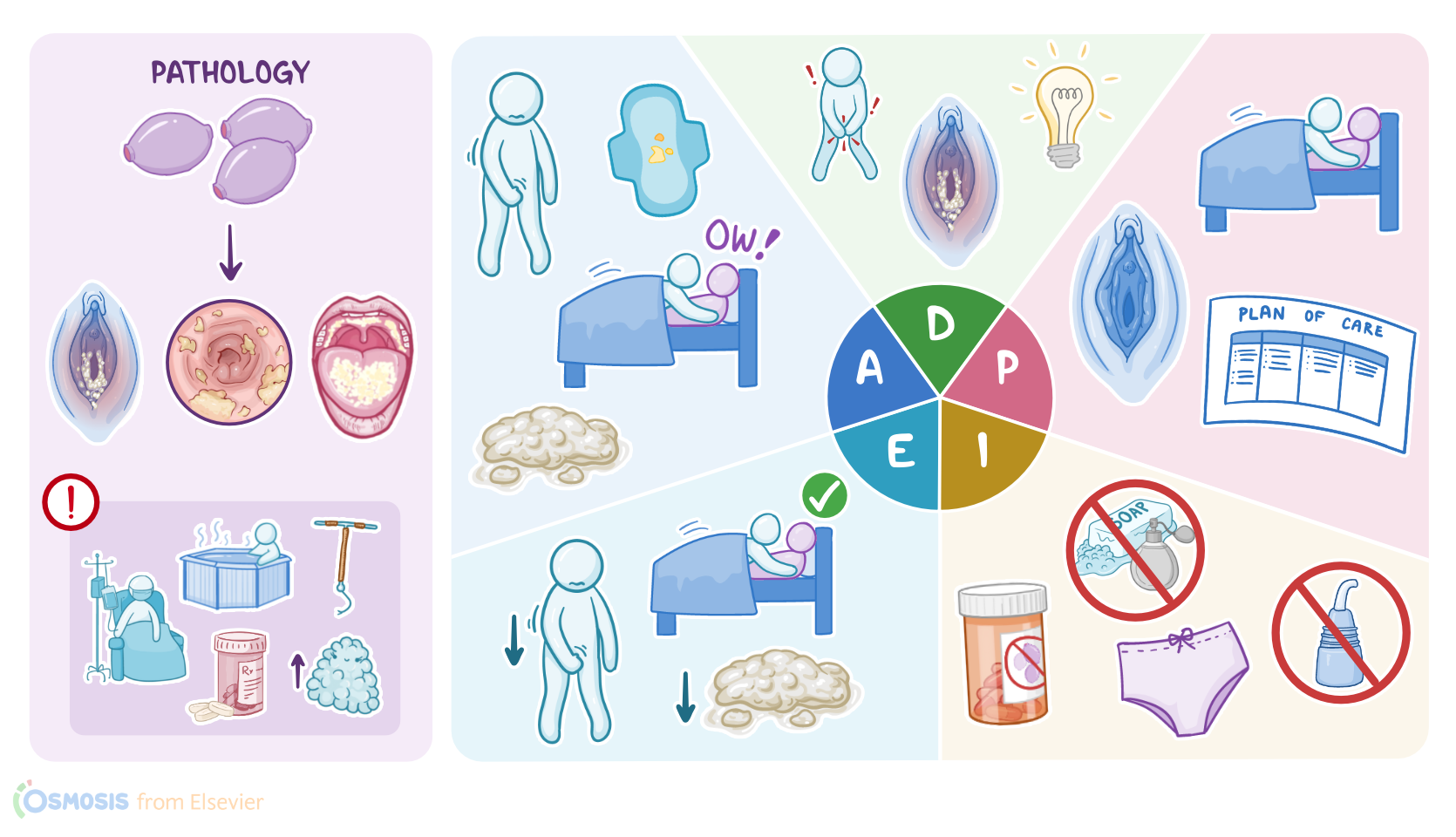
27 year old Olivia Hartman presents to the gynecology clinic with complaints of vulva itching, white clumpy vaginal discharge, and painful intercourse.
She reports that she recently completed antibiotic therapy to treat a urinary tract infection. After a sample of the vaginal discharge is tested, the gynecologist diagnoses Olivia with candidiasis and anti-fungal treatment is prescribed.
Now candidiasis is a fungal infection caused by Candida species, most commonly Candida albicans. Candida albicans makes part of the normal human microbial flora, so it's typically present in low numbers on the skin and mucous membranes, most notably the vaginal mucosa in females.
Pathology0:28–3:41
Now candidiasis occurs when there's overgrowth of Candida albicans, which disrupts the normal microbial flora. Most often, candidiasis affects the female reproductive organs, therefore, it's often referred to as candida vulvovaginitis.
One of the most common risk factors for Candida overgrowth is recent antibiotic use, since it kills off some important bacteria that are also part of the normal microbial flora, which means that there's normally less competition for Candida to thrive.
Other important risk factors include having diabetes mellitus, being immunocompromised, or taking corticosteroids, all of which can lead to a weakened immune system that can't keep Candida under control.
Finally, there's increased risk of candidiasis in those who use hot tubs, as well as those with intrauterine devices, implanted prosthetic devices, or high estrogen levels, which can be due to combined oral contraceptive use, estrogen therapy, or pregnancy, since all these factors favor candida overgrowth.
The most important clinical feature of candidiasis is a thick, white, odorless vaginal discharge that looks like cottage cheese.
Unfortunately, many clients can experience recurrent candidiasis, which is defined as 4 or more episodes of candidiasis within 1 year.
Now, in immunocompromised clients or those with implanted prosthetic devices, candida may get into the blood, causing candidaemia.
From the blood, candida can spread to other organs, which is known as invasive candidiasis. Diagnosis is based on clinical findings and potassium hydroxide or KOH test in which a sample of the vaginal discharge is mixed with 10% potassium hydroxide, eventually revealing signs of candida infection like budding yeasts, hypphi, and pseudohyphae.
If the KOH test is negative, a vaginal culture is needed to confirm the diagnosis. Finally, clients with candidiasis typically have a normal vaginal pH, which is between 4.0 and 4.5, which helps rule out other causes of vaginosis.
Finally, diagnosis of candidemia or invasive candidiasis is done by taking a blood or tissue sample and sending it for culture.
Treatment of candidiasis can involve topical or oral antifungal medications like Azoles. The preferred treatment is generally a single dose of oral fluconazole.
Finally, all clients should have good body hygiene and avoid excess moisture. Now let's see how Olivia is doing.
Assessment3:41–4:51
After washing your hands, introducing yourself, and confirming Olivia's identity, you begin your assessment. When you ask about her symptoms, Olivia reports persistent itching on and around her vulva and increased vaginal discharge.
Olivia tells you that she is sexually active with her spouse but stopped having intercourse when it became uncomfortable.
She expresses concern about possibly infecting her husband and wonders if he will need treatment too. You assure Olivia that candidiasis is not considered a sexually transmitted infection, and her husband should remain unaffected.
Her vital signs are temperature 98.6 °F or 37 °C, heart rate 70 BPM, respirations 16 per minute, BP 113/60 millimeters of mercury, and oxygen saturation 99% on room air.
You document your findings and leave the room to confer with a gynecologist. With the assessment data that you have collected, you establish the following nursing diagnoses impaired comfort related to pruritus, edema, and erythema, sexual dysfunction related to painful intercourse, and readiness for enhanced knowledge related to health management.
Diagnosis4:51–5:08
Planning5:08–5:29
Next, you collaborate with a gynecologist and create a plan of care for Olivia with these goals. By the follow-up visit in one week, the pruritus, discharge, edema, and erythema will be resolved.
Olivia will be able to have pain-free intercourse and she will be able to properly manage the candidiasis at home and prevent recurrent episodes.
After reviewing the gynecologist's orders, you begin implementing Olivia's plan of care. Olivia is prescribed a single dose of the oral anti-fungal agent, fluconazole, and you encourage her to take it as soon as she gets home.
Implementation5:29–6:45
You explain that some side effects may occur such as headaches, Nausea or abdominal pain and that she should call the office if these become bothersome or do not go away on their own to help manage the pruritus you teach her the importance of practicing good hygiene while avoiding excess moisture, harsh soaps, and scented feminine hygiene products.
Although candidiasis is not a sexually transmitted infection, you stress the importance of refraining from sexual activity until her current symptoms are resolved, as friction to the affected area may prolong the infection and increase irritation.
Next, to prevent recurrent episodes of candidiasis, you ensure that Olivia understands the benefits of wearing non-tight cotton underwear, changing promptly out of wet clothing like workout attire or swimsuits, avoiding hot tubs, and avoid douching which removes protective vaginal flora.
You remind Olivia that the itching and irritation may continue temporarily even after the infection is gone. Lastly, you let her know if her current symptoms appear to be worsening before her scheduled follow-up visit, she should call the office to let her gynecologist know.
Evaluation6:45–7:19
It has now been one week since Olivia was diagnosed with candidiasis, so let's check in with her and evaluate how things are going.
Olivia reports that the pruritis and vaginal discharge has steadily decreased, and Olivia tells you that she was able to engage in pain-free intercourse.
Direct evaluation of the site confirms the absence of edema, erythema, or vaginal discharge. Olivia goes on to say that she bought cotton underwear and continues to practice careful hygiene to prevent recurrent episodes.
You are glad to see that Olivia has met her care goals. All right, as a quick recap.
Summary7:19–7:59
Olivia Hartman presented to the gynecology clinic with signs and symptoms of candidiasis, a fungal infection. Your assessment revealed vulva puritis, edema, and erythema, as well as abnormal vaginal discharge.
The priority nursing diagnoses you established were impaired comfort, sexual dysfunction, and readiness for enhanced knowledge.
Careful planning allowed you to create goals that focused on alleviating Olivia's symptoms and implementation of the care plan involved providing a prescription of fluconazole and teaching her the appropriate self-care.
Finally, you evaluated that Olivia's plan of care was effective in restoring her well-being.
| CANDIDIASIS | ||
| KEY POINTS | NOTES | |
| PATIENT REPORT |
| |
| PATHOPHYSIOLOGY |
| |
| DIAGNOSIS AND TREATMENT |
| |
| ASSESSMENT |
| |
| NURSING DIAGNOSES |
| |
| PLANNING |
| |
| IMPLEMENTATION |
| |
| EVALUATION |
| |
- "Ackley and Ladwig’s Nursing Diagnosis Handbook: An Evidence-Based Guide to Planning Care, 13th edition" Mosby (2022)
- "Treatment for recurrent vulvovaginal candidiasis (thrush)" Cochrane Database Syst Rev (2022)
- "Invasive Candidiasis" Semin Respir Crit Care Med (2020)
- "Pathogenesis and virulence of Candida albicans" Virulence (2022)
- "Harrison’s Principles of Internal Medicine, 21st edition" McGraw Hill / Medical (2022)
- "Candidemia and Invasive Candidiasis" Infect Dis Clin North Am (2021)
- "Critical Care Nursing: Diagnosis and Management, 9th edition" Elsevier (2021)
No notes for this video yet
Try adding a note below