Case study - Accidental ingestion: Nursing
Introduction0:00–0:32
Nurse Olivia works in the emergency department and is caring for Daisy, a 2-year-old who was brought in by Ellen, Daisy’s caregiver, after accidentally ingesting acetaminophen.
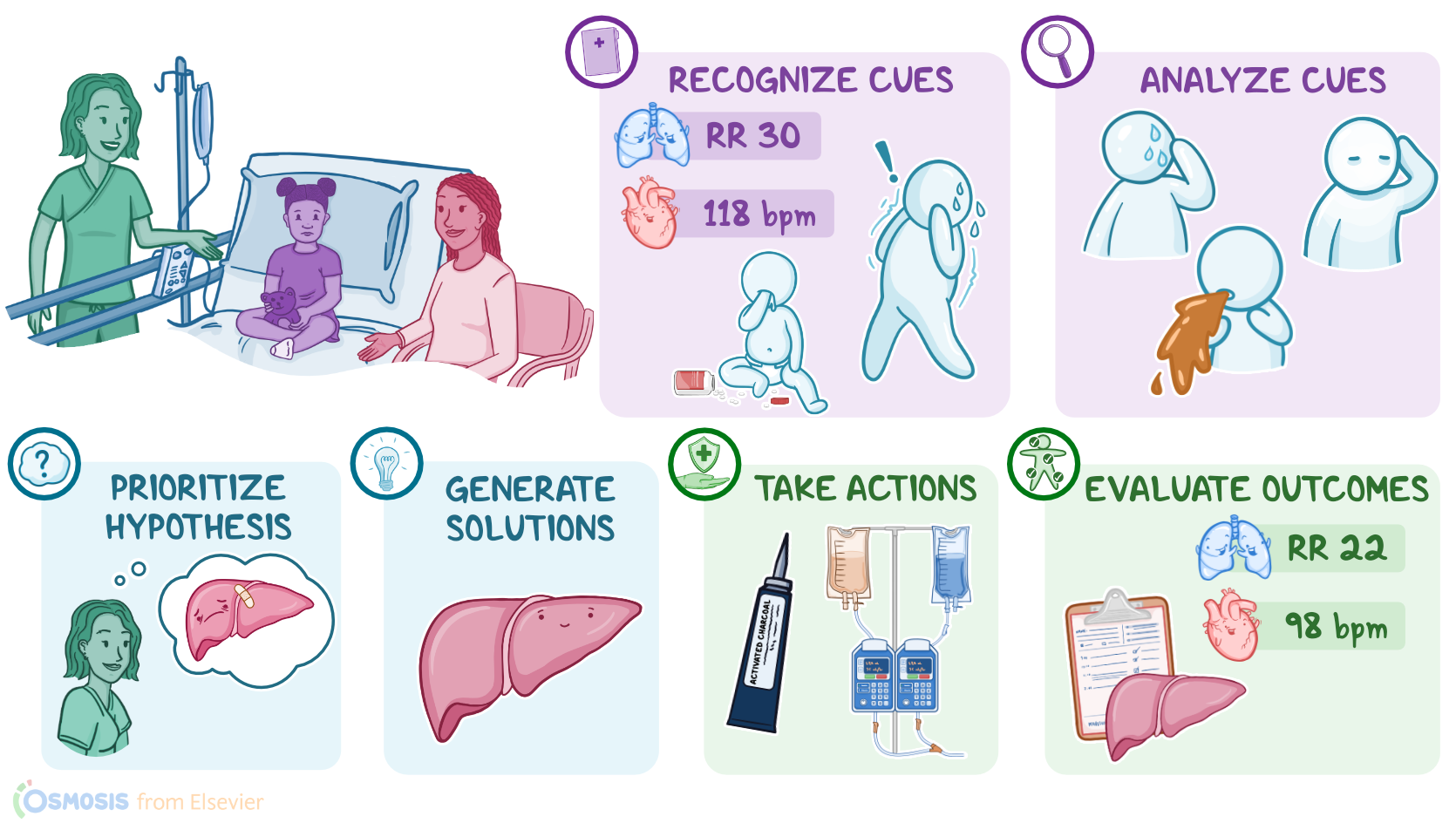
After settling Daisy in her room, Nurse Olivia goes through the steps of the Clinical Judgment Measurement Model to make clinical decisions about Daisy’s care by recognizing and analyzing cues, prioritizing hypotheses, generating solutions, taking action, and evaluating outcomes.
Recognizing and Analyzing Cues0:32–3:35
First, Nurse Olivia recognizes important cues including Daisy’s vital signs which are temperature 98.6 F, or 37 C, heart rate 118 beats per minute, respiratory rate 30 breaths per minute, and blood pressure 92/52 mmHg.
Nurse Olivia notes Daisy is pale and sweating. She also notices Daily is restless, whimpers occasionally, and is easily consoled by Ellen, so she determines Daisy’s pain rating is 3 out of 10 according to the Face, Legs, Activity, Cry, and Consolability, or FLACC, scale.
A gentle abdominal assessment reveals no tenderness. Nurse Olivia: Ellen, can you tell me about what happened before you brought Daisy here?
Ellen: Well, I was at home making dinner, when I noticed Daisy chewing while holding an open bottle of our acetaminophen pills.
Nurse Olivia: How long ago was that? Ellen: About two hours ago.
I must’ve left the bottle open after I took some pills for my headache. Then the phone rang, and I completely forgot to put the lid back on.
Nurse Olivia: Do you have any idea how many pills she ingested? Ellen: I think she had about 13; it was a new bottle and I had only taken a couple for myself.
Nurse Olivia: Do you know how many miligrams are in each pill? Ellen: 160 milligrams.
Nurse Olivia: Okay. Then, after you discovered Daisy had taken the medicine, what happened next?
Ellen: I called Poison Control right away, and they asked me how many pills were in the bottle too. Then they told me to bring Daisy to the hospital immediately.
Nurse Olivia: You did the right thing. Have you noticed any changes in Daisy appearance or behavior?
She reviews the electronic health record, or EHR, and notes that Daisy’s weight is 12.7 kilograms, or 28 pounds. She knows that the toxic dose of acetaminophen is 150 milligrams per kilogram in children, and since Daisy ingested 13,160 milligram pills, she exceeded the toxicity level for her age and weight.
Nurse Olivia also knows that an overdose of acetaminophen can cause hepatotoxicity, and the clinical course occurs in four stages.
Based on Daisy’s presentation of diaphoresis, pallor, and vomiting, Nurse Olivia determines Daisy is likely at stage one.
She recognizes that without immediate intervention, Daisy’s condition can advance to stage two, where hepatic injury can manifest as pain in the right upper quadrant.
Nurse Olivia determines that Daisy needs effective management of her acetaminophen poisoning to prevent hepatic injury. Using the information she's gathered, Nurse Olivia selects a priority hypothesis of risk for impaired liver function.
Prioritizing Hypotheses, Generating Solutions, and Taking Action3:35–5:21
Then, she generates solutions to address this hypothesis, and she establishes the expected outcome that after intervening, Daisy will show no signs of hepatic injury.
Nurse Olivia then takes action to implement these solutions. She reviews the EHR, and notes Daisy’s serum acetaminophen level is elevated, and her liver enzymes are normal.
She also sees that Daisy is prescribed oral activated charcoal for GI decontamination; intravenous N-acetylcysteine, which is the antidote for acetaminophen poisoning; and continuous IV fluids to maintain hydration.
Nurse Olivia gathers the supplies and administers the medications according to the principles of safe medication administration.
Thirty minutes later, Nurse Olivia reenters the room to check on Daisy and Ellen. She notes Daisy is resting comfortably in the bed holding Ellen’s hand.
Nurse Olivia: Ellen, how are you doing? Ellen: I’m okay.
I was so scared. I don’t want this to ever happen again.
Nurse Olivia: I understand that must’ve been frightening. To prevent this from happening in the future, it’s important to keep all medications locked out of Daisy’s reach.
Also, after taking medications yourself, remember to replace the childproof top before engaging in other tasks. Ellen: Okay.
I will be more careful in the future. Thank you for helping us.
Nurse Olivia: You’re welcome. Nurse Olivia then exits the room to contact Poison Control to update them about Daisy’s response to treatment.
Later, at the end of her shift, Nurse Olivia evaluates the outcomes of her actions. She checks the EHR and sees that Daisy's latest liver enzyme results remain normal and her acetaminophen level is undetectable.
Evaluating Outcomes5:21–6:10
Then, she takes Daisy’s vital signs, which are temperature 98.9 F, or 37.2 C, heart rate 98 beats per minute, respiratory rate 22 breaths per minute, and blood pressure 102/60 mmHg.
Nurse Olivia sees that Daisy appears comfortable, relaxed, and is sitting up in the bed drinking from a juice box. Nurse Olivia determines that Daisy hasn’t experienced signs of hepatic injury.
Review6:10–6:42
Alright, as a quick recap...Nurse Olivia recognized and analyzed cues related to Daisy’s risk for impaired liver function and prioritized hypotheses and generated solutions to address this problem.
Nurse Olivia then implemented pharmacologic measures to manage Daisy’s acetaminophen poisoning, and evaluated Daisy's outcomes, comparing them to the expected outcome.
Since Daisy did not experience signs of progressing hepatic injury, Nurse Olivia determined that the plan of care was successful.
| CASE STUDY - ACCIDENTAL INGESTION | ||
| KEY POINTS | NOTES | |
| INTRODUCTION |
| |
| RECOGNIZING AND ANALYZING CUES |
| |
| PRIORITIZING HYPOTHESES, GENERATING SOLUTIONS, AND TAKING ACTIONS |
| |
| EVALUATING OUTCOMES |
| |
- "Wong’s essentials of pediatrics. (11th ed.)" Elsevier (2022)
- "Wong’s nursing care for infants and children. (11th ed.)" Elsevier (2019)
- "Perry’s Maternal Child Nursing Care in Canada, (3rd ed.)" Elsevier (2022)
No notes for this video yet
Try adding a note below