Case study - Anaphylactic reaction: Nursing
Introduction0:00–0:32
Nurse. Mackenzie works on an inpatient medical surgical unit and is caring for Demetrius, a 56 year old who was admitted for pyelonephritis.
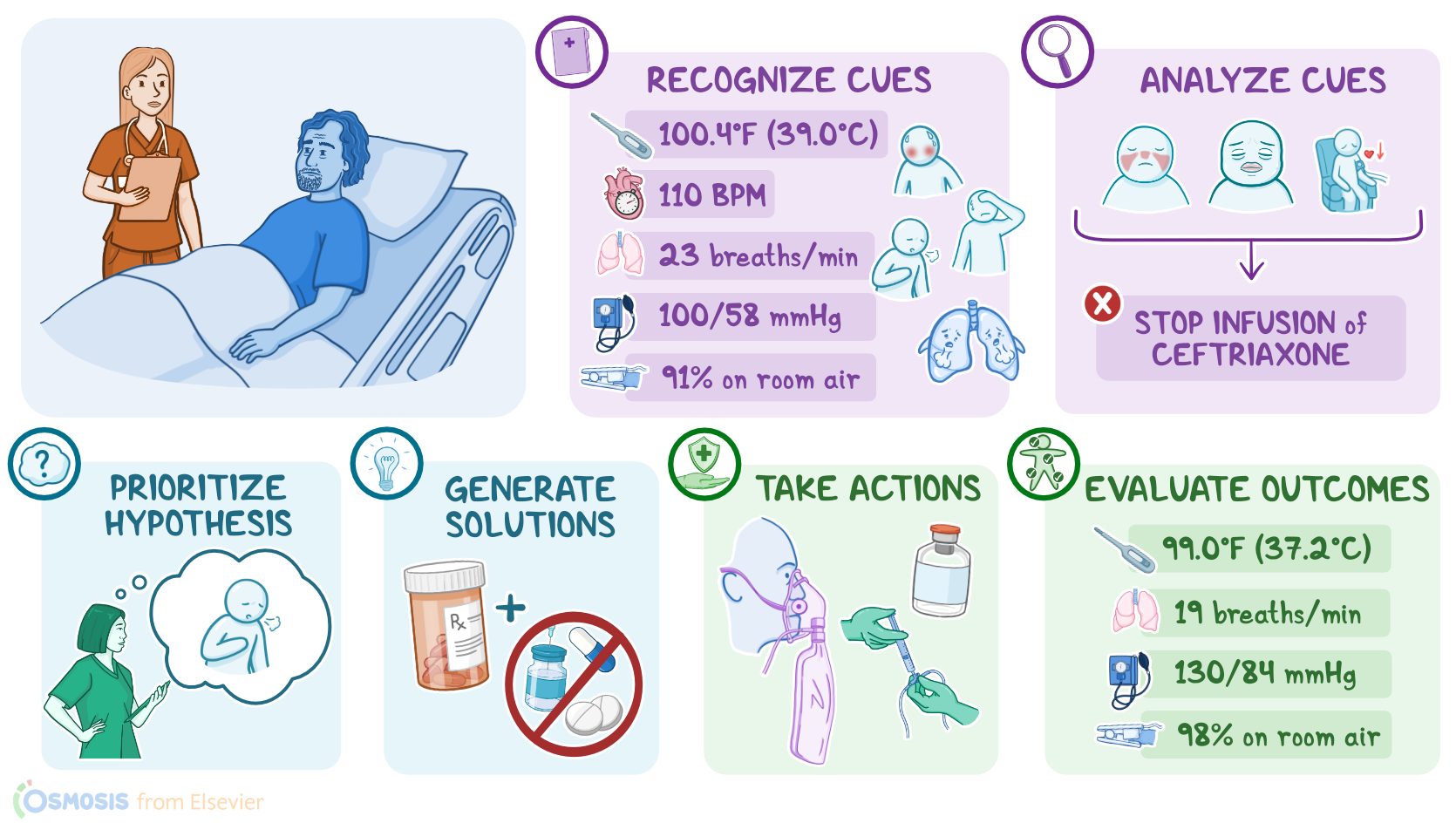
In collaboration with the registered nurse, RN Anita nurse Mackenzie goes through the steps of the clinical judgment measurement model to make clinical decisions about Demetrius's care by recognizing and analyzing cues, prioritizing hypotheses, generating solutions, taking action and evaluating outcomes.
First, nurse, Mackenzie recognizes important cues including demetrius vital signs which include temperature 100.4 °F or 39 °C, heart rate 110 BPM respirations, 23 breaths per minute BP, 100/58 of me and oxygen saturation of 91% on room air.
Recognizing and Analyzing Cues0:32–3:04
She notices that Demetrius's face is flushed, he has a worried expression and that he's short of breath. Nurse Mackenzie auscultates, his lung sounds and notes expiratory wheezes bilaterally.
She also sees that cefTRIAXone is currently infusing through Demetrius's intravenous line along with normal saline. Next nurse Mackenzie analyzes these cues.
She reviews the electronic health record or EHR and notes that the infusion of cefTRIAXone was started 10 minutes ago by RN Anita.
She also sees that Demetrius has no documented allergy to cefTRIAXone but understands that if Demetrius received the antibiotic in the past, that this first exposure may have caused his body to produce antibodies against it.
Sensitizing him a process where certain immune cells called T lymphocytes are activated and stimulate B lymphocytes to secrete IgE antibodies into the bloodstream.
These IgE antibodies then bind to the surface of other cells called mast cells and basophils which are full of Granules that contain proinflammatory molecules like histamine.
Then on his second exposure, the mast cells and basophils which already have IgE antibodies on their surface release their proinflammatory molecules triggering an allergic reaction.
Nurse Mackenzie also understands that histamine plays a major role in allergic reactions by causing blood vessel dilation and increased permeability.
Meaning that while blood vessel diameter and blood flow to the affected area, increase fluid is also allowed to leak out the blood vessel wall more easily and get into the interstitial space between cells.
This can manifest as erythema or redness swelling called angioedema and a drop in BP. At the same time, histamine can cause the smooth muscle that lines the bronchi to constrict, making it harder for air to get through, resulting in respiratory symptoms like shortness of breath, coughing or wheezing nurse, Mackenzie realizes Demetrius is likely experiencing anaphylaxis and needs immediate airway management.
Now, using the information she has gathered along with Demetrius's medical history. Nurse, Mackenzie stops the infusion of cefTRIAXone and reports her findings to RN Anita.
Prioritizing Hypotheses, Generating Solutions, and Taking Action3:04–5:16
And together they choose a priority hypothesis of ineffective breathing pattern. Then they generate solutions to address Demetrius's ineffective breathing pattern that will include pharmacologic and nonpharmacologic interventions.
And they establish the expected outcome that after intervening, Demetrius will maintain a patent airway. Then nurse Mackenzie and RN Anita take action to implement these solutions.
While RN Anita initiates a rapid response. Nurse, Mackenzie places a non rebreather mask over Demetrius's nose and mouth providing 100% oxygen at 10 L per minute.
Nurse Mackenzie then assists him to an upright position to expand his airway and attaches him to a portable BP monitor and sets it to cycle every five minutes.
Once the healthcare provider arrives at the bedside, a stat injection of intramuscular epinephrine and an increased fluid bullous is ordered a Anita then administers the injection according to the principles of safe medication administration and initiates a bolus of normal saline through Demetrius's IV.
Meanwhile, nurse Mackenzie calmly offers emotional support to Demetrius holding his hand and providing reassurance. After 10 minutes, Demetrius's breathing becomes unlabored and upon auscultation, wheezing is no longer present per RN Anita's instruction.
Nurse Mackenzie removes the non rebreather mask and measures his oxygen saturation on room air which is 97%. That was so scary.
I felt like I couldn't breathe. I know that must have been scary.
It seems like you had an allergic reaction to the antibiotic in your IV. We stopped the antibiotic and gave you medicine to halt the reaction.
Thank you for helping me. I feel better.
Now, that's good. Continue to take slow deep breaths.
I will stay right here with you. 20 minutes later, nurse Mackenzie evaluates the outcome of her actions.
Evaluating Outcomes5:16–5:45
Demetrius's current vital signs are temperature 99 °F or 37.2 °C, heart rate, 100 BPM, respirations, 19 breaths per minute BP, 130/84 millimeters of mercury and oxygen saturation.
98% on room air. Demetrius's airway remains patent and he is able to breathe without difficulty.
All right. As a quick recap, nurse, Mackenzie recognized and analyzed cues related to Demetrius's anaphylaxis and in collaboration with RNA Anita prioritized hypotheses and generated solutions to address this problem.
Review5:45–6:15
Nurse Mackenzie and RN Anita then implemented pharmacologic and non pharmacologic measures and evaluated Demetrius's outcomes and compared them to the expected outcome.
Since Demetrius was able to maintain a patent airway, they determined the plan of care was successful.
| CASE STUDY - ANAPHYLACTIC REACTION | ||
| KEY POINTS | MY NOTES | |
| INTRODUCTION |
| |
| RECOGNIZING AND ANALYZING CLUES |
| |
| PRIORITIZING HYPOTHESES, GENERATING SOLUTIONS, AND TAKING ACTIONS |
| |
| EVALUATING OUTCOMES |
| |
- "Adult health nursing. (9th ed.). " Elsevier. ISBN: 9780323826143 (2023)
- "Medical-surgical nursing. (8th ed.). " Elsevier. ISBN: 9780323828451 (2023)
- "Medical-surgical nursing: Concepts and practice. (5th ed.). " Elsevier. ISBN: 9780323811866 (2023)
No notes for this video yet
Try adding a note below