Case study - Anorexia nervosa: Nursing
Introduction0:00–0:31
Nurse Pat works in a medical psychiatric unit and is caring for Lily, a 22-year-old who was recently admitted for malnourishment secondary to anorexia nervosa.
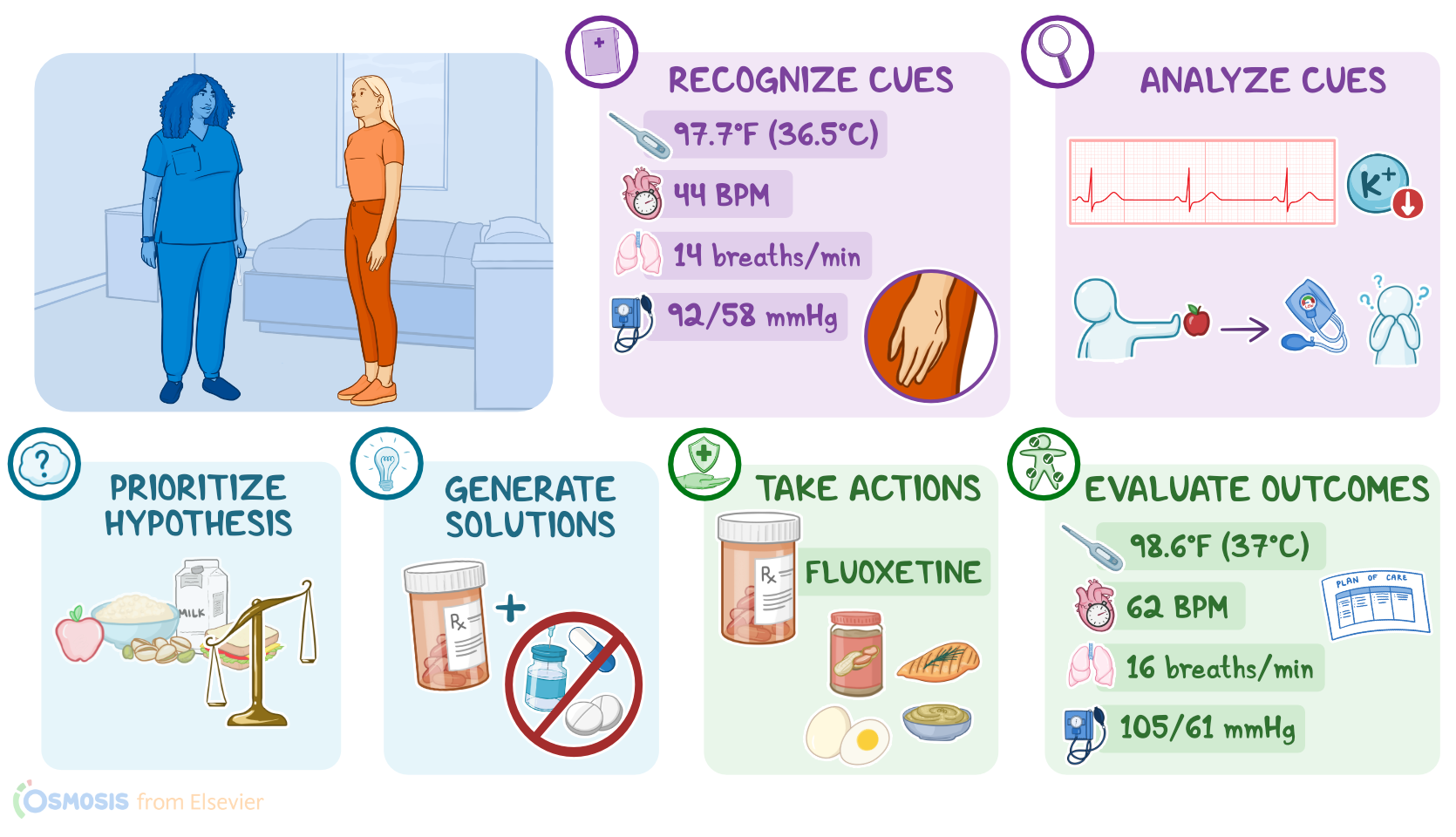
After settling Lily in her room, Nurse Pat goes through the steps of the Clinical Judgment Measurement Model to make clinical decisions about Lily’s care by recognizing and analyzing cues, prioritizing hypotheses, generating solutions, taking action, and evaluating outcomes.
First, Nurse Pat recognizes important cues, including Lily’s vital signs, which are temperature 97.7 F or 36.5 C, heart rate 44 beats per minute, respirations 14 breaths per minute, and blood pressure 92/58 mmHg.
Recognizing and Analyzing Cues0:31–2:14
Nurse Pat notices that Lily is very thin, and her skin is dry, pale, and has poor turgor. When asked how she’s feeling, Lily is tearful and reports that she’s very anxious about going out in public because she’s concerned that she’s gained weight.
She also states she's been restricting her food intake and hasn’t eaten anything in two days. Next, Nurse Pat analyzes these cues.
They review the electronic health record, or EHR, and note that Lily's ECG shows sinus bradycardia, her basic metabolic panel indicates hypokalemia, or low potassium level, at 3.4 mEq/L, and her most recent body mass index, or BMI, is 16, which is below normal.
Nurse Pat knows that patients with anorexia nervosa restrict the amount of food they eat, and prolonged food restriction causes malnourishment which can lead to complications like dehydration and electrolyte depletion, causing hypotension and bradycardia.
Additionally, prolonged anorexia can affect the brain, causing symptoms like confusion, irritability, or restlessness, as well as mental health problems like depression or anxiety.
Nurse Pat realizes Lily needs nutritional management and emotional support. Now, using the information they’ve gathered, along with Lily’s medical history, Nurse Pat chooses a priority hypothesis of imbalanced nutrition.
Prioritizing Hypotheses, Generating Solutions, and Taking Action2:14–4:55
Then, they generate solutions to address Lily’s imbalanced nutrition that will include pharmacologic and nonpharmacologic interventions; and they establish the expected outcome that after intervening, Lily will voluntarily participate in the treatment program before discharge.
Nurse Pat then takes action to implement these solutions. They check the EHR and see that Lily is prescribed fluoxetine, which is a selective serotonin reuptake inhibitor, or SSRI.
Nurse Pat also notes that Lily is prescribed a special diet, consisting of high protein and high calorie meals to improve her nutrition.
Nurse Pat enters Lily’s room to discuss the plan of care. Nurse Pat: Hi Lily, your health care provider prescribed a medication for you called fluoxetine.
Lily: I don’t like having to take medications…what’s it for? Nurse Pat: It’s a medication that’ll help with the anxiety you’ve been feeling.
It can take a couple weeks to feel a change though. Lily: Okay, I guess I’ll take it.
I want to feel less anxious. Nurse Pat then administers the fluoxetine according to the principles of safe medication administration.
Nurse Pat: Okay, now Lily could you tell me about how you’ve been feeling lately? Lily: Well, ever since my parents dropped me off at college for my final semester, I’ve been really struggling to relax.
Somehow, when I restrict the amount of food I eat, it makes me feel better. Nurse Pat: I understand.
Although it makes you feel better in the moment to restrict food, it can make your body really sick and put you at risk for complications, especially with your heart.
Lily: That makes me nervous. I don’t want to gain any weight.
Nurse Pat: I know that eating can be scary, but I want you to know I’ll be here to support you. Lily: Thank you.
Nurse Pat: Okay so Lily, it’s just about snack time for the unit. We encourage all the patients to sit together during this time.
Are you willing to try to have a snack? Lily: I’ll try.
Nurse Pat and Lily walk to the milieu together and sit with other patients. Nurse Pat introduces Lily to the group, and they welcome her while Lily plays with her food.
During snack time, Nurse Pat enters a referral for the registered dietician and unit counselor to speak with Lily. Prior to discharge, Nurse Pat enters Lily’s room to evaluate the outcome of their actions.
Evaluating Outcomes4:55–5:43
They take Lily’s vital signs, which are temperature 98.6 F or 37 C, heart rate 62 beats per minute, respirations 16 breaths per minute and blood pressure 105/61 mmHg.
Nurse Pat reviews the EHR and notes that Lily has gained five pounds and her electrolytes have stabilized. Nurse Pat also speaks with Lily who reports that she’s enjoyed spending time with the other patients, and it’s helped her to participate in the treatment plan.
Lily reports that she plans to attend outpatient counseling and take part in a local eating disorder support group. Alright, as a quick recap...Nurse Pat recognized and analyzed cues related to Lily’s impaired nutrition and prioritized hypotheses and generated solutions to address this problem.
Review5:43–6:11
Nurse Pat then implemented pharmacologic and nonpharmacologic interventions and evaluated Lily’s outcome and compared them to the expected outcome.
Since Lily voluntarily participated in the treatment plan by discharge, Nurse Pat determined that the plan of
| CASE STUDY - ANOREXIA NERVOSA | ||
| KEY POINTS | NOTES | |
| INTRODUCTION |
| |
| RECOGNIZING AND ANALYZING CUES |
| |
| PRIORITIZING HYPOTHESES, GENERATING SOLUTIONS, AND TAKING ACTIONS |
| |
| EVALUATING OUTCOMES |
| |
- "Varcarolis’s Canadian psychiatric mental health nursing. (3rd ed.)" Elsevier (2023)
- "Keltner’s psychiatric nursing. (9th ed.)" Elsevier (2023)
No notes for this video yet
Try adding a note below