Case study - Chronic lymphocytic leukemia: Nursing
Introduction0:00–0:33
Nurse. Tracy works on an inpatient oncology unit and is caring for Margie a 60 year old with a history of chronic lymphocytic leukemia or CLL.
In collaboration with the registered nurse R. And Lisa nurse.
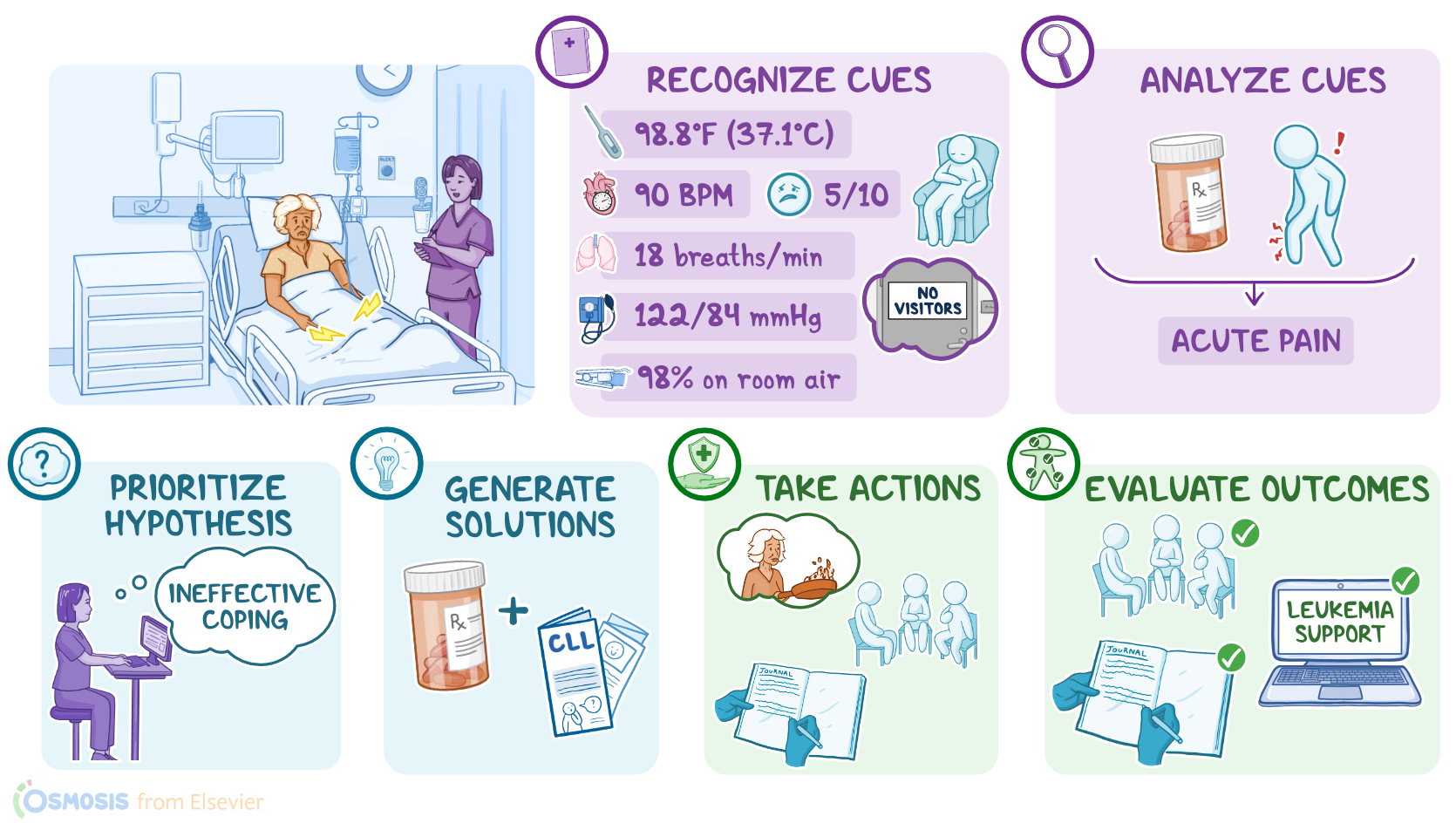
Tracy goes through the steps of the clinical judgment measurement model to make clinical decisions about Margie's care by recognizing and analyzing cues, prioritizing hypotheses, generating solutions, taking action and evaluating outcomes.
Recognizing and Analyzing Cues0:33–2:47
First, nurse, Tracy recognizes important cues including Margie's vital signs which are temperature 98.8 °F or 37.1 °C. Heart rate, 90 BPM respirations, 18 per minute BP, 100 and 22/84 millimeters of mercury and oxygen saturation of 98%.
Nurse Tracy notes, Margie has various small bruises on her back and legs and generalized lymphadenopathy or swollen lymph nodes.
She notices Margie grimacing with movement and when asked about pain, Margie reports a pain level of five out of 10 in her legs and a pain tolerance level of three out of 10.
Nurse, Tracy sees a sign on Margie's door requesting no visitors. So she asks Margie about how she's feeling.
Margie. I see you don't want visitors today?
No, I'm very tired besides, I've been such a burden to them. They probably want to break from me.
You don't have to have visitors if you aren't feeling up for it. Have your family or friends mentioned not wanting to visit?
No, they haven't. But I'd rather be alone.
There's so much I can't control right now with my leukemia and I'm, I'm feeling overwhelmed. Also.
My pain is bothering me. I have extra doses of pain medicine to take between scheduled doses, but I forget to ask until my pain is too bad.
Next, nurse Tracy analyzes these cues. She reviews the electronic health record or EHR and notes that Margie has scheduled pain medication as well as doses to take as needed or PRN for breakthrough pain.
The medication administration record shows that Margie hasn't received any PRN pain medication. Today, nurse Tracy recognizes uncontrolled pain can interfere with effective coping.
Nurse. Tracy also reviews documentation from Margie's previous nurses and notes, Margie has become progressively withdrawn over the last week.
Nurse Tracy compares her findings to Margie's assessment conducted by R and Lisa and realizes Margie needs help with effective coping.
Now, using the information she's gathered nurse Tracy reports her findings to R and Lisa and they choose a priority hypothesis of ineffective coping.
Prioritizing Hypotheses, Generating Solutions, and Taking Action2:47–5:14
Then she collaborates with R and Lisa to generate solutions to address Margie's ineffective coping that will include pharmacologic and nonpharmacologic interventions.
They establish the expected outcome that after intervening, Margie will demonstrate two new coping strategies prior to discharge.
Nurse, Tracy then takes action to implement these solutionss. She begins by administering the prescribed prn pain medication following safe medication administration principles.
Next, she sits down with Margie to reinforce the education R and Lisa has provided about coping strategies. Nurse Tracy also uses active listening techniques by leaning forward, making eye contact and facing Margie while gently touching her hand.
Margie. I was wondering if we could talk more about how you're feeling regarding your diagnosis.
You mentioned earlier that you feeling overwhelmed. I'm sick of feeling tired and being in pain all the time.
It feels like there's nothing I can do about it. That's understandable.
You can tell me when your pain is a three or above and I'll administer your prn pain medication as for your fatigue, balancing, rest with activity and spacing out activities throughout the day can help.
You can try doing the most tiring activities such as showering when you have the most energy. Do you have family or friends who can help at home when you're too tired for tasks like cooking?
Yes. My husband has been great at taking care of everything.
I worry he's doing too much now that he has to take care of me and have you talked to him about how you're feeling? No, I haven't talking with loved ones about how you're feeling, can help them understand your feelings and give you a chance to express difficult emotions.
It gives them a chance to let you know what they are thinking too. Ok.
I'll try to talk to my family. More.
Nurse. Tracy also reinforces information on support groups, encourages Margie to think about what she's hopeful for and suggests journaling as a way to process her feelings.
Evaluating Outcomes5:14–5:55
One week later, Margie is preparing for discharge and nurse Tracy evaluates the outcome of her actions when she enters the room.
Margie is sitting in her recliner having lunch with her husband. Nurse, Tracy asks Margie how she's been feeling.
I'm doing better. My husband and I talked about our feelings which really helped.
I also started journaling and joined a support group here at the hospital and I found one online and the resources you gave me.
It's nice to know. I'm not alone.
Nurse, Tracy also learns Margie has been taking prn pain medication when her pain is more than three out of 10. And Margie reports that her pain is under control.
Review5:55–6:30
All right. As a quick recap.
Nurse, Tracy recognized and analyzed cues related to Margie's ineffective coping and in collaboration with RN Lisa prioritized hypotheses and generated solutions to address this problem.
Nurse, Tracy and RN Lisa then took action by implementing pharmacologic and nonpharmacologic measures to address Margie's ineffective coping and evaluated Margie's outcomes comparing them to the expected outcome.
Since Margie demonstrated two new effective coping strategies, they determined the plan of care was successful
| CASE STUDY - CHRONIC LYMPHOCYTIC LEUKEMIA | ||
| KEY POINTS | MY NOTES | |
| INTRODUCTION |
| |
| RECOGNIZING AND ANALYZING CLUES |
| |
| PRIORITIZING HYPOTHESES, GENERATING SOLUTIONS, AND TAKING ACTIONS |
| |
| EVALUATING OUTCOMES |
| |
- "Adult health nursing (9th ed.)" Elsevier (2023)
- "Medical-surgical nursing (8th ed.)" Elsevier (2023)
- "Medical-surgical nursing: Concepts and practice (5th ed.)" Elsevier (2023)
No notes for this video yet
Try adding a note below