Case study - Diabetic ketoacidosis (DKA): Nursing
Introduction0:00–0:38
Nurse Andrea works on a medical-surgical unit and is caring for Mario, a 32-year-old male with a history of type 1 diabetes mellitus, who was recently admitted from the emergency department for diabetic ketoacidosis, or DKA.
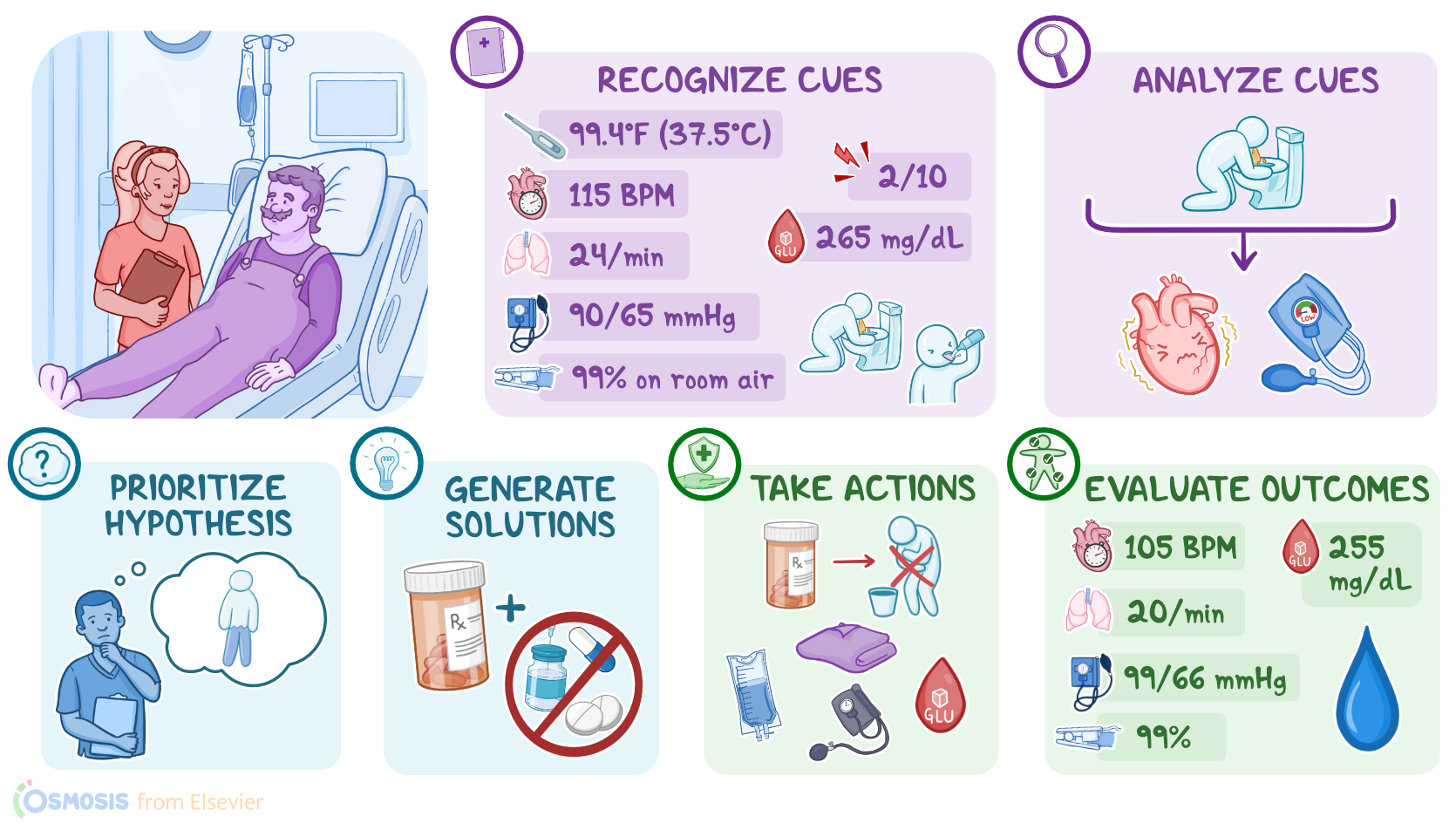
After settling Mario in his room, Nurse Andrea goes through the steps of the Clinical Judgment Measurement Model to make clinical decisions about Mario’s care by recognizing and analyzing cues, prioritizing hypotheses, generating solutions, taking action, and evaluating outcomes.
First, Nurse Andrea recognizes important cues, including Mario’s vital signs which are temperature 99.4 F, or 37.5 C, heart rate 115 beats per minute, respirations 24 breaths per minute, blood pressure 90/65 mmHg, and oxygen saturation 99 percent on room air.
Recognizing and Analyzing Cues0:38–2:06
His pain rating is 2 out of 10. Upon assessment, Nurse Andrea notes Mario is alert and oriented, his mucous membranes are dry, and he reports nausea with two episodes of emesis.
Nurse Andrea also notes that he has a continuous insulin drip and IV fluids infusing into a peripheral IV, and his current blood glucose level is 265 mg/dL.
She understands that the elevated glucose levels in DKA cause osmotic diuresis and significant fluid loss, and that the acidosis is causing Mario’s nausea and vomiting, resulting in additional loss of fluid and electrolytes.
She also knows that fluid loss will continue until Mario’s blood glucose level is stabilized, and that tachycardia and hypotension are signs of dehydration.
Nurse Andrea recognizes that Mario needs fluid management. Now, using the information she's gathered, Nurse Andrea chooses a priority hypothesis of fluid volume deficit.
Prioritizing Hypotheses, Generating Solutions, and Taking Action2:06–4:31
Then, she generates solutions to address Mario’s fluid volume deficit, including pharmacologic and nonpharmacologic interventions; and she establishes the expected outcome that after intervening, Mario’s systolic blood pressure will remain above 90 mmHg for the duration of the shift.
Then, Nurse Andrea takes action to implement these solutions. First, she calls the health care provider to report her assessment findings.
The health care provider orders a 250 mL bolus of isotonic fluids and an increase in Mario’s maintenance IV fluid rate. The health care provider also orders an antiemetic medication, oral fluids as tolerated, and strict intake and output.
Then, Nurse Andrea enters Mario’s room. Nurse Andrea: Hi Mario.
I just spoke with your health care provider because I’m concerned that you’re dehydrated. I’d like to help with this by giving you some medication for your nausea.
Mario: Okay. I’d really like to be able to drink something without feeling sick.
My mouth is so dry. Nurse Andrea administers the antiemetic following safe medication administration principles.
Nurse Andrea: Let’s give this medication a little time to work before you try to drink anything. In the meantime, I brought you some swabs that can moisten your mouth.
When you start feeling less nauseated, you can try a few of these ice chips. Mario: Thanks.
I hope the medicine helps. Nurse Andrea: I’m also going to give you additional fluids through your IV, and I’ll monitor your hydration status by measuring the fluids going in, like through your IV, and fluids going out, like when you urinate.
Mario: Okay. Nurse Andrea then provides Mario with a clean urinal and instructs him “Ring this call bell when you've voided”.
She also provides him with an emesis bag and instructs him "Let me know if you have additional emesis”. Then, she ensures Mario’s room is comfortable and provides him with cool washcloths for comfort.
Before leaving the room, she programs the blood pressure cuff to run every fifteen minutes and sets the alarm for a systolic blood pressure less than 90 mmHg.
She also continues to monitor the insulin drip and Mario’s blood glucose levels according to her unit’s protocol. At the end of her shift, Nurse Andrea enters the room to evaluate the outcomes of her actions.
Evaluating Outcomes4:31–5:07
She takes Mario’s vital signs, which are blood pressure 99/66 mmHg, heart rate 105 beats per minute, respirations 20 breaths per minute, and oxygen saturation 99 percent on room air.
His current blood glucose level is 255 mg/dL. He states he is no longer nauseated and has been able to tolerate ice chips.
Nurse Andrea reviews the insulin titration and fluid management orders to verify whether rate changes are needed. Alright, as a quick recap...Nurse Andrea recognized and analyzed cues related to Mario’s DKA, and prioritized hypotheses and generated solutions to address this problem.
Review5:07–5:38
Nurse Andrea then implemented pharmacologic and nonpharmacologic measures to stabilize Mario’s dehydration and evaluated Mario’s outcomes compared with the expected outcomes.
Since Mario’s blood pressure remained above 90 mmHg following interventions, Nurse Andrea determined the plan of
| CASE STUDY - DIABETIC KETOACIDOSIS (DKA) | ||
| KEY POINTS | NOTES | |
| INTRODUCTION |
| |
| RECOGNIZING AND ANALYZING CUES |
| |
| PRIORITIZING HYPOTHESES, GENERATING SOLUTIONS, AND TAKING ACTIONS |
| |
| EVALUATING OUTCOMES |
| |
- "Lewis's medical-surgical nursing: Assessment and management of clinical problems. (12th ed.)" Elsevier (2022)
- "Medical-surgical nursing: Concepts for interprofessional and collaborative care. (10th ed.)" Elsevier (2021)
- "Lewis’s medical-surgical nursing in Canada: Assessment and management of clinical problems. (5th ed.)" Elsevier (2023)
No notes for this video yet
Try adding a note below