Case study - Pressure injury: Nursing
Introduction0:00–0:32
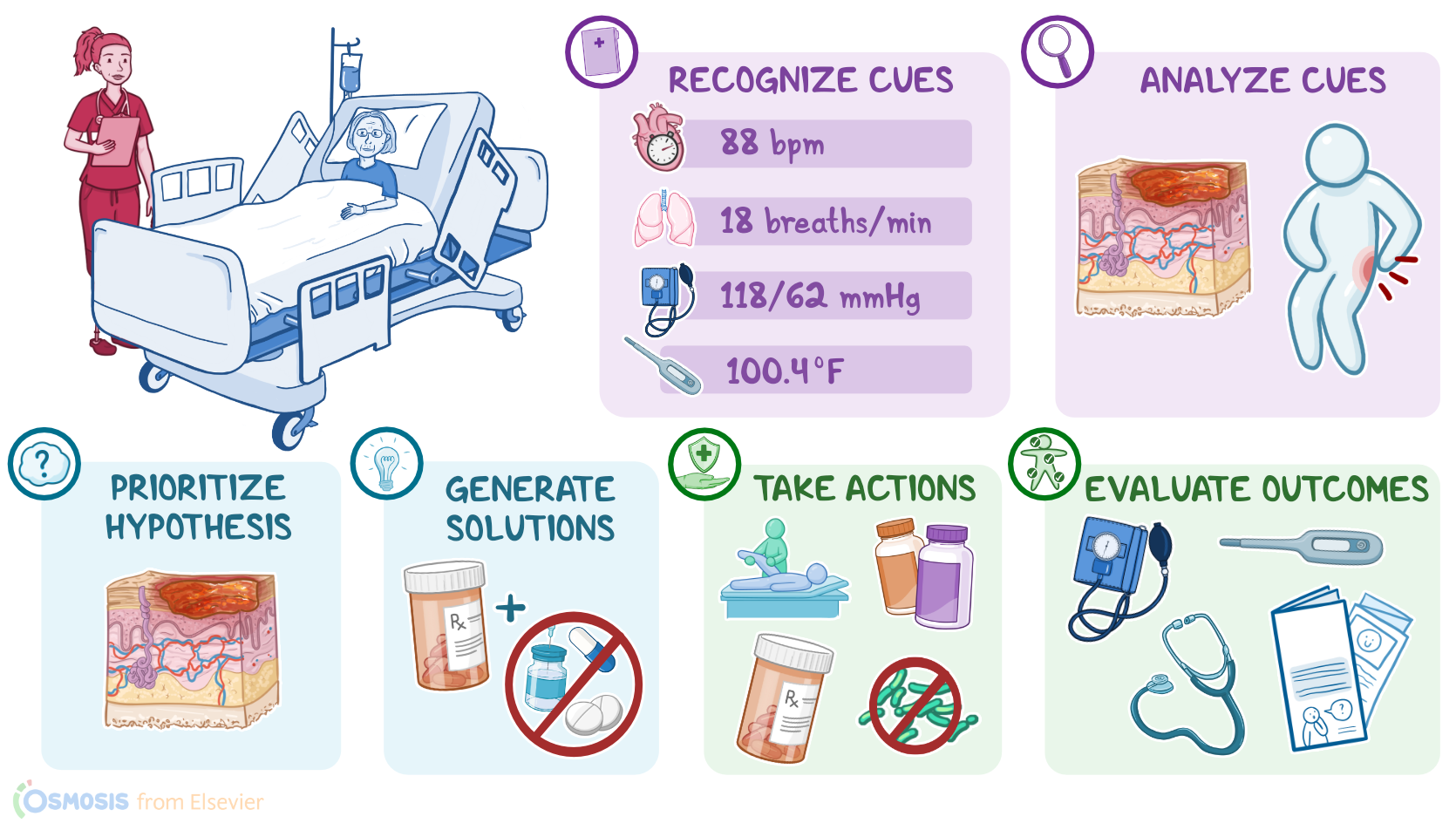
After settling Margaret in her room, Nurse Hailey goes through the steps of the Clinical Judgment Measurement Model to make clinical decisions about Margaret’s care by recognizing and analyzing cues, prioritizing hypotheses, generating solutions, taking action, and evaluating outcomes.
Recognizing and Analyzing Cues0:32–1:35
First, Nurse Hailey recognizes important cues, including Margaret’s vital signs, which are blood pressure 118/62 mmHg, heart rate 88 beats per minute, respirations 18 breaths per minute, and temperature of 100.4 F or 38 C.
Nurse Hailey also notes that Margaret is incontinent; and a skin assessment reveals an area on her coccyx that’s pink and moist, without slough or eschar.
Nurse Hailey recognizes that immobility and pain can contribute to pressure injuries and realizes that Margaret is experiencing impaired tissue integrity.
She shares her assessments with the wound care nurse who classifies Margaret’s coccyx redness as a stage 2 pressure injury.
Now, using the information she has gathered, along with Margaret’s medical history, Nurse Hailey chooses a priority hypothesis of impaired tissue integrity.
Prioritizing Hypotheses, Generating Solutions, and Taking Action1:35–4:47
Then, she generates solutions to address Margaret’s impaired tissue integrity that'll include nonpharmacologic and pharmacologic interventions; and she establishes the expected outcome that after intervening, Margaret will demonstrate a healing pressure injury without further breakdown of skin or the development of infection by time of discharge.
Nurse Hailey then takes action to implement these solutions. She knows that since Margaret has a stage 2 pressure injury, she needs to complete the wound care recommended by the wound nurse; administer the prescribed pain medication; reposition Margaret at least every 2 hours; encourage Margaret to work with physical therapy; provide a diet high in protein, carbohydrates, and vitamins; and provide education.
I also want to take another look at your wound and apply the dressing. But before I move you, I need to assess your pain.
Margaret: I feel okay right now, but it hurts when I move. Could I have my pain medication first?
She informs Margaret that while they wait for the medication to take effect, she’ll provide her with information about how to prevent another fall after she’s discharged home.
Nurse Hailey: So, there are a few ways you can prevent having another fall. For example, wearing non-slip socks or slippers and removing throw rugs or other obstacles can help a lot.
Also, having adequate lighting so you can always see where you are going, especially at night, is important. You’ll also want to establish a toileting schedule which can decrease the number of times you’re incontinent.
Margaret: I agree, I don’t want to keep having bathroom accidents or suffer another fall. My daughter is coming up to the hospital in a few minutes, so you can chat with her too.
Nurse Hailey: Great! I’d like to talk to you both about introducing a nutritional supplement that will promote wound healing, and about wound care and preventing infections.
Margaret: Thank you Nurse Hailey, I want to get better. Soon, Margaret reports her pain is under control and her daughter arrives at the bedside.
Nurse Hailey shows Margaret’s daughter how to assess the wound and apply a new dressing. Then, Nurse Hailey talks to them about infection and fall prevention, the use of a toileting schedule, and how dietary supplements can promote wound healing.
Lastly, Nurse Hailey teaches them about the signs and symptoms of infection and instructs them to notify the health care provider of signs of wound infection.
Evaluating outcomes4:47–5:19
A week later, Margaret is ready to discharge home, so Nurse Hailey evaluates the outcomes of her interventions. She takes Margaret’s vital signs, evaluates her pain and reassesses her wound.
The wound is clean, dry, and the dressing is intact, and Margaret reports her pain is manageable and she’s been working with physical therapy daily.
Review5:19–5:49
Alright, as a quick recap… Nurse Hailey recognized and analyzed cues related to Margaret’s impaired tissue integrity, prioritized hypotheses, and generated solutions to address this problem.
Nurse Hailey then implemented pharmacologic and nonpharmacologic measures to address Margaret’s pressure injury, and evaluated Margaret’s outcomes, comparing them to the expected outcomes.
Since Margaret’s pressure injury remained stable, Nurse Hailey determined that the plan of care was successful.
| CASE STUDY - PRESSURE INJURY | ||
| KEY POINTS | NOTES | |
| INTRODUCTION |
| |
| RECOGNIZING AND ANALYZING CUES |
| |
| PRIORITIZING HYPOTHESES, GENERATING SOLUTIONS, AND TAKING ACTIONS |
| |
| EVALUATING OUTCOMES |
| |
- "Lewis's medical-surgical nursing: Assessment and management of clinical problems (12th ed.)" Elsevier (2022)
- "Medical-surgical nursing: Concepts for interprofessional and collaborative care (10th ed.)" Elsevier (2021)
No notes for this video yet
Try adding a note below