Celiac disease: Nursing process (ADPIE)

1,069views

Celiac disease: Nursing process (ADPIE)

Medical Surgical

Medical Surgical

Arrhythmias - Asystole: Nursing
Arrhythmias - Atrial fibrillation (Afib): Nursing
Arrhythmias - Atrial flutter (Aflutter): Nursing
Arrhythmias - Heart blocks: Nursing
Arrhythmias - Premature atrial contractions (PACs): Nursing
Arrhythmias - Premature ventricular contractions (PVCs): Nursing
Arrhythmias - Sinus tachycardia and sinus bradycardia: Nursing
Arrhythmias - Supraventricular tachycardia (SVT): Nursing
Arrhythmias - Ventricular fibrillation (Vfib): Nursing
Arrhythmias - Ventricular tachycardia (Vtach): Nursing
Arterial embolism: Nursing
Electrocardiogram (ECG) - Normal sinus rhythm (NSR): Nursing
Cardiomyopathy: Nursing
Congenital heart defects - Acyanotic: Nursing
Congenital heart defects - Cyanotic: Nursing
Endocarditis: Nursing
Heart defects that decrease pulmonary blood flow - Nursing considerations & client education: Nursing
Kawasaki disease: Nursing
Myocarditis: Nursing
Pericarditis: Nursing
Shock - Anaphylactic: Nursing
Shock - Cardiogenic: Nursing
Shock - Hypovolemic: Nursing
Shock - Neurogenic: Nursing
Shock - Obstructive: Nursing
Shock - Septic: Nursing
Valvular heart disease: Nursing
Geriatric considerations - Cardiac: Nursing
Aortic aneurysm: Nursing process (ADPIE)
Coronary artery disease (CAD) and angina pectoris: Nursing process (ADPIE)
Hypertension: Nursing process (ADPIE)
Left-sided heart failure: Nursing process (ADPIE)
Myocardial infarction (MI): Nursing process (ADPIE)
Pericardial effusion and cardiac tamponade: Nursing process (ADPIE)
Rheumatic heart disease: Nursing process (ADPIE)
Alpha-1 adrenergic blockers: Nursing pharmacology
Alpha-2 adrenergic agonists: Nursing pharmacology
Angiotensin II receptor blockers (ARBs): Nursing pharmacology
Angiotensin-converting enzyme (ACE) inhibitors: Nursing pharmacology
Antiarrhythmics: Nursing pharmacology
Antihyperlipidemics - Fibrates: Nursing pharmacology
Antihyperlipidemics - Miscellaneous: Nursing pharmacology
Antihyperlipidemics - Statins: Nursing pharmacology
Beta-adrenergic blockers: Nursing pharmacology
Calcium-channel blockers: Nursing pharmacology
Cardiac glycosides: Nursing pharmacology
Direct-acting vasodilators: Nursing pharmacology
Nitrates: Nursing pharmacology
Sympathomimetic medications: Nursing pharmacology
Adrenal insufficiency (Addison disease): Nursing
Cushing syndrome and Cushing disease: Nursing
Hyperparathyroidism: Nursing
Hypoparathyroidism: Nursing
Hypopituitarism: Nursing
Infant of a diabetic mother (IDM): Nursing
Phenylketonuria (PKU): Nursing
Diabetes insipidus: Nursing process (ADPIE)
Diabetes mellitus (DM): Nursing process (ADPIE)
Diabetic ketoacidosis (DKA): Nursing process (ADPIE)
Hyperosmolar hyperglycemic state (HHS): Nursing process (ADPIE)
Hyperthyroidism: Nursing process (ADPIE)
Hypothyroidism: Nursing process (ADPIE)
Syndrome of inappropriate antidiuretic hormone (SIADH): Nursing process (ADPIE)
Glucocorticoids and mineralocorticoids: Nursing pharmacology
Insulin: Nursing pharmacology
Medications affecting the parathyroid glands: Nursing pharmacology
Medications for antidiuretic hormone (ADH) disorders: Nursing pharmacology
Medications for thyroid disorders: Nursing pharmacology
Medications for growth hormone disorders: Nursing pharmacology
Oral antidiabetic medications - Alpha-glucosidase inhibitors: Nursing pharmacology
Oral antidiabetic medications - Biguanides and thiazolidinediones: Nursing pharmacology
Oral antidiabetic medications - DPP-4 inhibitors: Nursing pharmacology
Oral antidiabetic medications - Sodium-glucose co-transporter-2 (SGLT-2) inhibitors: Nursing pharmacology
Oral antidiabetic medications - Sulfonylureas and meglitinides: Nursing pharmacology
Amblyopia: Nursing
Cataracts: Nursing
Detached retina: Nursing
Hearing impairment and otosclerosis: Nursing
Legal blindness: Nursing
Macular degeneration: Nursing
Meniere disease: Nursing
Pharyngitis: Nursing
Strabismus: Nursing
Geriatric considerations - Sensory: Nursing
Otitis media: Nursing
Epistaxis: Nursing process (ADPIE)
Eye injury: Nursing process (ADPIE)
Glaucoma: Nursing process (ADPIE)
Tonsillitis: Nursing process (ADPIE)
Antiglaucoma medications: Nursing pharmacology
Eye anesthetics: Nursing pharmacology
Mydriatics and cycloplegics: Nursing pharmacology
Ophthalmic anti-inflammatories and anti-infectives: Nursing pharmacology
Biliary atresia: Nursing
Cholecystitis: Nursing
Cholelithiasis: Nursing
Diarrhea: Nursing
Diverticular disease: Nursing
Hepatitis: Nursing
Inflammatory bowel disease - Crohn disease and ulcerative colitis: Nursing
Intestinal obstruction: Nursing
Irritable bowel syndrome (IBS): Nursing
Jaundice: Nursing
Esophageal atresia and tracheoesophageal fistula: Nursing
Geriatric considerations - Gastrointestinal: Nursing
Hirschsprung disease: Nursing
Hyperemesis gravidarum: Nursing
Necrotizing enterocolitis: Nursing
Omphalocele and gastroschisis: Nursing
Appendicitis: Nursing process (ADPIE)
Celiac disease: Nursing process (ADPIE)
Cirrhosis: Nursing process (ADPIE)
Gastroesophageal reflux disease (GERD): Nursing process (ADPIE)
Hiatal hernia: Nursing process (ADPIE)
Pancreatitis: Nursing process (ADPIE)
Peptic ulcer disease (PUD): Nursing process (ADPIE)
Antacids: Nursing pharmacology
Antidiarrheals: Nursing pharmacology
Antiemetics: Nursing pharmacology
Antispasmodics (GI): Nursing pharmacology
Gallstone-dissolving agents: Nursing pharmacology
Gastric mucosal protective agents: Nursing pharmacology
Histamine H2 antagonists: Nursing pharmacology
Laxatives: Nursing pharmacology
Medications for hepatic encephalopathy: Nursing pharmacology
Pancreatic enzyme replacements: Nursing pharmacology
Proton pump inhibitors (PPIs): Nursing pharmacology
Treatment for Helicobacter pylori: Nursing pharmacology
Weight loss medications: Nursing pharmacology
Chronic kidney disease (CKD): Nursing
Dialysis care: Nursing
Epididymitis: Nursing
Glomerulonephritis: Nursing
Nephrotic syndrome: Nursing
Polycystic kidney disease (PKD): Nursing
Pyelonephritis: Nursing
Renal and urinary calculi: Nursing
Urinary retention: Nursing
Bladder exstrophy: Nursing
Circumcision: Nursing
Cryptorchidism: Nursing
Enuresis: Nursing
Geriatric considerations - Urinary: Nursing
Hypospadias and epispadias: Nursing
Acute kidney injury (AKI): Nursing process (ADPIE)
Benign prostatic hyperplasia (BPH): Nursing process (ADPIE)
Urinary incontinence - Stress: Nursing process (ADPIE)
Urinary tract infections (UTIs): Nursing process (ADPIE)
Diuretics - Osmotic and carbonic anhydrase inhibitors: Nursing pharmacology
Diuretics - Thiazide, thiazide-like, loop, and potassium-sparing diuretics: Nursing pharmacology
Antispasmodics (GU): Nursing pharmacology
Cholinergic therapy (GU): Nursing pharmacology
Anemia - Aplastic: Nursing
Anemia - Iron-deficiency: Nursing
Anemia - Macrocytic: Nursing
Disseminated intravascular coagulation (DIC): Nursing
Neutropenia: Nursing
Polycythemia: Nursing
Thalassemia: Nursing
Thrombocytopenia: Nursing
Arterial blood gas (ABG) - Overview: Nursing
Arterial blood gas (ABG) - Metabolic acidosis: Nursing
Arterial blood gas (ABG) - Respiratory alkalosis: Nursing
Blood cultures: Nursing
Cardiac biomarkers - Creatine kinase (CK): Nursing
Cardiac biomarkers - Troponin: Nursing
Coagulation studies - Partial thromboplastin time (PTT): Nursing
Complete blood count (CBC) - Hemoglobin and hematocrit: Nursing
Complete blood count (CBC) - Platelets: Nursing
Complete blood count (CBC) - Red blood cells (RBC): Nursing
Complete blood count (CBC) - White blood cells (WBC) and differential: Nursing
Complete metabolic panel (CMP) - Blood urea nitrogen (BUN) and creatinine (Cr): Nursing
Complete metabolic panel (CMP) - Chloride: Nursing
Complete metabolic panel (CMP) - Estimated glomerular filtration rate (eGFR): Nursing
Complete metabolic panel (CMP) - Glucose: Nursing
Complete metabolic panel (CMP) - Liver function tests (LFT): Nursing
Complete metabolic panel (CMP) - Potassium: Nursing
Complete metabolic panel (CMP) - Sodium: Nursing
Hemolytic disease of the fetus and newborn: Nursing
Hemolytic uremic syndrome: Nursing
Hemophilia: Nursing process (ADPIE)
Leukemia: Nursing process (ADPIE)
Sickle cell disease: Nursing process (ADPIE)
Anticoagulants - Direct thrombin and factor Xa inhibitors: Nursing pharmacology
Anticoagulants - Heparin: Nursing pharmacology
Anticoagulants - Warfarin: Nursing pharmacology
Antihyperlipidemics - Bile acid sequestrants and cholesterol absorption inhibitors: Nursing pharmacology
Antiplatelet agents: Nursing pharmacology
Blood products: Nursing pharmacology
Hematopoietic growth factors: Nursing pharmacology
Hemostatics: Nursing pharmacology
Iron preparations: Nursing pharmacology
Thrombolytics: Nursing pharmacology
Immune response - Adaptive: Nursing
Autoimmunity: Nursing
Human immunodeficiency virus (HIV) and acquired immunodeficiency syndrome (AIDS): Nursing
Hypersensitivity reactions - Type I: Nursing
Hypersensitivity reactions - Type II: Nursing
Hypersensitivity reactions - Type III: Nursing
Hypersensitivity reactions - Type IV: Nursing
Inflammatory process: Nursing
Immune response - Innate: Nursing
Immunodeficiency disorders - Primary: Nursing
Scleroderma: Nursing
Immunodeficiency disorders - Secondary: Nursing
Sjögren syndrome: Nursing
Systemic lupus erythematosus (SLE): Nursing
Toxic shock syndrome (TSS): Nursing
Erythema infectiosum (Fifth disease): Nursing
Fever: Nursing
Infectious mononucleosis: Nursing
Mumps (Parotitis): Nursing
Neonatal sepsis: Nursing
Pertussis: Nursing
Poliomyelitis: Nursing
Postpartum infections: Nursing
Roseola (Exanthem subitum): Nursing
Rubella (German measles): Nursing
Rubeola (Measles): Nursing
Smallpox: Nursing
Zika virus: Nursing
Anaphylaxis: Nursing process (ADPIE)
Lyme disease: Nursing process (ADPIE)
Rheumatoid arthritis (RA): Nursing process (ADPIE)
Antirejection immunosuppressants: Nursing pharmacology
Biologic agents: Nursing pharmacology
Vaccines: Nursing pharmacology
Immunoglobulins: Nursing pharmacology
Immunosuppressants for autoimmune diseases: Nursing pharmacology
Immunomodulators: Nursing pharmacology
Disease-modifying therapy for multiple sclerosis: Nursing pharmacology
Acne: Nursing
Animal and snake bites: Nursing
Burn injury: Nursing
Cutaneous fungal infections: Nursing
Erysipelas and cellulitis: Nursing
Herpes simplex virus (HSV): Nursing
Herpes zoster: Nursing
Impetigo: Nursing
Insect stings and bites: Nursing
Pediculosis and scabies: Nursing
Psoriasis: Nursing
Rocky Mountain spotted fever (RMSF): Nursing
Skin cancer - Basal cell carcinoma, squamous cell carcinoma, and melanoma: Nursing
Urticaria: Nursing
Geriatric considerations - Integumentary: Nursing
Atopic dermatitis: Nursing process (ADPIE)
Frostbite: Nursing process (ADPIE)
Methicillin-resistant Staphylococcus aureus (MRSA): Nursing process (ADPIE)
Pressure injury: Nursing process (ADPIE)
Debridement agents: Nursing pharmacology
Keratolytics: Nursing pharmacology
Antibiotics - Topical: Nursing pharmacology
Antifungals - Topical: Nursing pharmacology
Corticosteroids - Topical: Nursing pharmacology
Medications for acne vulgaris: Nursing pharmacology
Amputation: Nursing
Carpal tunnel syndrome: Nursing
Herniated intervertebral disc: Nursing
Hip fractures: Nursing
Muscular dystrophies - Duchenne and Becker: Nursing
Myasthenia gravis: Nursing
Osteoarthritis: Nursing
Osteomyelitis: Nursing
Osteoporosis: Nursing
Paget disease of bone: Nursing
Craniosynostosis: Nursing
Developmental dysplasia of the hip: Nursing
Juvenile idiopathic arthritis: Nursing
Scoliosis: Nursing
Acute compartment syndrome: Nursing process (ADPIE)
Fractures: Nursing process (ADPIE)
Gout: Nursing process (ADPIE)
Musculoskeletal injuries: Nursing process (ADPIE)
Acetylcholinesterase inhibitors for myasthenia gravis: Nursing pharmacology
Analgesics: Nursing pharmacology
Skeletal muscle relaxants: Nursing pharmacology
Altered level of consciousness (LOC): Nursing
Amyotrophic lateral sclerosis (ALS): Nursing
Bell palsy: Nursing
Cerebral palsy: Nursing
Encephalitis: Nursing
Guillain-Barré syndrome: Nursing
Head injury: Nursing
Hemorrhagic stroke - Intracranial hemorrhage (ICH) and subarachnoid hemorrhage (SAH): Nursing
Epidural and subdural hematoma: Nursing
Huntington disease: Nursing
Increased intracranial pressure (ICP): Nursing
Intracranial aneurysm: Nursing
Migraines: Nursing
Multiple sclerosis (MS): Nursing
Physiology of pain: Nursing
Spinal cord injury (SCI): Nursing
Delirium: Nursing
Dementia: Nursing
Brachial plexus injury: Nursing
Neurological assessment - Neonate: Nursing
Neural tube defects: Nursing
Meningitis: Nursing process (ADPIE)
Parkinson disease: Nursing process (ADPIE)
Seizure disorder: Nursing process (ADPIE)
Stroke: Nursing process (ADPIE)
Trigeminal neuralgia: Nursing process (ADPIE)
Antiepileptics: Nursing pharmacology
Medications for Alzheimer disease: Nursing pharmacology
Medications for migraines: Nursing pharmacology
Biology of cancer: Nursing
Bladder tumors: Nursing
Bone tumors: Nursing
Brain tumors: Nursing
Cervical cancer: Nursing
Colorectal cancer: Nursing
Esophageal cancer: Nursing
Gastric cancer: Nursing
Laryngeal cancer: Nursing
Liver cancer: Nursing
Lung cancer: Nursing
Lymphoma - Hodgkin and non-Hodgkin: Nursing
Multiple myeloma: Nursing
Neuroblastoma: Nursing
Ovarian cancer: Nursing
Pancreatic cancer: Nursing
Prostate cancer: Nursing
Renal cancer: Nursing
Retinoblastoma: Nursing
Testicular cancer: Nursing
Breast cancer: Nursing process (ADPIE)
Tumor lysis syndrome (TLS): Nursing Process (ADPIE)
Alkylating agents: Nursing pharmacology
Angiogenesis inhibitors: Nursing pharmacology
Antimetabolites: Nursing pharmacology
Antitumor antibiotics: Nursing pharmacology
Hormones and hormone modulators for cancer: Nursing pharmacology
Other antineoplastics: Nursing pharmacology
Plant extracts for chemotherapy: Nursing pharmacology
Platinum-based agents: Nursing pharmacology
Buerger disease: Nursing
Raynaud phenomenon: Nursing
Peripheral arterial disease (PAD): Nursing process (ADPIE)
Peripheral venous disease (PVD): Nursing process (ADPIE)
Contraception - Barrier methods: Nursing
Contraception - Hormonal methods: Nursing
Contraception - Natural methods: Nursing
Contraception - Permanent methods: Nursing
Endometriosis: Nursing
Genital warts: Nursing
Infertility: Nursing
Syphilis: Nursing
Gestational trophoblastic disease: Nursing
Precocious puberty: Nursing
Candidiasis: Nursing process (ADPIE)
Gonorrhea and chlamydia: Nursing process (ADPIE)
Pelvic inflammatory disease (PID): Nursing process (ADPIE)
Acute respiratory distress syndrome (ARDS): Nursing
Anthrax: Nursing
Aspergillosis: Nursing
Atelectasis: Nursing
Chest tube care: Nursing
COVID-19: Nursing
Cystic fibrosis: Nursing
Flail chest: Nursing
Influenza: Nursing
Pleural effusion: Nursing
Pleurisy: Nursing
Pneumothorax and hemothorax: Nursing
Pulmonary contusion: Nursing
Pulmonary edema: Nursing
Rib fracture: Nursing
Rupture of diaphragm: Nursing
Sarcoidosis: Nursing
Tuberculosis (TB): Nursing
Bronchopulmonary dysplasia (BPD): Nursing
Congenital diaphragmatic hernia: Nursing
Geriatric considerations - Respiratory: Nursing
Neonatal respiratory distress syndrome (NRDS): Nursing
Asthma: Nursing process (ADPIE)
Bacterial pneumonia: Nursing process (ADPIE)
Bronchiolitis and respiratory syncytial virus (RSV): Nursing process (ADPIE)
Carbon monoxide poisoning: Nursing process (ADPIE)
Chronic obstructive pulmonary disease (COPD): Nursing process (ADPIE)
Epiglottitis: Nursing process (ADPIE)
Foreign body aspiration and upper airway obstruction: Nursing process (ADPIE)
Laryngotracheobronchitis (LTB) and croup: Nursing process (ADPIE)
Smoke inhalation injury: Nursing process (ADPIE)
Venous thromboembolism (VTE): Nursing process (ADPIE)
Antihistamines: Nursing pharmacology
Bronchodilators: Nursing pharmacology
Corticosteroids - Inhaled: Nursing pharmacology
Mast cell stabilizers - Inhaled: Nursing pharmacology
Leukotriene modifiers: Nursing pharmacology
Medications to control airway secretions: Nursing pharmacology
Oxygen therapy: Nursing pharmacology
Respiratory stimulants: Nursing pharmacology
Preoperative care: Nursing
Postoperative care: Nursing
Palliative and hospice care: Nursing
Postmortem care and considerations: Nursing

Notes

CELIAC DISEASE

KEY POINTS
NOTES
PATIENT REPORT
  • 29-year-old woman
  • History celiac disease
  • Severe watery diarrhea, vomiting, dehydration

PATHOPHYSIOLOGY
  • Celiac disease
    • Immune-mediated disorder where gluten triggers immune cells to attack the small intestine
    • Intestinal villi damaged
    • Villi atrophy
    • Diarrhea, vomiting, fatty stools, abdominal distension, and malabsorption of nutrients occurs
  • Signs and symptoms
    • Diarrhea
    • Vomiting
  • Complications
    • Electrolyte imbalance
    • Anemia
    • Dehydration
    • Metabolic acidosis

ASSESSMENT
  • Stomach pain
  • Bloating
  • No appetite 
  • Loose stools, vomiting
  • Foul-smelling, fatty stool 
  • Thin arms and legs
  • Dry lips and mucous membranes
  • Abdomen distended with hyperactive bowel sounds
  • Decreased capillary refill and skin turgor
  • Heart rate: 117
  • Respiratory rate: 20
  • Blood pressure: 108/70 mmHg
  • Temperature: 99.9 F (37.7 C)
  • Pain: 7/10
  • BUN: 22 mg/dL (7.85 mmol/L)
  • Sodium: 150 mEq/L (150 mmol/L)
  • Hemoglobin: 11 g/dL (6.83 mmol/L)
  • Hematocrit: 33%
  • Red blood cells: 3.8 cells/mcL
  • MCH: 22.3 pg 
  • MCHC: 32.3 g/dL (323 g/L)
  • MCV: 75 fL
  • RDW: 18.1%

NURSING DIAGNOSES
  • Acute pain related to intestinal inflammation
  • Readiness for enhanced knowledge related to dietary restrictions
  • Diarrhea related to malabsorption 
  • Dehydration related to excessive gastric losses
  • Electrolyte imbalance related to increased gastrointestinal losses
  • Anemia related to malabsorption

PLANNING
  • Restore normal bowel habits
  • Adequate fluid volume 
  • Normalized electrolytes
  • Adequate daily intake of iron
  • Pain-free

IMPLEMENTATION
  • Collect intake and output
  • Assess skin turgor and mucous membranes
  • Teach about dietary supplements
  • Review gluten-free diet
  • Teach about complications

EVALUATION
  • Stools decreased
  • No vomiting
  • Heart rate: 100
  • Respiratory rate: 16
  • Blood pressure: 118/76 mmHg
  • Temperature: 98.9 F (37.1 C)
  • Lips and mucous membranes pink and moist
  • Capillary refill less than 2 seconds
  • Pain: 4/10
  • Verbalizes understanding of teaching

Transcript

Watch video only

Samantha Wilberson is a 29-year-old female client who was admitted to the Medical-Surgical floor during the night. Ms. Wilberson has a history of celiac disease and was directly admitted to the department by her gastroenterologist after a severe bout of watery diarrhea, vomiting, and dehydration. She says the last time she remembers feeling this sick was over a year ago after she had a bad case of the flu

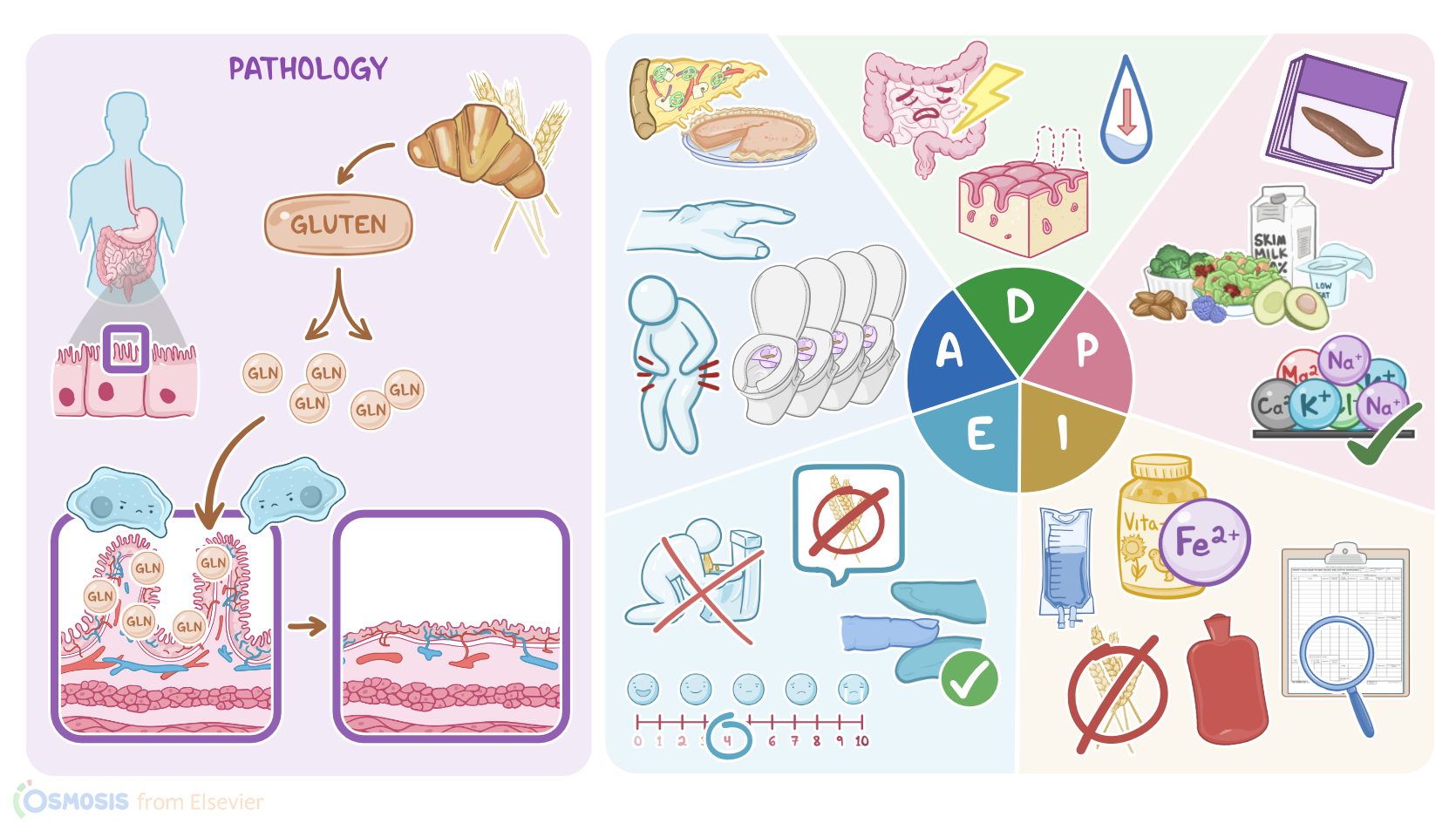
Celiac disease, also known as gluten enteropathy or celiac sprue, is currently understood as an immune-mediated disorder where the gluten in food triggers the body’s immune cells to attack the cells in the small intestine. Celiac disease is hereditary, and people with a first-degree relative with celiac disease, like a parent or sibling, have a 1 in 10 risk of developing it. Some people may be genetically predisposed to Celiac disease. In fact, it is estimated to affect 1 in 100 people worldwide. 

Now, gluten’s found in all sorts of wheats and grains, including rye and barley, and is the main culprit in Celiac disease. The intestine’s inability to fully digest the protein fractions of gluten leads to a build-up of the amino acid glutamine. This accumulation is toxic to the intestinal mucosa, damaging the intestinal villi, which are those small finger-like projections that line the small intestine and help promote nutrient absorption. When the villi become damaged, they can atrophy. This leads to complications like diarrhea, vomiting, fatty stools, abdominal distention, and malabsorption of important nutrients like iron and vitamin B12-- which can lead to anemia

Symptoms of Celiac disease are commonly first noticed between the ages of 1 and 5. Usually, there’s a period of time anywhere between 3- 6 months from the time gluten is introduced in the diet and the manifestations of Celiac disease are apparent. And of course, because gluten intake leads to complications, lifelong dietary changes are necessary in order to prevent flare-ups. Occasionally a client like Ms. Wilberson can experience an acute episode where symptoms of Celiac disease are exacerbated. This is called a Celiac crisis. The severe loss of GI contents through diarrhea and vomiting can cause complications like electrolyte imbalances, severe dehydration, and metabolic acidosis. People living with Celiac disease have a greater risk for developing coronary artery disease and small bowel cancers. And left untreated, Celiac disease can increase the chance of developing other autoimmune disorders, like Type I diabetes mellitus and multiple sclerosis

Now that we’ve gone over the pathology, let’s look at how the nursing process can be applied. The process consists of Assessment, Diagnosis, Planning, Implementation, and Evaluation; also known as ADPIE. 

So, after you greet Ms. Wilberson and introduce yourself as her nurse, you begin your assessment by first asking her how she’s feeling today. She tells you that her stomach hurts really bad and she’s feeling bloated. She then continues on to express that she has no appetite, and thinks she “overdid it with the food” at her company party a night ago, sharing that she had lots of pastries, breaded chicken tenders, and pizza, and expresses that she understands she made improper food choices. She states that she’s had several loose stools since she was admitted, last using the bathroom just before you entered, and has vomited “only a few times last night”. You check the bathroom and observe that there’s a toilet hat in place with stool present; foul-smelling and fatty in appearance. You ask Ms. Wilberson how many bowel movements she’s had since admission and she reports “4 or 5”. As you listen to Ms. Wilberson describe her symptoms, you’re visually assessing her and notice that her arms and legs appear very thin. Her lips and mucous membranes are dry. Upon closer inspection of her abdomen, you observe its distended and auscultate hyperactive bowel sounds. You assess her capillary refill and skin turgor and notice both are decreased. Ms. Wilberson’s vital signs are HR 117, RR: 20 BP: 108/70, Oral Temp.: 99.9° F, Pain: 7/10. Next, you review her recent lab results, and note the following: BUN level of 22 mg/dL, sodium level of 150 mEq/L, hemoglobin 11 g/dL, hematocrit 33%, RBC 3.8 cells/mcL, MCH 22.3 pg, MCHC 32.2 g/dL, MCV is 75 fL, RDW 18.1%. Finally, you document all your assessment findings before leaving the room.

Now after you’ve completed your assessment, you prepare a few nursing diagnoses, or clinical judgments about Ms. Wilberson’s responses to her health problem, Celiac disease. These diagnoses help nurses determine what to anticipate, or watch out for, in your clients. In doing so, you can think ahead and make a plan to address these issues! Based off the assessment data you’ve collected, your diagnoses include: acute pain related to intestinal inflammation, readiness for enhanced knowledge related to dietary restrictions, Diarrhea related to malabsorption secondary to celiac disease, dehydration related to excessive gastric loses, electrolyte imbalance related to increased gastrointestinal loses, and anemia related to malabsorption secondary to celiac disease.

As you begin planning Ms. Wilberson’s care you’re sure to keep in mind prioritizing her most important needs first. Well, now that you’ve gathered lots of information and have formed some great nursing diagnoses, it’s time to actively collaborate with other members of the interdisciplinary team to provide and develop a holistic plan of care to help Ms. Wilberson achieve the goals and desired outcomes to restore her overall well-being. Reflecting on the assessment data you’ve collected and the nursing diagnoses you’ve created, you determine the prioritization of goals include restoration of normal bowel habits by discharge; adequate fluid volume status by discharge, her electrolyte values will be within normal limits by discharge, she’ll adopt adequate daily intake of dietary iron by discharge, she’ll be pain-free by the end of shift, and understanding and commit to life-long dietary modifications by discharge. 

After collaborating with the team and obtaining the necessary orders, you review the plan of care with the nursing assistant assigned to help Ms. Wilberson with her basic care needs, so you delegate the collection of I&Os. Collecting this information is important to monitor Ms. Wilberson’s diarrhea and to determine her fluid volume status. Ms. Wilberson is receiving IV fluids as well, so you remind the nursing assistant to alert you if the fluid bag running low. In the meantime, you’ll focus on assessing skin turgor and mucous membranes to determine if fluid balance restoration has been effective then follow up to ensure the physician’s order for labs has been inputted so you can continue to monitor her lab results. 

Sources

  1. "Ackley and Ladwig’s Nursing Diagnosis Handbook: An Evidence-Based Guide to Planning Care, 13th edition" Mosby (2022)
  2. "The Gluten-Free Diet for Celiac Disease and Beyond" Nutrients (2021)
  3. "Celiac disease: a comprehensive current review" BMC Med (2019)
  4. "Harrison’s Principles of Internal Medicine. 21st edition" McGraw Hill / Medical (2022)
  5. "Celiac Disease: Fallacies and Facts" Am J Gastroenterol (2021)
  6. "Updates in the diagnosis and management of coeliac disease" Best Pract Res Clin Gastroenterol (2023)
  7. "Critical Care Nursing: Diagnosis and Management, 9th edition" Elsevier (2021)