Complete metabolic panel (CMP) - Total protein: Nursing
A 78-year-old male is brought to the clinic by his daughter, who says she noticed her father has been losing weight and has recently become lethargic and confused.
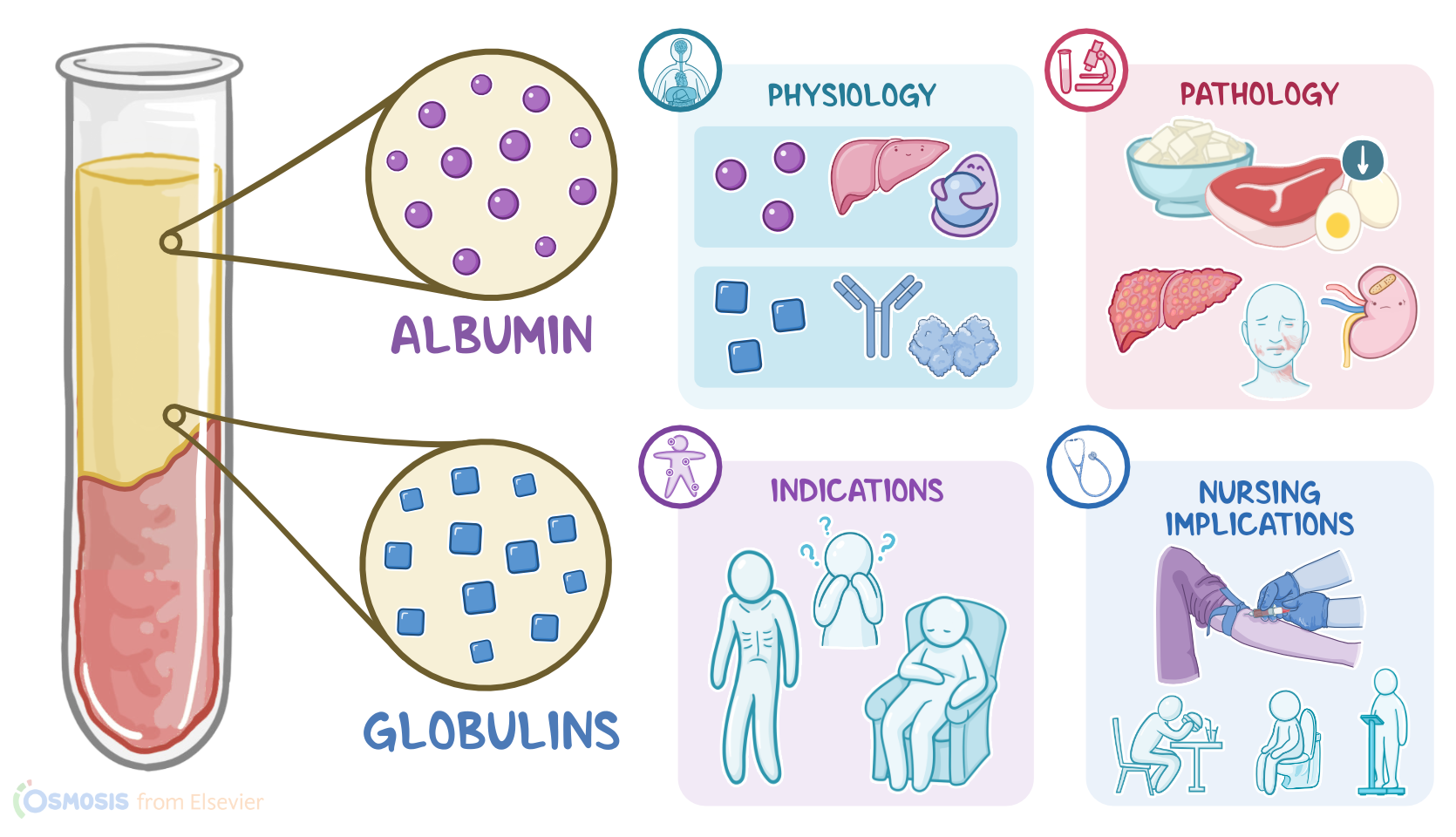
Based on these findings, the health care provider is concerned about undernutrition and orders a complete metabolic panel, or CMP, to evaluate his nutritional status.Alright, total serum protein measures two proteins found in the serum: albumin and globulins.
Albumin is produced by the liver, and is the body’s most abundant protein. It keeps fluids from leaking out into the tissues by helping to maintain oncotic pressure within the intravascular space.
Next, globulins include alpha, beta, and gamma globulins. These proteins also serve as carrier proteins, as well as enzymes, immunoglobulins, and clotting factors.
The albumin value can be divided by the globulin value, to get the albumin:globulin ratio, also known as the A/G ratio. Now, total serum proteins can be drawn on their own, or as a part of a complete metabolic panel.
In healthy adults, total protein ranges from 6.4 to 8.3 g/dL; albumin ranges from 3.1 to 4.3 g/dL; globulin ranges from 2.6 to 4.1 g/dL, the A/G ratio is usually slightly higher than 1.Alright, there are some conditions that can increase a client’s total serum protein.
Chronic inflammatory diseases, such as systemic lupus erythematosus and multiple myeloma can increase the production of some types of protein.
Alternatively, if the amount of fluid in the blood decreases, like with dehydration, the blood becomes more concentrated, and the protein value can increase.
On the other hand, decreased total serum protein can be caused by a long-term decrease in protein intake, like in undernutrition; or decreased absorption of nutrients.
Low total serum protein can also be caused by decreased production, like in chronic liver disease, or with increased elimination, like in nephrotic syndrome; or the loss of proteins through burn wounds due to increased vascular permeability.Now, the total serum protein will be measured when there’s a history of conditions that can predispose a client to a protein imbalance, or when there are signs or symptoms of an imbalance.Alright, let’s look at the nursing implications for a client with altered total serum protein.
Your goals of care are to assist in addressing the underlying cause and restore normal protein levels. First, collect a sample by venipuncture using a red or gold topped tube, which has a clot activator to separate serum for testing.
Then, if your client has an increased total serum protein, assess for signs of dehydration, such as headache, dry mucous membranes, delayed capillary refill, and dark urine.
Administer prescribed IV fluids and be sure to encourage oral fluid intake. Closely monitor vital signs, intake and output, as well as repeat total serum protein levels.
Also be sure to check other diagnostic test results to determine if the underlying cause is due to chronic inflammation.
Now, if your client has a decreased total serum protein, your interventions will depend on the cause. For instance, if your client’s low protein is due to undernutrition, monitor their weight, intake, and output; and collaborate with the dietician to perform a thorough health and nutrition assessment to ensure their nutritional needs are met.
If your client has lost too much protein due to a chronic disease, take steps to address the underlying cause, and administer the prescribed IV albumin, as indicated.Alright, as a quick recap… Total serum protein measures the serum level of albumin and globulins.
High total serum protein could be due to chronic inflammatory diseases, and low total serum protein can be caused by a long-term decrease in protein intake, decreased absorption of nutrients, decreased protein production, or with increased elimination.
Nursing implications include assisting in addressing the underlying cause and restoring normal protein levels.
| TOTAL PROTEIN | ||
| KEY POINTS | NOTES | |
| PHYSIOLOGY |
| |
| PATHOLOGY |
| |
| INDICATIONS |
| |
| NURSING IMPLICATIONS |
| |
No notes for this video yet
Try adding a note below