Contraception - Barrier methods: Nursing
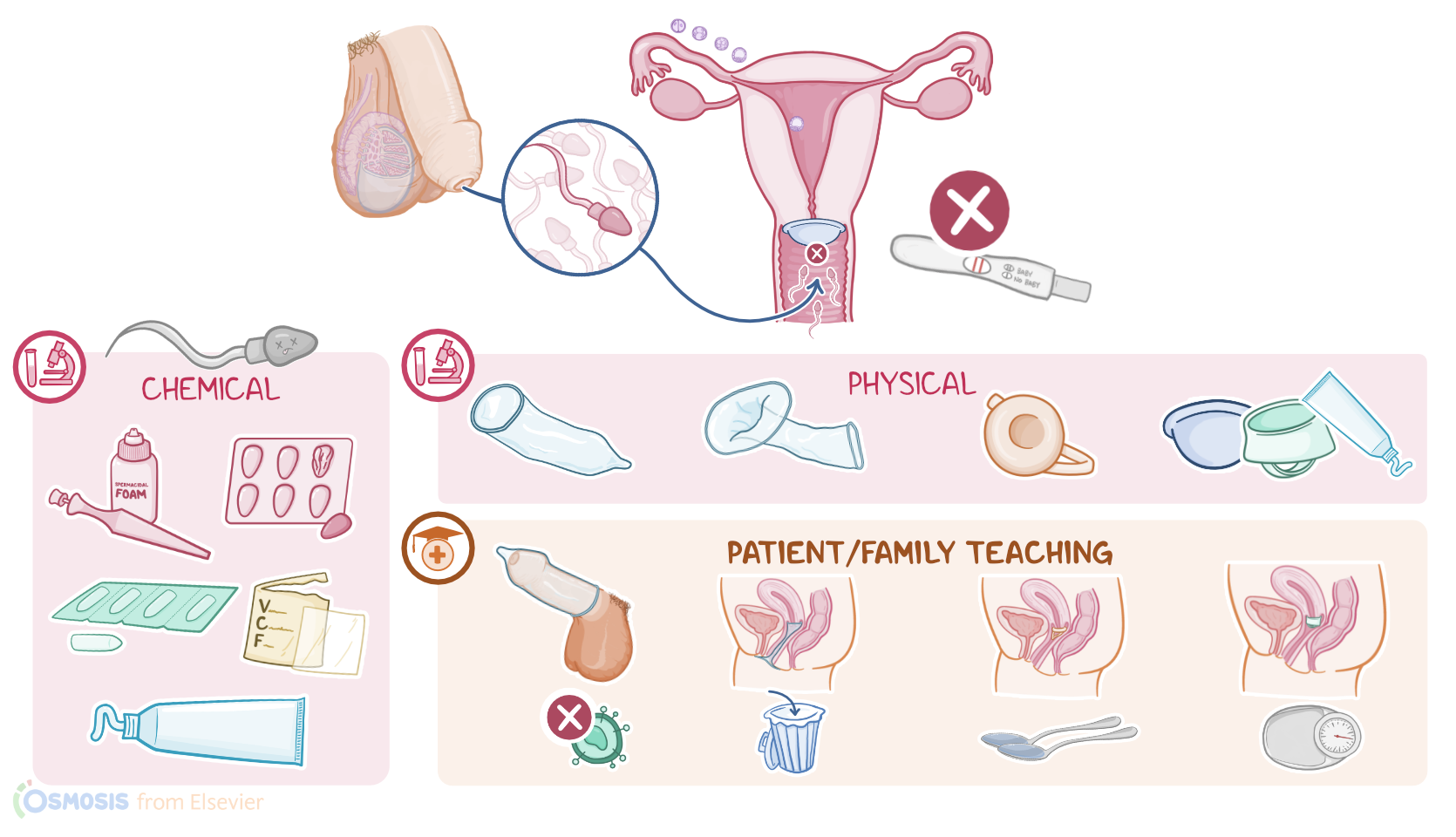
Barrier methods of contraception are reversible methods that can be used to prevent pregnancy. They get their name because they act as a “barrier” that prevents the sperm from getting into contact with the egg. They can be further classified as chemical or mechanical barriers, both of which prevent the sperm from entering the cervix.
Alright, now let’s quickly review the physiology of fertilization, starting with the ovaries, which are the paired female gonads. Each month, they release one mature egg, also called oocyte, which is the female gamete. After leaving the ovaries, this egg enters the fallopian tube and reaches the widest part of it, called the ampulla of the fallopian tube, where it can be fertilized by a sperm.
Sperm, on the other hand, is produced continuously by the testicles, and during intercourse, the penis releases it into the vagina. In order to reach the oocyte, sperm must cross the vagina, as well as the external cervical os, or opening, the endocervical canal, the internal cervical os, and the uterine cavity, to finally reach the fallopian tube, where one of them can finally fertilize the oocyte, so that a zygote is formed. The zygote then starts dividing and travels to the uterine cavity, where it can implant and develop into a fetus.
With this in mind, barrier contraceptives can act on several levels to prevent a sperm from meeting the oocyte. Let’s look at chemical barrier contraceptives first, namely spermicides. These are available as foams, foaming tablets, suppositories, vaginal films, creams, and gels. They contain chemical compounds like nonoxynol-9 or octoxynol that act like a surfactant, disrupting the sperm’s cell membrane, so the neck of the sperm detaches from the head, reducing mobility and causing cell death. So spermicides live up to their name by essentially killing sperm before they can enter the cervix. Overall, this method is about 80% effective as a contraceptive.
| CONTRACEPTION - BARRIER METHODS | ||
| KEY POINTS | NOTES | |
| DEFINITION |
| |
| PHYSIOLOGY |
| |
| PATHOPHYSIOLOGY |
| |
| PATIENT AND FAMILY TEACHING |
| |
No notes for this video yet
Try adding a note below