Coronary artery disease (CAD) and angina pectoris: Nursing process (ADPIE)
Client Report0:00–0:32
Dwayne Harris is a 52 year old African-American male client presenting to the cardiac catheterization lab to undergo a percutaneous coronary intervention, also known as PCI.
Mr. Harris has a diagnosis of coronary artery disease, chronic stable angina, hyperlipidemia, and is a current smoker with a 20 pack year history.
Because his angina is no longer responding to treatment, his cardiologist recommended PCI for Mr. Harris.
Coronary artery disease or CAD is the narrowing or obstruction of coronary arteries. This narrowing is caused by atherosclerosis, a lipid containing plaque that accumulates on artery walls.
Pathology0:32–5:39
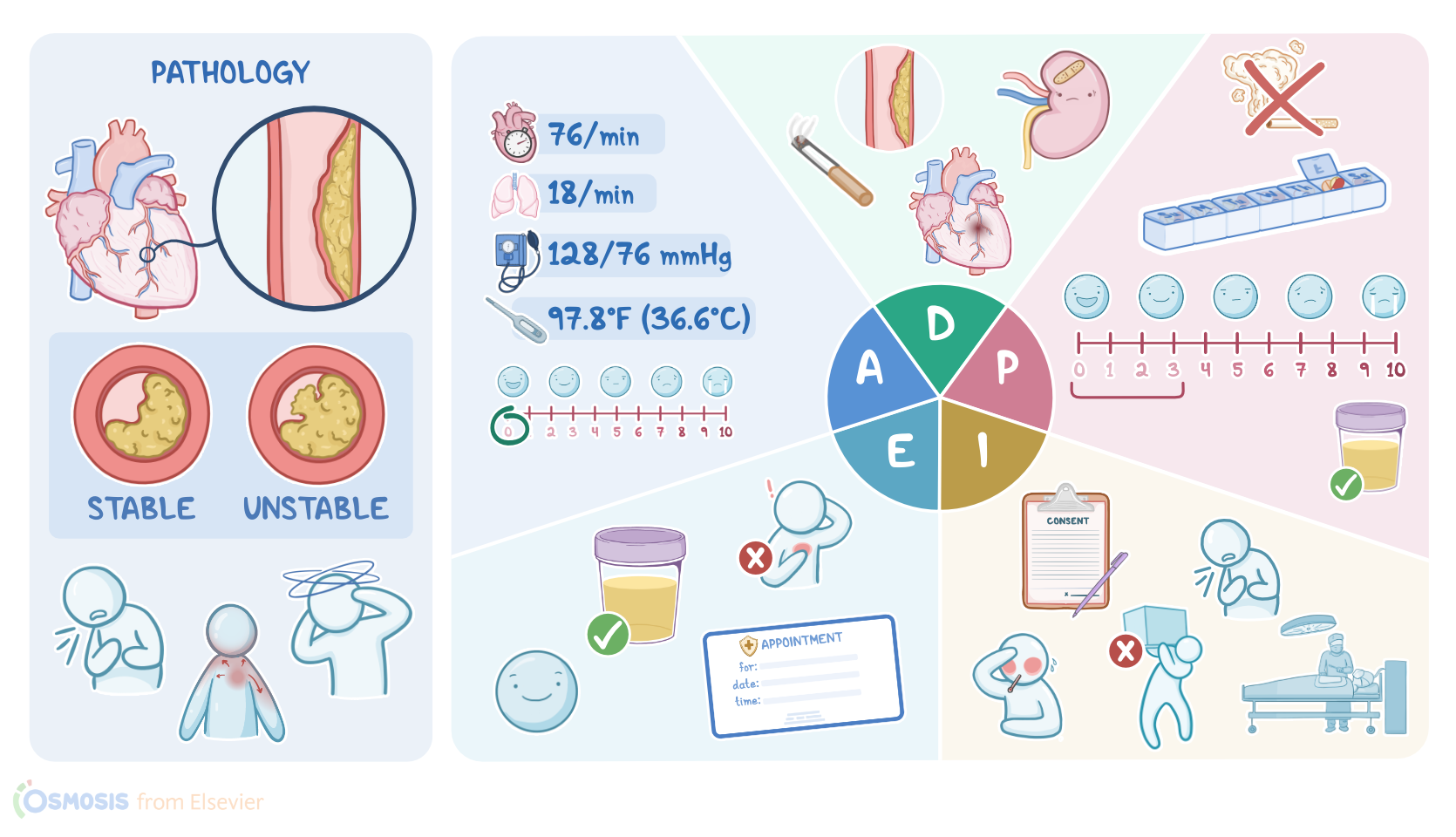
Myocardial ischemia leads to a type of chest pain called angina, which can be either stable or unstable. Stable angina usually occurs when the atherosclerotic plaque is fixed to the artery wall and occludes at least 75% of the coronary artery.
Whereas with unstable angina, the plaque ruptures and almost completely occludes the artery lumen. The clinical presentation helps to differentiate stable and unstable angina using the acronym OPQRST.
O stands for onset, which for stable angina is during activity or emotional stress due to increased oxygen demand, whereas for unstable angina, onset can be sudden or even at rest.
P is for palliation. Stable angina is relieved by rest or vasodilators like nitroglycerin, whereas unstable angina is not relieved.
Q stands for the quality of pain, which often involves pressure, crushing, squeezing, or tightness. Pain is more severe with unstable angina.
R stands for radiation of pain, because it often radiates to the shoulders, arms, jaw, neck, or back. S is for sight, which is deep substernal and sometimes hard to localize, meaning the client is unable to point to the site of the pain with a single finger.
T stands for time. With stable angina, pain can last 15 seconds to 15 minutes.
Whereas in unstable angina, the pain will last longer than 20 minutes. Besides causing angina, the myocardial oxygen supply and demand imbalance from CAD can also lead to dyspnea, diaphoresis, palpitations, dizziness, and pallor, and digestive disturbances.
Now, there are several non-modifiable and modifiable risk factors contributing to CAAD and its complications. Advanced age is the greatest risk factor, with men over 45 and women over 55 years of age being at most risk.
Other non-modifiable risk factors include biological male sex, family history of hypercholesterolemia, and belonging to African-American, Native American, Native Hawaiian, and South Asian demographic groups.
Modifiable risk factors include smoking tobacco, hypertension, dyslipidemia, diabetes mellitus, obesity, and physical inactivity.
Psychosocial factors such as stress and depression can be risk factors for CAD too, due to their association with factors like smoking, physical inactivity, and obesity, as well as their association with elevated systemic inflammation, which contributes to atherosclerosis.
OK. Treating CAD centers around lifestyle modifications, medication management, and if needed, coronary revascularization procedures.
Lifestyle modifications involve controlling modifiable risk factors. Several medications are used to treat CAD as well.
Nitrates like nitroglycerin and calcium channel blockers such as amlodipine work by dilating coronary arteries. Beta blockers like propranolol reduce myocardial oxygen demand by decreasing heart rate and contractility.
Antiplatelet medications like aspirin are used to reduce platelet aggregation in coronary arteries. Cholesterol-lowering medications are prescribed to reduce atherosclerotic plaque formation, including statins like atorvastatin, fibric acid derivatives such as fenofibrate, omega-3 fatty acids, bile acid sequestrants like cholestopol, cholesterol absorption inhibitors such as ezetimib, and PCSK9 inhibitors like evolacumab.
If stable angina isn't effectively treated by lifestyle modifications and medication therapy, coronary revascularization procedures may be necessary.
PCI is a minimally invasive procedure that involves inserting a catheter through the radial or femoral artery and injecting contrast dye to locate the blockage.
After the blockage is located, a tiny balloon is inserted in the obstructed coronary artery to compress plaque against the artery wall.
If needed, a stent can be placed during PCI to keep the artery patent. Alternatively, atherectomy devices are used to remove the plaque.
Coronary bypass grafting or CABG can be done instead of PCI. This is a major surgical procedure that involves using a vein or artery from elsewhere in the body to bypass the blockage and improve myocardial blood flow.
OK, so let's get back to Mr. Harris and begin his assessment.
Assessment5:39–7:28
You introduce yourself, perform hand hygiene, and confirm his identity. After asking if he feels ready for his procedure, he says he's anxious, but hopefully, it will help him have less chest pain when taking his daily walks.
Your assessment reveals warm, dry, intact skin with good turgid. His oral temperature is 97.8 °F or 36.6 °C.
Lungs are clear with a respiratory rate of 18 breaths per minute, and SPO2 is 98% on room air. Heart sounds are normal, and he has a regular heart rate of 76 BPM, and BP of 128/76 millimeters of mercury.
Bowel sounds are active, and Mr. Harris confirms he hasn't had anything to eat or drink since midnight.
No peripheral edema is present, and pedal pulses are normal. His pain score is 0 out of 10.
Reviewing his pre-operative tests, you know, electrocardiogram or ECG showed normal sinus rhythm, BUN 15 mg per deciliter, creatinine, 0.8 mg per deciliter, sodium, 140 milliequivalents per liter.
Potassium 3.5 milliequivalents per liter, total cholesterol, 275 mg per deciliter. LDL 190 mg per deciliter, HDL 30 mg per deciliter, and triglycerides, 200 mg per deciliter.
You note, his current medications include daily atorvastatin, propranolol, aspirin, and nitroglycerin as needed. After documenting your assessment findings, you let Mr.
Harris know you will be back shortly to finish preparing him for his procedure. All right, it's time to create nursing diagnoses unique to Mr.
Diagnosis7:28–8:06
Harris's needs. Your nursing diagnoses include risk for vascular trauma related to undergoing PCI, risk for bleeding related to undergoing PCI, risk for infection related to invasive procedure, pain related to invasive procedure, risk for renal injury related to contrast dye.
Administration, risk for decreased cardiac tissue perfusion related to CAD, hyperlipidemia, procedure-related vasospasm and arrhythmias, deficient knowledge related to post-PCI care, and ineffective health maintenance related to hyperlipidemia, and continued smoking.
Based on your nursing diagnoses, you plan goals that will help Mr. Harris reach optimal outcomes.
Planning8:06–8:54
During his procedure and prior to discharge, Mr. Harris will show no signs or symptoms of complications, including bleeding, coronary vasospasm, infection, or dysrhythmias.
His pain will be managed at or below his stated level of tolerance, 3 out of 10. His post-procedure urine output will be adequate, and his BUN and creatinine will be within normal limits, and he will verbalize understanding of post-procedure care, including how to better manage his hyperlipidemia and CAD through lifestyle modifications, smoking cessation, and adherence to his medication regimen.
Implementation8:54–11:25
After the cardiologist explains the risks, benefits, and alternatives of PCI to Mr. Harris, you ensure the consent form is signed.
Along with the surgical technician, you assist the cardiologist throughout Mr. Harris's PCI including administering anticoagulants, IV fluids, and preparing the femoral artery for catheter insertion.
You monitor Mr. Harris during the procedure and administer IV nitroglycerin as instructed to decrease coronary vasospasm.
The cardiologist successfully completes the PCI with a balloon catheter and stent placement. During Mr.
Harris's recovery, you monitor his vital signs, pain level, ECG, catheter insertion site for bleeding, or hematoma, peripheral pulses, level of consciousness, mobility, urinary output, and post-procedure labs, as well as symptoms such as chest pain, nausea, and vomiting.
The cardiologist will be notified if there are evident complications such as bleeding or hematoma formation, chest pain, abnormal heart rhythm, or signs of renal impairment.
After Mr. Harris is alert and oriented, you spend time providing education.
Your education includes incision site care, post-PCI activity restrictions, including no heavy lifting, sports, driving, or sexual activity for 2 to 5 days.
You review symptoms that warrant medical attention, such as chest pain or shortness of breath, not relieved by rest, dizziness, palpitations, bleeding, redness or drainage from the incision site, and a temperature over 101 °F or 38.3 °C.
He will be resuming his current medications in addition to starting the P2Y12 inhibitor, clopidogrel, which will help avoid reocclusion.
An ice pack placed over the insertion site for 10 to 20 minutes will help reduce swelling and pain. Regarding his CAD and hyperlipidemia, you review important lifestyle changes, including smoking cessation, dietary guidelines, and increasing exercise that can help him avoid further complications and improve his overall health.
You advise him to drink plenty of fluids to help clear the body of contrast dye. Finally, to help with smoking cessation, you provide him with tips on how to quit smoking and contact information for a local support group.
Throughout your care for Mr. Harris, you document your nursing interventions and assessment findings.
Evaluation11:25–12:40
By six hours post-operatively, Mr. Harris's vital signs are BP 120/70 millimeters of mercury, heart rate 70 BPM, respirations 12 per minute, oxygen 98% on room air, temperature, 97.0 °F or 36.1 °C, and pain, 2 out of 10 at the catheter insertion site, which has no signs of bleeding or hematoma.
His ECG shows a normal sinus rhythm. He has voided 1000 mL of pale yellow urine, and you note his BUN is 17 mg per deciliter, and creatinine is 0.9 mg per deciliter.
Mr. Harris has been alert and oriented, able to ambulate with standby assistance, and has not reported chest pain.
His skin is warm, dry, intact, and his pedal pulses are normal. After final evaluation by the cardiologist, Mr.
Harris is ready to be discharged home. He verbalizes understanding of your discharge instructions, and before he leaves, you ensure Mr.
Harris has a follow-up appointment scheduled with his cardiologist. Through an interdisciplinary team approach, Mr.
Harris will continue to be monitored and hopefully avoid worsening of his CAD or complications from his PCI. All right.
Summary12:40–14:04
It's a quick recap. Your client, Mr.
Harris, presented to the cardiac catheterization lab for a PCI to treat his chronic stable angina resulting from CAD. CAD is caused by atherosclerotic plaque that leads to obstruction of the coronary arteries, which decreases oxygen supply to the myocardial tissue, causing ischemia and angina.
Angina can be either stable, which means the plaque remains fixed to the artery wall, or unstable, which occurs when the plaque moves and causes a larger occlusion.
Treatment includes lifestyle modifications, medications, and coronary revascularization procedures such as PCI or CABG. Your assessment revealed Mr.
Harris experiences angina during activity, which is relieved by rest. Nursing diagnoses include pain and risk for vascular trauma, bleeding, infection, renal injury, decreased cardiac tissue perfusion, deficient knowledge, and ineffective health maintenance.
Care planning for Mr. Harris includes monitoring for post-PCI complications and providing education on post-PCI care and lifestyle modifications.
You implement your plan alongside the interdisciplinary team, and evaluate the effectiveness of care provided. As Mr.
Harris continues to be monitored, adjustments will be made to his care plan to help him achieve an optimal state of health.
| CORONARY ARTERY DISEASE (CAD) AND ANGINA PECTORIS | ||
| KEY POINTS | NOTES | |
| PATIENT REPORT |
| |
| PATHOPHYSIOLOGY |
| |
| TREATMENT |
| |
| ASSESSMENT |
| |
| NURSING DIAGNOSES |
| |
| PLANNING |
| |
| IMPLEMENTATION |
| |
| EVALUATION |
| |
- "Epidemiology of Coronary Artery Disease" Surg Clin North Am (2022)
- "Angina: contemporary diagnosis and management" Heart (2020)
- "Predictive utility of stress tests in the detection of asymptomatic coronary artery disease in atherosclerotic stroke patients" J Stroke Cerebrovasc Dis (2023)
- "Harrison’s Principles of Internal Medicine, 21st edition" McGraw Hill / Medical (2022)
- "Gender in cardiovascular medicine: chest pain and coronary artery disease" Eur Heart J (2019)
- "Critical Care Nursing: Diagnosis and Management, 9th edition" Elsevier (2021)
No notes for this video yet
Try adding a note below