Enuresis: Nursing
Introduction0:00–0:03
Introduction0:03–0:37
Enuresis is more commonly known as “bedwetting,” and this is called nocturnal enuresis if it happens mainly at night, or diurnal enuresis if it mainly happens during the day.
Primary enuresis is defined as involuntary urination in a client who has never developed bladder control. Secondary enuresis refers to involuntary urination in a client who’s already developed bladder control.
Okay, first, let’s cover some basic physiology of urine production and excretion. Kidneys filter the blood to produce urine in a process that is controlled by several hormones, including vasopressin, which is also known as antidiuretic hormone, or ADH for short.
Physiology0:37–2:33
ADH is produced by the hypothalamus and stored in the posterior pituitary. Now, when a person is thirsty or dehydrated, the posterior pituitary releases ADH into the blood, which then travels to the kidneys to increase water reabsorption, subsequently decreasing urine production.
The bladder’s main function is to store urine, and as the urine accumulates, the walls of the bladder start to stretch, subsequently stretching the specialized nerve cells located in the bladder wall.
Once stretched enough, these nerve cells send a signal through the spinal cord to the pontine micturition center in the brainstem and activates the micturition reflex.
Ultimately, this results in micturition or urination. Now, until the 12th month of life, infants have no voluntary control over urination.
Between the 12th and 18th month, they develop some control, while between the 24th and 30th month, most people develop full control over the bladder.
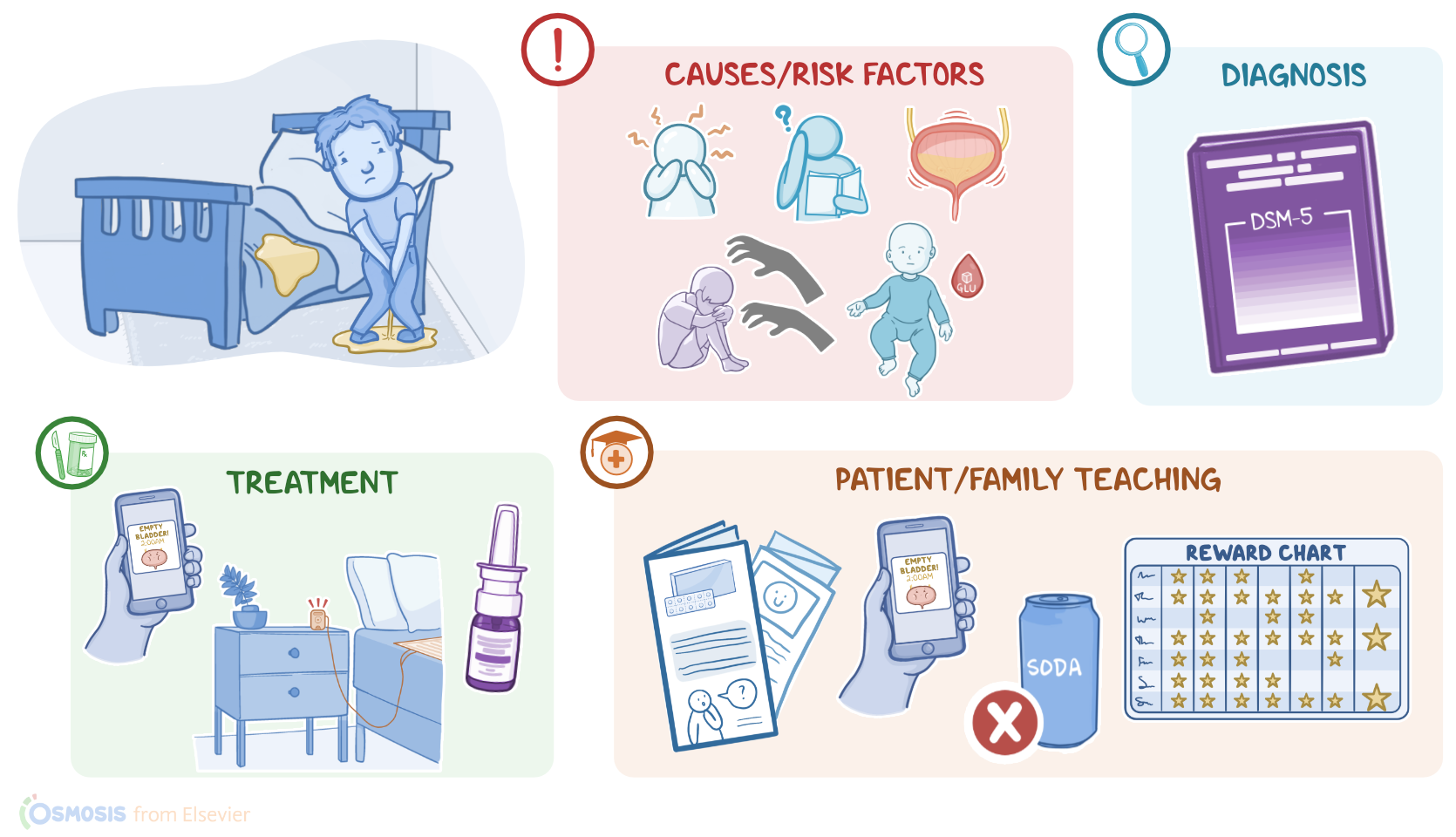
Moreover, older children and adults can delay emptying their bladder if they are in a socially unacceptable situation. In these situations, the brain sends inhibitory signals to the pontine micturition center, eventually preventing the contraction of the bladder and micturition.The exact cause of primary enuresis remains unknown, but some theories suggest that this condition could be associated with anxiety and neurodevelopmental problems, as well as slow maturation, or hyperactivity of the bladder.
Causes & risk factors2:33–3:24
On the other hand, common causes of secondary enuresis include physiological stress, like sexual abuse; central diabetes insipidus; and medications, such as valproate, which is used to treat epilepsy in children.
Other causes of secondary enuresis include urinary tract infections and constipation. Now, important risk factors for developing enuresis include a family history of enuresis; low socioeconomic status; and major life changes or stressors, like the birth of a sibling, family conflict, or separation from a parent or guardian.Now, the exact pathological process of primary enuresis remains unclear, but some sources suggest that three factors contribute to the development of primary nocturnal enuresis.
Pathology3:24–5:26
The first factor is decreased ADH production, especially at night. This results in decreased water reabsorption and subsequently increased urine production when the person is sleeping.
Next, there’s reduced functional capacity of the bladder, which means the bladder can store less urine before micturition is triggered.
Finally, there’s the inability to wake up when the bladder is full. Often, it’s a combination of these 3 factors that leads to nocturnal enuresis.Now moving on to the pathology of secondary enuresis, starting with central diabetes insipidus, which is also associated with decreased production of ADH by the hypothalamus.
Next up is the use of valproate. One theory suggests that valproate can trigger the thirst center and increase water intake, eventually increasing urine production.
The second theory suggests that valproate can cause bladder contraction and relaxation of the urinary sphincters.. Similarly, urinary tract infections, like cystitis, or inflammation of the bladder, can induce uncoordinated contractions of the bladder that can result in enuresis.
Finally, enuresis can be caused by constipation, because the rectum fills with stool and directly exerts pressure on the surrounding structures, including the urethral sphincters, the bladder, and the nerves that innervates them.
Additionally, recurrent loss of urine can cause a skin rash on the genital area or genitourinary infections. The most important clinical manifestation of enuresis is repeatedly urinating in bed or on clothes, resulting in urine-soaked clothes and bed sheets.
Clinical manifestations5:26–5:36
Diagnosis of enuresis is based on detailed history and physical assessment, and is confirmed using the Diagnostic and Statistical Manual for Mental Disorders fifth edition or DSM-5 criteria, So, there are four main criteria that must be met in order to confirm the diagnosis of primary enuresis.
Diagnosis5:36–6:29
First, there’s voluntary or involuntary urination into the bed or clothes. Second, this behavior should occur at least 2 times per week for three consecutive months, or cause significant distress.
Third, the client must be at least 5 years old; and finally, this behavior should not be associated with some other medication, substance, or medical condition.
Treatment6:29–7:27
Non-pharmacological treatment is based on bladder training and the use of a bedwetting alarm. Bladder training establishes a regular voiding schedule, so the child is assisted to empty their bladder on a set schedule instead of waiting for the urge to urinate.
Bladder training can also involve scheduled awakenings during the night, so parents or other caregivers will need to wake up the child during the night to empty their bladder to prevent enuresis.
The bedwetting alarm, also known as the bell and pad technique, consists of a special moisture-sensitive pad, which is placed on the bed, attached to an alarm.
So, when the enuresis occurs, the special pad triggers the alarm to wake up the child to stop the stream of urine. On the other hand, pharmacological treatment includes medications such as vasopressin analogs, like desmopressin, and tricyclic antidepressants, like imipramine.
Alright, let’s take a look at the nursing care you’ll be providing for a child with enuresis. Your priority nursing goals are to provide psychosocial support and monitor for complications.
Management and care7:27–8:27
Start by asking the child’s parents about their child’s voiding pattern and encourage them to talk about its impact on family life.
Also assess them for their degree of motivation to begin treatment, and be sure to refer the family to counseling to support their ability to provide behavioral interventions.
Lastly, determine if the child is experiencing low self-esteem due the the enuresis, and refer the family to pediatric mental health counseling, as neededThen, assess the child’s perineal skin, checking for signs of rash.
Report to the healthcare provider if redness and irritation are present, gently cleanse the area, and apply the prescribed barrier cream.Now, moving on to client and family teaching.
Begin by reassuring the child’s caregivers that enuresis is a common childhood problem. If their child is prescribed medication, be sure to provide information about how the medication helps with the problem, and instruct them to take the medication exactly as directed.Then review strategies they should do to help their child establish a normal voiding pattern.
General client and family teaching8:27–10:15
If a bedwetting alarm is used, demonstrate how to use the device. Also ensure they take measures to keep the bed linens dry, to decrease the frustration involved in changing and washing them.
Strongly recommend they use a fitted plastic sheet to protect the mattress. Then, teach them about bladder training and timed voiding, and encourage them to keep a voiding diary track their child’s voiding pattern, number of wet and dry nights, and the amount of fluids their child consumes.
Also limit the amount of fluids their child consumes at night, and emphasize the importance of limiting any sources of caffeine that may be found in colas and other sodas, as well as chocolate.
Be sure they know to always assist their child to empty their bladder right before bed. Lastly, instruct them to contact their healthcare provider if their child’s enuresis worsens or does not seem to get better with treatment; if any complications such as infection or impaired skin occur; or if they feel discouraged and need additional psychosocial support.Finally, encourage them to establish goals and a reward system for when their child keeps dry.
Emphasize the importance of praising the child on dry mornings. Be sure to remind them that bedwetting is not the child’s fault, and stress the importance of not teasing or punishing their child when bedwetting occurs.All right, as a quick recap….
Nocturnal enuresis happens mainly at night, whereas diurnal enuresis happens during the day. Common causes that could contribute to enuresis are anxiety, abnormal neurological development, abnormal bladder physiology or function, sexual abuse, central diabetes insipidus, and certain medications, like valproate.
Review10:15–11:23
Diagnosis of enuresis is based on detailed history and physical assessment, and is confirmed using the Diagnostic and Statistical Manual for Mental Disorders fifth edition or DSM-5 criteria.
Treatment includes pharmacological options, as well as non-pharmacological choices such as, motivational therapy, bladder training and moisture alarms.
Priority nursing goals include providing psychosocial support and monitoring for complications. Client teaching focuses on learning about the disorder, strategies to establish a normal voiding pattern, and when to contact the healthcare provider.
moisture. Alarms priority nursing goals include providing psychosocial support and monitoring for complications teaching focuses on learning about the disorder strategies to establish a normal voiding pattern.
And when to contact the health care provider,
| ENURESIS | ||
| KEY POINTS | NOTES | |
| DEFINITION |
| |
| PHYSIOLOGY |
| |
| CAUSES AND RISK FACTORS |
| |
| PATHOPHYSIOLOGY |
| |
| SIGNS AND SYMPTOMS |
| |
| DIAGNOSIS |
| |
| TREATMENT |
| |
| MANAGEMENT OF CARE |
| |
| PATIENT AND FAMILY TEACHING |
| |
No notes for this video yet
Try adding a note below