Environmental emergencies: Nursing
Introduction0:00–0:15
An environmental emergency refers to an event or condition related to exposure to weather, which can include emergencies involving heat and cold.
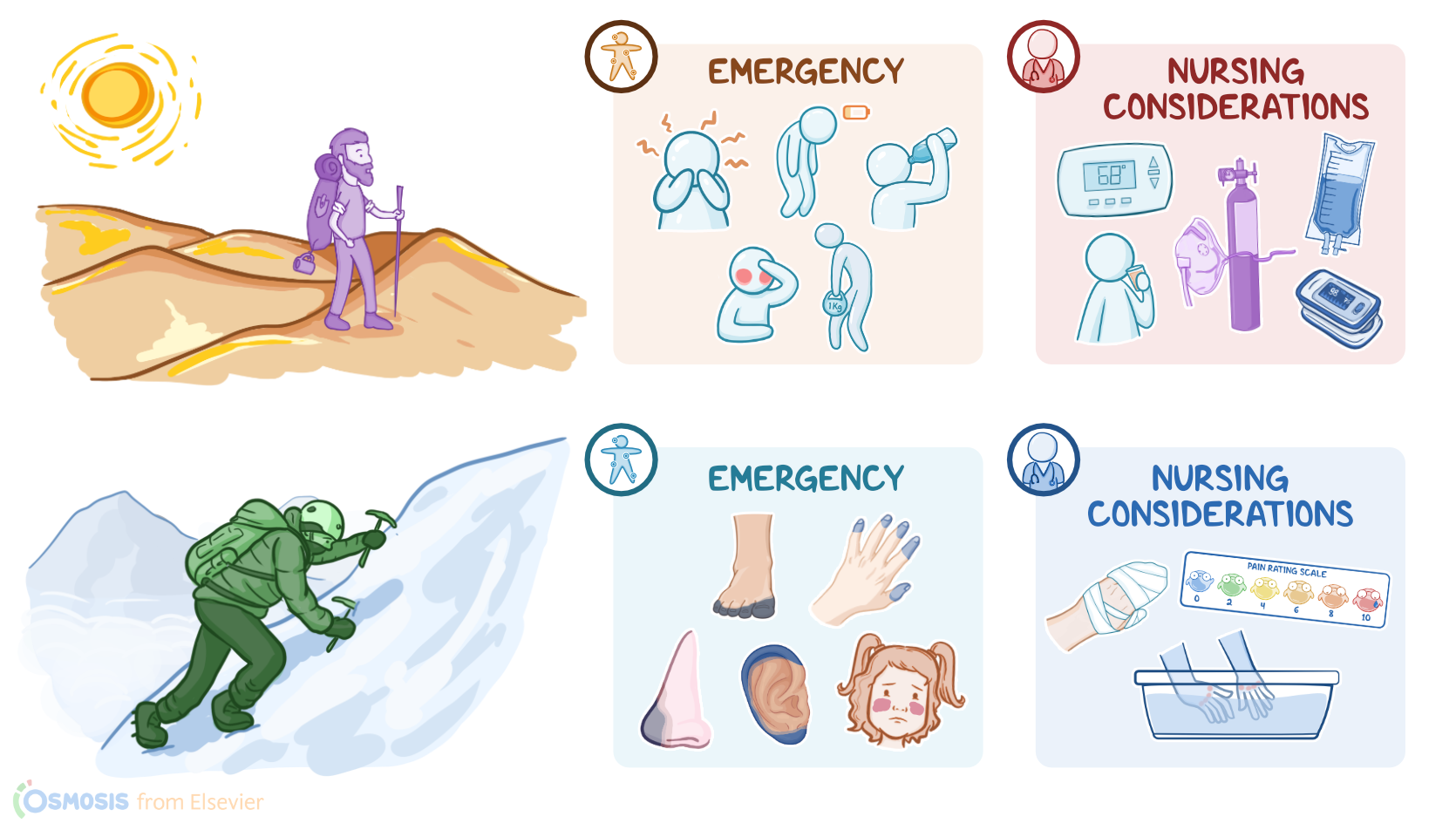
Alright, so heat-related emergencies happen when the body’s normal thermoregulatory mechanisms like sweating, vasodilation, and increased respirations, are less effective in situations where there’s prolonged exposure to heat, or if there’s brief exposure to intense heat.
Heat-Related Emergencies0:15–1:36
Heat exhaustion happens when heat exposure occurs over hours or days, like during a hike on a hot day, leading to a body temperature as high as 105.8° F or 41° C.
Other assessment findings can include anxiety, fatigue, nausea, thirst, and pale skin. If left untreated, heat exhaustion can progress to heat stroke, which is a medical emergency.
With heat stroke, the body’s thermoregulatory mechanisms fail, leading to a temperature above 105.8° F or 41° C. Other assessment findings can include weakness and hot, flushed, dry skin.
Now, in both heat exhaustion and heat stroke, fluid and electrolytes are lost through perspiration, which can manifest as tachycardia, weak pulses, and decreased blood pressure.
In heat stroke, an excessive loss of sodium can lead to cerebral edema, brain hemorrhage, and mental status changes ranging from confusion to coma.
Alright, when caring for your patient with a heat-related emergency ensure they are in a cool environment. For heat exhaustion, provide fluid and electrolyte replacement orally, or intravenously, if needed.
Nursing Considerations for Heat-Related Emergencies1:36–2:48
For heat stroke, provide high-flow oxygen and initiate continuous pulse oximetry; establish IV access to replace fluids and electrolytes; and initiate rapid cooling measures.
Be sure to monitor their temperature closely to control shivering, which can lead to heat production. Then, obtain a 12-lead ECG, and monitor laboratory test results, including CBC, electrolytes, and coagulation studies.
Insert an indwelling urinary catheter and check for myoglobinuria, which could result from rhabdomyolysis, or muscle breakdown, which can happen due to heat-related muscle damage.
Alright, moving on to cold-related emergencies. These are caused by prolonged exposure to cold water or air, and can be either localized, like frostbite; or systemic, like hypothermia.
Cold-Related Emergencies2:48–4:18
Frostbite is an injury that's caused when tissues freeze and intracellular ice crystals form, damaging the cell’s organelles, breaking the cellular membrane, and causing death of the cells.
The patient may report numbness, tingling or burning. Now, hypothermia is when the core body temperature drops below 95° F or 35° C.
Hypothermia stimulates vasoconstriction, as the body attempts to conserve heat, and induces shivering to generate heat. The cooling of blood makes it more viscous, increasing the risk of clotting; and slows the blood flow through the microcirculation, which can cause hypoxia, anaerobic metabolism, and metabolic acidosis.
Myocardial contractility is also impaired, and dysrhythmias may occur. Assessment findings can include lethargy, confusion, bradycardia, hypotension, and decreased respiratory rate.
Okay, when you’re caring for your patient with frostbite, treatment is focused on rewarming the affected area and preventing further injury.
Nursing Considerations for Cold-Related Emergencies4:18–6:04
Gently remove clothing or jewelry and carefully immerse the affected area in a circulating, temperature-controlled bath.
If the face is affected, apply clean, warm, wet washcloths. Remember to avoid massaging the affected area during rewarming, as this can damage the tissue.
Then assess your patient’s pain level and administer prescribed analgesics. Next, when caring for a patient with hypothermia, begin by removing any wet clothing and applying warm, dry blankets.
Provide heated, humidified supplemental oxygen and initiate rewarming, as ordered, which can include air- or fluid-filled heating blankets, warm water immersion, internal warming with warm IV fluids, or extracorporeal warming with hemodialysis.
Also be sure to place your patient on continuous ECG monitoring and obtain frequent vital signs, including the core temperature using a rectal probe or an indwelling urinary catheter with continuous monitoring.
Throughout the rewarming process, monitor their electrolytes, especially potassium, since rewarming can cause rebound hyperkalemia due to electrolyte shifts.
Once your patient’s core temperature is between 90 and 95° F or 32 to 35° C, anticipate discontinuing rewarming interventions.
Alright, as a quick recap…. Environmental emergencies include heat- and cold-related emergencies.
Review6:04–6:32
Heat-related emergencies occur when the body’s thermoregulatory mechanisms are unable to compensate for exposure to heat and include heat exhaustion and heat stroke.
Cold-related emergencies occur with exposure to cold air or water and include frostbite and hypothermia. Care for patients with an environmental emergency focuses on restoring a normal temperature and treating complications.
| ENVIRONMENTAL EMERGENCIES | ||
| KEY POINTS | NOTES | |
| DEFINITION |
| |
| HEAT-RELATED EMERGENCIES |
| |
| NURSING CONSIDERATIONS FOR HEAT-RELATED EMERGENCIES |
| |
| COLD-RELATED EMERGENCIES |
| |
| NURSING CONSIDERATIONS FOR COLD-RELATED EMERGENCIES |
| |
- "Lewis's medical-surgical nursing: Assessment and management of clinical problems. (12th ed.). " Elsevier. (2022)
- "Medical-surgical nursing: Concepts for interprofessional and collaborative care. (10th ed.). ISBN: 978-0323654050 " Elsevier. (2021)
- "Lewis’s medical-surgical nursing in Canada: Assessment and management of clinical problems. (5th ed.). ISBN 978-0323791588 " Elsevier (2023)
No notes for this video yet
Try adding a note below