Growth and development - Early and middle adulthood: Nursing
Notes
| GROWTH AND DEVELOPMENT - EARLY AND MIDDLE ADULTHOOD | ||
| KEY POINTS | NOTES | |
| DEFINITION |
| |
| GROWTH |
| |
| DEVELOPMENT |
| |
| PATIENT AND FAMILY TEACHING |
| |
Transcript
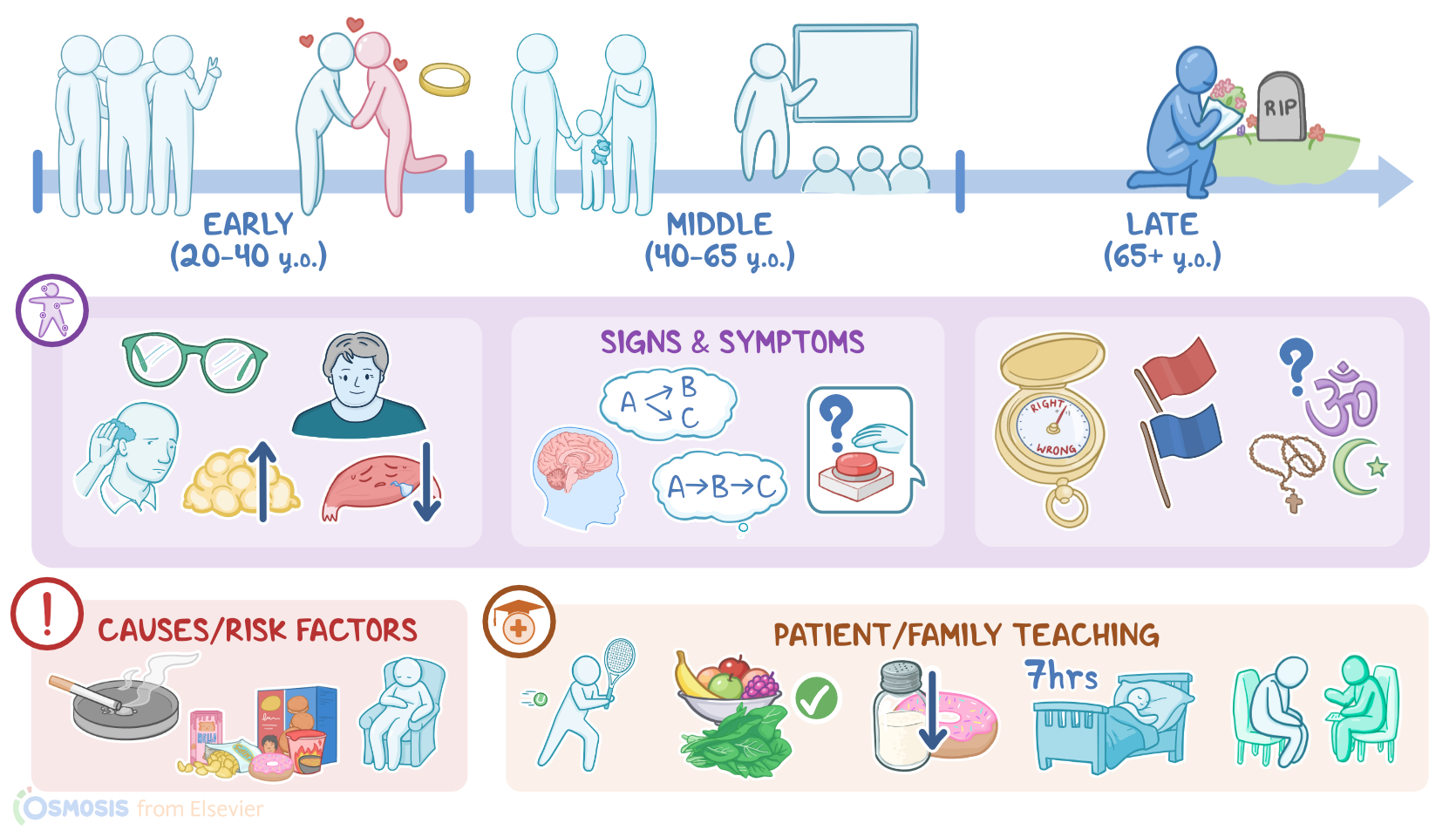
Adulthood is the longest stage of life, spanning from 20 years of age until the end of life. Adulthood is further divided into three consecutive phases: early adulthood, between 20 and 40 years old; middle adulthood, between 40 and 65 years old; and late adulthood, from age 65 and onward.
Now, developmental psychologists involved in studying development early and middle include Jean Piaget, Erik Erikson, and Lawrence Kohlberg.
First, it’s important to note that growth and development are two different concepts. Growth refers to physical changes in height, weight, and the appearance of the body; whereas development refers to the acquisition of complex motor, cognitive, and social skills.
Alright, now compared to other stages of life, adulthood is a time of minimal physical growth. By this point, physical maturation is complete, although height and weight can increase slightly. Young adults are at their peak in terms of physical abilities, including muscle strength, endurance, reaction time, and cardiac function; though poor lifestyle habits, such as smoking, as well as an unhealthy diet, or lack of exercise can increase the risk for future illnesses or trigger the onset of chronic conditions at an early age.
The aging process actually begins during early adulthood, although very slowly, and continues through middle adulthood. Around the age of 30, the lens of the eye begins to stiffen and thicken, affecting the ability to focus on close objects, a condition known as presbyopia.
Hearing can start to decrease as well, called presbycusis. Hair can start to thin out and become gray as early as the age of 35; the skin becomes drier and less elastic, wrinkles start to appear, and reproductive capacity starts to decline.
Later, the basal metabolic rate decreases, so it’s more difficult to gain muscle mass, while at the same time, fat tends to accumulate, particularly on the abdomen and lower body.
Now, cognitive development remains relatively steady throughout early and middle adulthood. According to Piaget, early and middle adults continue from adolescence in the formal operational stage.
During this stage, individuals begin to look at ideas from multiple angles and understand that problems can have more than one right or wrong answer. They also develop the ability to think rationally, meaning they can use logic to solve concrete as well as abstract problems. Compared to previous stages of life, young adults are more pragmatic when solving problems and making life-changing decisions and tend to be less reckless than in their teenage years. This is usually the time where they may choose to pursue additional education or identify their chosen career, which further enhances problem-solving skills and the capacity for creativity.
Sources
Silvestri LA. Saunders Comprehensive Review for the NCLEX-RN. 9th Edition. Saunders; 2022. ISBN: 978-0-323-79530-2
Potter PA, Perry AG, Stockert PA, Hall A. Fundamentals of Nursing. 11th edition. Elsevier; 2022. ISBN: 978-0-323-81034-0
Simpkins SD, Tulagan N, Lee G, Ma TL, Zarrett N, Vandell DL. Children’s developing work habits from middle childhood to early adolescence: Cascading effects for academic outcomes in adolescence and adulthood. Developmental Psychology. 2020;56(12):2281-2292. doi:10.1037/dev0001113
Meinhardt-Injac B, Daum MM, Meinhardt G. Theory of mind development from adolescence to adulthood: Testing the two-component model. Br J Dev Psychol. 2020;38(2):289-303. doi:10.1111/bjdp.12320
Mitchell LL, Lodi-Smith J, Baranski EN, Whitbourne SK. Implications of identity resolution in emerging adulthood for intimacy, generativity, and integrity across the adult lifespan. Psychol Aging. 2021;36(5):545-556. doi:10.1037/pag0000537