Hygiene - Ostomy care: Nursing skills

1,700views

Hygiene - Ostomy care: Nursing skills

Adult Nursing 1 AAS

Adult Nursing 1 AAS

Charge nurse as a leader: Nursing
Health history: Nursing
Health literacy: Nursing
Health and illness models: Nursing
Health promotion and illness prevention: Nursing
Chronic disease: Nursing
Palliative and hospice care: Nursing
Body fluid compartments
Complete metabolic panel (CMP) - Chloride: Nursing
Complete metabolic panel (CMP) - Sodium: Nursing
Complete metabolic panel (CMP) - Potassium: Nursing
Complete metabolic panel (CMP) - Calcium: Nursing
Renin-angiotensin-aldosterone system
Arterial blood gas (ABG) - Metabolic acidosis: Nursing
Arterial blood gas (ABG) - Respiratory acidosis: Nursing
Arterial blood gas (ABG) - Metabolic alkalosis: Nursing
Arterial blood gas (ABG) - Respiratory alkalosis: Nursing
Arterial blood gas (ABG) - Overview: Nursing
Preoperative care: Nursing
Postoperative care: Nursing
Biology of cancer: Nursing
Physiology of pain: Nursing
Respiratory system anatomy and physiology
Geriatric considerations - Respiratory: Nursing
Ventilation
Foreign body aspiration and upper airway obstruction: Nursing process (ADPIE)
Pharyngitis: Nursing
Anatomy of the larynx and trachea
Laryngeal cancer: Nursing
Care of an intubated client: Nursing skills
Acute respiratory distress syndrome (ARDS): Nursing
Tuberculosis (TB): Nursing
Atelectasis: Nursing
Chronic obstructive pulmonary disease (COPD): Nursing process (ADPIE)
Lung cancer: Nursing
Asthma: Nursing process (ADPIE)
Pleural effusion: Nursing
Chronic bronchitis
Emphysema
Pulmonary embolism
Pneumonia
Chest tube care: Nursing
Oxygenation - Oxygen therapy: Nursing skills
Pulmonary edema: Nursing
Pulmonary hypertension
Pleurisy: Nursing
Flail chest: Nursing
Pulmonary contusion: Nursing
Rib fracture: Nursing
Pneumothorax and hemothorax: Nursing
Bacterial pneumonia: Nursing process (ADPIE)
Geriatric considerations - Cardiac: Nursing
Cardiac work
Stroke volume, ejection fraction, and cardiac output
Cardiac cycle
Arrhythmias - Heart blocks: Nursing
Shock - Cardiogenic: Nursing
Arrhythmias - Premature atrial contractions (PACs): Nursing
Cardiac afterload
Cardiac preload
Abnormal heart sounds
Heart failure: Pathology review
Heart failure
Normal heart sounds
Cardiovascular system anatomy and physiology
Pericardial effusion and cardiac tamponade: Nursing process (ADPIE)
Cardiac contractility
Arrhythmias - Supraventricular tachycardia (SVT): Nursing
Anatomy of the heart
Vital signs - Pulse: Nursing skills
Cardiac biomarkers - Troponin: Nursing
Cardiac conduction system
Arrhythmias - Sinus tachycardia and sinus bradycardia: Nursing
ECG rate and rhythm
Arrhythmias - Ventricular tachycardia (Vtach): Nursing
Cardiac biomarkers - Creatine kinase (CK): Nursing
Valvular heart disease: Nursing
ECG basics
Pericarditis: Nursing
Rheumatic heart disease: Nursing process (ADPIE)
Aortic valve disease
Cardiomyopathy: Nursing
Arrhythmias - Premature ventricular contractions (PVCs): Nursing
Physical assessment - Heart and neck vessels: Nursing
Vital signs - Blood pressure (BP): Nursing skills
Hypertension: Nursing process (ADPIE)
Atherosclerosis and arteriosclerosis: Pathology review
Coronary artery disease (CAD) and angina pectoris: Nursing process (ADPIE)
Myocardial infarction (MI): Nursing process (ADPIE)
Myocarditis: Nursing
Left-sided heart failure: Nursing process (ADPIE)
Arrhythmias - Atrial flutter (Aflutter): Nursing
Arrhythmias - Asystole: Nursing
Arrhythmias - Ventricular fibrillation (Vfib): Nursing
Mitral valve disease
Endocarditis: Nursing
ECG axis
ECG intervals
Electrocardiogram (ECG) - Normal sinus rhythm (NSR): Nursing
Arrhythmias - Atrial fibrillation (Afib): Nursing
Action potentials in pacemaker cells
Peripheral arterial disease (PAD): Nursing process (ADPIE)
Peripheral venous disease (PVD): Nursing process (ADPIE)
Arterial embolism: Nursing
Physical assessment - Peripheral vascular system: Nursing
Raynaud phenomenon: Nursing
Aortic aneurysm: Nursing process (ADPIE)
Aneurysms
Venous thromboembolism (VTE): Nursing process (ADPIE)
Blood components
Platelet plug formation (primary hemostasis)
Coagulation (secondary hemostasis)
Complete blood count (CBC) - Red blood cells (RBC): Nursing
Complete blood count (CBC) - White blood cells (WBC) and differential: Nursing
Complete blood count (CBC) - Hemoglobin and hematocrit: Nursing
Complete blood count (CBC) - Platelets: Nursing
Anemia - Macrocytic: Nursing
Anemia - Aplastic: Nursing
Anemia - Iron-deficiency: Nursing
Non-hemolytic normocytic anemia: Pathology review
Anemia of chronic disease: Year of the Zebra
Pernicious anemia: Year of the Zebra
Thalassemia: Nursing
Vitamin B12 deficiency
Polycythemia: Nursing
Platelet disorders: Pathology review
Essential thrombocythemia (NORD)
Coagulation studies - Prothrombin time (PT) and international normalized ratio (INR): Nursing
Coagulation studies - Partial thromboplastin time (PTT): Nursing
Disseminated intravascular coagulation (DIC): Nursing
Thrombocytopenia: Nursing
Leukemia: Nursing process (ADPIE)
Lymphoma - Hodgkin and non-Hodgkin: Nursing
Multiple myeloma: Nursing
Blood groups and transfusions
Blood transfusion reactions and transplant rejection: Pathology review
Gastrointestinal system anatomy and physiology
Geriatric considerations - Gastrointestinal: Nursing
Physical assessment - Abdomen: Nursing
Physical assessment - Anus, rectum, and prostate: Nursing
Liver anatomy and physiology
Complete metabolic panel (CMP) - Liver function tests (LFT): Nursing
Jaundice: Nursing
Achalasia: Year of the Zebra
Hiatal hernia: Nursing process (ADPIE)
Gastroesophageal reflux disease (GERD): Nursing process (ADPIE)
Esophageal disorders: Pathology review
Esophageal cancer: Nursing
Nutrition - Enteral: Nursing skills
Peptic ulcer disease (PUD): Nursing process (ADPIE)
Gastric cancer: Nursing
Diarrhea: Nursing
Irritable bowel syndrome (IBS): Nursing
Malabsorption syndromes: Pathology review
Appendicitis: Nursing process (ADPIE)
Diverticular disease: Nursing
Diverticulosis and diverticulitis
Inflammatory bowel disease - Crohn disease and ulcerative colitis: Nursing
Hygiene - Ostomy care: Nursing skills
Colorectal cancer: Nursing
Intestinal obstruction: Nursing
Gastrointestinal bleeding: Pathology review
Medications for hepatic encephalopathy: Nursing pharmacology
Hepatitis: Nursing
Hepatitis A and Hepatitis E virus
Hepatitis C virus
Cirrhosis: Nursing process (ADPIE)
Liver cancer: Nursing
Cholelithiasis: Nursing
Cholecystitis: Nursing
Pancreatitis: Nursing process (ADPIE)
Pancreatic cancer: Nursing
Renal system anatomy and physiology
Anatomy of the urinary organs of the pelvis
Glomerulonephritis: Nursing
Poststreptococcal glomerulonephritis
Nephrotic syndrome: Nursing
Acute kidney injury (AKI): Nursing process (ADPIE)
Chronic kidney disease (CKD): Nursing
The role of the kidney in acid-base balance
Complete metabolic panel (CMP) - Estimated glomerular filtration rate (eGFR): Nursing
Erythropoietin
Geriatric considerations - Urinary: Nursing
Dialysis care: Nursing
Renal cancer: Nursing
Urinary tract infections (UTIs): Nursing process (ADPIE)
Pyelonephritis: Nursing
Urinary incontinence - Stress: Nursing process (ADPIE)
Urinary retention: Nursing
Renal and urinary calculi: Nursing
Bladder tumors: Nursing
Hygiene - Urinary catheter care: Nursing skills
Renal clearance

Notes

HYGIENE - OSTOMY CARE

KEY POINTS
NOTES
DEFINITION
  • Surgical connection between organ and body surface 
  • Often created through the abdominal wall 
  • Can be permanent or temporary
  • Stoma 
    • Intestinal segment seen on abdominal surface 
    • Visible part of the ostomy 
    • Pouching system or appliance 
      • Includes skin barrier or adhesive wafer 
      • Pouch collects stool and flatus 
  • Indications
    • Intestinal tumor 
    • Bowel trauma 
    • Inflammatory bowel disease 
    • Bowel rest after surgery 

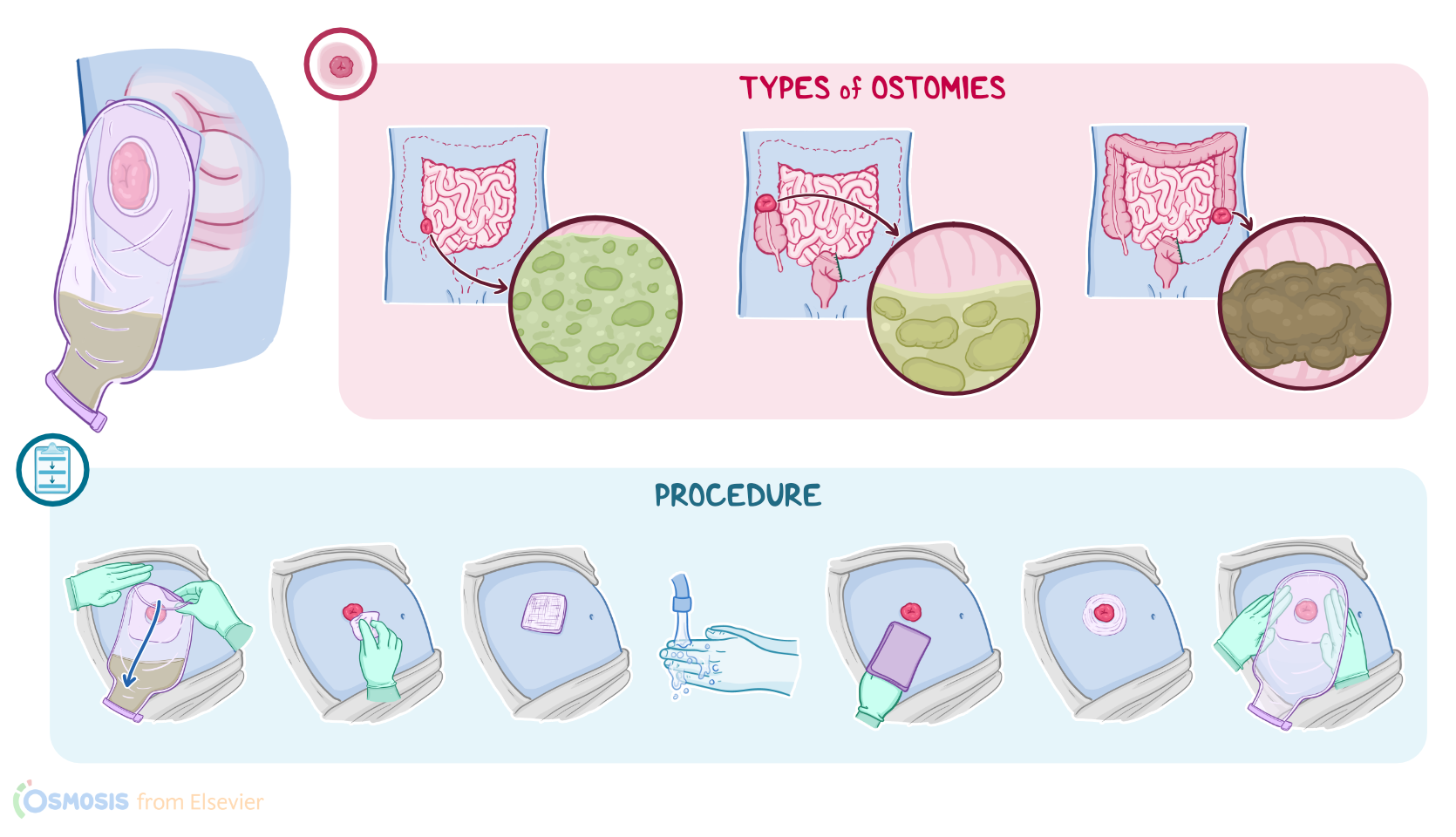
TYPES OF OSTOMIES
  • Ileostomy
    • Involves the ileum of the small intestine 
    • Stool is semi liquid
    • Flows at a fairly constant rate
  • Colostomy 
    • Involves the colon or large intestine 
    • Ascending colon produces watery loose stool
    • Descending colon produces more solid stool

TYPES OF OSTOMY POUCHING SYSTEMS
  • Drainable pouches 
    • Open ended and reusable 
    • Sealed with clip or Velcro system 
  • Closed ended pouches 
    • Disposable and replaced when full 
  • Skin barriers
    • Pre cut barriers 
      • Come in various stoma sizes 
    • Cut to fit barriers 
      • Require manual cutting to fit stoma 
  • System configuration 
    • One piece system 
      • Skin barrier is attached to pouch 
    • Two piece system 
      • Skin barrier and pouch are separate

COMMON CARE TIPS
  • Preparation  
    • Identify patient 
    • Explain the procedure clearly 
    • Answer any patient questions 
    • Maintain privacy and comfort 
      • Close door and draw bed curtains 
      • Keep patient covered as much as possible 
    • Choose appropriate position 
      • Standing sitting or lying in bed 
      • Can also be done in the bathroom 
    • Timing for colostomy care 
      • Choose time when stoma is inactive 
      • Morning is usually best 
  • Stoma care 
    • Stool can irritate surrounding skin 
    • Keep area clean and dry 
    • Use warm water for cleaning 
      • Test temperature with inside of wrist 
    • Fit the pouching system properly 
      • For pre cut systems match stoma size 
      • For cut to fit systems use measuring guide 
      • Cut opening slightly larger than stoma

OSTOMY CARE PROCEDURE
  • Supplies 
    • Two pairs of clean gloves 
    • Towel or bed protector 
    • Bedpan
    • Wash basin 
    • Warm water
    • Washcloths 
    • Adhesive remover, if needed 
    • Clean pouching system 
  • Preparation
    • Raise bed to comfortable height 
    • Position patient for stoma access 
    • Place towel or bed protector under patient 
  • Procedure
    • Remove soiled pouching system 
      • Loosen skin barrier with one hand 
      • Press skin with other hand while lifting 
      • Gently pull from top to bottom 
        • Use warm water or adhesive remover if needed 
      • Place soiled pouch in bedpan 
      • Observe stool color amount and consistency 
    • Clean and assess 
      • Remove gloves and wash hands 
      • Put on clean gloves 
      • Fill basin with warm water 
      • Clean rinse and dry peristomal skin gently 
      • Observe stoma for color and moisture 
      • Check peristomal skin for damage 
      • Minor bleeding is normal 
    • Apply new pouching system 
      • Remove backing from skin barrier 
      • Center over stoma with end pointing down 
      • Press edges to ensure good seal 
    • Finish procedure
      • Remove bed protector 
      • Check clothing and linens for cleanliness 
      • Remove gloves and perform hand hygiene 
      • Adjust clothing to cover pouch 
      • Assist patient to comfortable position 
      • Lower bed to original height

CLINICAL IMPLICATIONS
  • Abnormal signs and symptoms
    • Bluish or black stoma color 
    • Skin breakdown around the stoma 
    • Excessive bleeding from or near stoma 
    • Major changes in stool appearance 
    • Patient reports pain or discomfort
  • Document
    • Date and time of care provided 
    • Type of pouching system used 
    • Stool color and consistency 
    • Any abnormal findings or changes 
    • Actions taken and patient response
  • Notify HCP of abnormal findings
  • Support patient emotionally

Transcript

Watch video only

An ostomy is a surgically created connection between an internal organ and the outside of the body. When an ostomy is created within the abdominal wall, a piece of intestine is brought through the opening, and the part of the intestine that’s seen on the abdomen’s surface is called a stoma. 

The stoma is connected to a pouching system, also called an appliance, that’s composed of a skin barrier or adhesive wafer that attaches to the skin, and a pouch where stool and flatus collect. These ostomies can be permanent or temporary and can be necessary because of conditions like an intestinal tumor, bowel trauma, or inflammatory bowel disease; or to allow the bowel to rest and heal after surgery.

Now, an ostomy can be either an ileostomy or a colostomy depending on its location within the intestines. An ileostomy involves part of the small intestine, called the ileum; whereas a colostomy involves the part of the large intestine, or colon.

Keep in mind that normally, in the small intestine, the stool is mostly liquid because the majority of water is normally reabsorbed in the large intestine.

So, with an ileostomy, the stool is usually semi-liquid, and it flows at a fairly constant rate.

On the other hand, with a colostomy, the stool will have a different consistency depending on its location within the colon. So, if the colostomy is located near the beginning of the colon, like in the ascending colon, the stool is typically watery and loose; while if the colostomy is located near the end of the colon, like in the descending colon, the stool will be more solid.

Okay, let’s move on and discuss the types of pouching systems. There are drainable, or open-ended pouches, which are sealed with a clip or Velcro-type system at the bottom so they can be drained and reused. Then there are closed-ended, or disposable pouches which can be removed and replaced when full. Additionally, some pouching systems have pre-cut skin barriers, so they come in different sizes to match various stoma sizes. For other types, you’ll need to cut out the opening yourself.

Another variation refers to whether or not a skin barrier is attached to the pouch. If it is, it’s a one-piece; if not, it’s a two-piece.

Now, no matter the type of ostomy, there are some common care tips to keep in mind while providing ostomy care.

Before beginning, identify your patient, inform them about the procedure, and answer any questions they may have related to the procedure.

Close the door, draw the bed curtains, and keep them covered as much as possible to maintain privacy.

You can perform ostomy care when your patient is standing or sitting, or it can be done in the bathroom or while they are lying in bed.

For colostomies, you should choose a time to provide care when the stoma is not active, such as first thing in the morning. Also remember that the skin around the ostomy is in direct contact with stool, which can irritate the skin, so care should be taken to keep it clean. Remember to always use warm water for ostomy care, and you can make sure it’s at a comfortable temperature by testing it with the inside of your wrist.

Now, if you’re using a pre-cut pouching system, the opening should match the size of the stoma. If you cut the opening yourself, measure the stoma using a measuring guide, and trace the measurement on the skin barrier. Then, cut the opening a little larger than the stoma, to avoid putting pressure on it.

Now, to provide ostomy care, you’ll need two pairs of clean gloves; a towel or bed protector; a bed pan; a wash basin filled with warm water; washcloths; adhesive remover, if needed; and a clean pouching system.

In order to care for a patient with a pre-cut one-piece disposable pouching system, first raise the bed to a comfortable working height,

Sources

  1. "Fundamentals of nursing (11th ed.). ISBN: 9780323749619 " Elsevier (2025)
  2. "Clinical nursing skills & techniques (11th ed.). ISBN 978-0-443-10718-4 " Elsevier (2025)