Hygiene - Urinary catheter care: Nursing skills

1,864views

Hygiene - Urinary catheter care: Nursing skills

Adult Nursing 1 AAS

Adult Nursing 1 AAS

Charge nurse as a leader: Nursing
Health history: Nursing
Health literacy: Nursing
Health and illness models: Nursing
Health promotion and illness prevention: Nursing
Chronic disease: Nursing
Palliative and hospice care: Nursing
Body fluid compartments
Complete metabolic panel (CMP) - Chloride: Nursing
Complete metabolic panel (CMP) - Sodium: Nursing
Complete metabolic panel (CMP) - Potassium: Nursing
Complete metabolic panel (CMP) - Calcium: Nursing
Renin-angiotensin-aldosterone system
Arterial blood gas (ABG) - Metabolic acidosis: Nursing
Arterial blood gas (ABG) - Respiratory acidosis: Nursing
Arterial blood gas (ABG) - Metabolic alkalosis: Nursing
Arterial blood gas (ABG) - Respiratory alkalosis: Nursing
Arterial blood gas (ABG) - Overview: Nursing
Preoperative care: Nursing
Postoperative care: Nursing
Biology of cancer: Nursing
Physiology of pain: Nursing
Respiratory system anatomy and physiology
Geriatric considerations - Respiratory: Nursing
Ventilation
Foreign body aspiration and upper airway obstruction: Nursing process (ADPIE)
Pharyngitis: Nursing
Anatomy of the larynx and trachea
Laryngeal cancer: Nursing
Care of an intubated client: Nursing skills
Acute respiratory distress syndrome (ARDS): Nursing
Tuberculosis (TB): Nursing
Atelectasis: Nursing
Chronic obstructive pulmonary disease (COPD): Nursing process (ADPIE)
Lung cancer: Nursing
Asthma: Nursing process (ADPIE)
Pleural effusion: Nursing
Chronic bronchitis
Emphysema
Pulmonary embolism
Pneumonia
Chest tube care: Nursing
Oxygenation - Oxygen therapy: Nursing skills
Pulmonary edema: Nursing
Pulmonary hypertension
Pleurisy: Nursing
Flail chest: Nursing
Pulmonary contusion: Nursing
Rib fracture: Nursing
Pneumothorax and hemothorax: Nursing
Bacterial pneumonia: Nursing process (ADPIE)
Geriatric considerations - Cardiac: Nursing
Cardiac work
Stroke volume, ejection fraction, and cardiac output
Cardiac cycle
Arrhythmias - Heart blocks: Nursing
Shock - Cardiogenic: Nursing
Arrhythmias - Premature atrial contractions (PACs): Nursing
Cardiac afterload
Cardiac preload
Abnormal heart sounds
Heart failure: Pathology review
Heart failure
Normal heart sounds
Cardiovascular system anatomy and physiology
Pericardial effusion and cardiac tamponade: Nursing process (ADPIE)
Cardiac contractility
Arrhythmias - Supraventricular tachycardia (SVT): Nursing
Anatomy of the heart
Vital signs - Pulse: Nursing skills
Cardiac biomarkers - Troponin: Nursing
Cardiac conduction system
Arrhythmias - Sinus tachycardia and sinus bradycardia: Nursing
ECG rate and rhythm
Arrhythmias - Ventricular tachycardia (Vtach): Nursing
Cardiac biomarkers - Creatine kinase (CK): Nursing
Valvular heart disease: Nursing
ECG basics
Pericarditis: Nursing
Rheumatic heart disease: Nursing process (ADPIE)
Aortic valve disease
Cardiomyopathy: Nursing
Arrhythmias - Premature ventricular contractions (PVCs): Nursing
Physical assessment - Heart and neck vessels: Nursing
Vital signs - Blood pressure (BP): Nursing skills
Hypertension: Nursing process (ADPIE)
Atherosclerosis and arteriosclerosis: Pathology review
Coronary artery disease (CAD) and angina pectoris: Nursing process (ADPIE)
Myocardial infarction (MI): Nursing process (ADPIE)
Myocarditis: Nursing
Left-sided heart failure: Nursing process (ADPIE)
Arrhythmias - Atrial flutter (Aflutter): Nursing
Arrhythmias - Asystole: Nursing
Arrhythmias - Ventricular fibrillation (Vfib): Nursing
Mitral valve disease
Endocarditis: Nursing
ECG axis
ECG intervals
Electrocardiogram (ECG) - Normal sinus rhythm (NSR): Nursing
Arrhythmias - Atrial fibrillation (Afib): Nursing
Action potentials in pacemaker cells
Peripheral arterial disease (PAD): Nursing process (ADPIE)
Peripheral venous disease (PVD): Nursing process (ADPIE)
Arterial embolism: Nursing
Physical assessment - Peripheral vascular system: Nursing
Raynaud phenomenon: Nursing
Aortic aneurysm: Nursing process (ADPIE)
Aneurysms
Venous thromboembolism (VTE): Nursing process (ADPIE)
Blood components
Platelet plug formation (primary hemostasis)
Coagulation (secondary hemostasis)
Complete blood count (CBC) - Red blood cells (RBC): Nursing
Complete blood count (CBC) - White blood cells (WBC) and differential: Nursing
Complete blood count (CBC) - Hemoglobin and hematocrit: Nursing
Complete blood count (CBC) - Platelets: Nursing
Anemia - Macrocytic: Nursing
Anemia - Aplastic: Nursing
Anemia - Iron-deficiency: Nursing
Non-hemolytic normocytic anemia: Pathology review
Anemia of chronic disease: Year of the Zebra
Pernicious anemia: Year of the Zebra
Thalassemia: Nursing
Vitamin B12 deficiency
Polycythemia: Nursing
Platelet disorders: Pathology review
Essential thrombocythemia (NORD)
Coagulation studies - Prothrombin time (PT) and international normalized ratio (INR): Nursing
Coagulation studies - Partial thromboplastin time (PTT): Nursing
Disseminated intravascular coagulation (DIC): Nursing
Thrombocytopenia: Nursing
Leukemia: Nursing process (ADPIE)
Lymphoma - Hodgkin and non-Hodgkin: Nursing
Multiple myeloma: Nursing
Blood groups and transfusions
Blood transfusion reactions and transplant rejection: Pathology review
Gastrointestinal system anatomy and physiology
Geriatric considerations - Gastrointestinal: Nursing
Physical assessment - Abdomen: Nursing
Physical assessment - Anus, rectum, and prostate: Nursing
Liver anatomy and physiology
Complete metabolic panel (CMP) - Liver function tests (LFT): Nursing
Jaundice: Nursing
Achalasia: Year of the Zebra
Hiatal hernia: Nursing process (ADPIE)
Gastroesophageal reflux disease (GERD): Nursing process (ADPIE)
Esophageal disorders: Pathology review
Esophageal cancer: Nursing
Nutrition - Enteral: Nursing skills
Peptic ulcer disease (PUD): Nursing process (ADPIE)
Gastric cancer: Nursing
Diarrhea: Nursing
Irritable bowel syndrome (IBS): Nursing
Malabsorption syndromes: Pathology review
Appendicitis: Nursing process (ADPIE)
Diverticular disease: Nursing
Diverticulosis and diverticulitis
Inflammatory bowel disease - Crohn disease and ulcerative colitis: Nursing
Hygiene - Ostomy care: Nursing skills
Colorectal cancer: Nursing
Intestinal obstruction: Nursing
Gastrointestinal bleeding: Pathology review
Medications for hepatic encephalopathy: Nursing pharmacology
Hepatitis: Nursing
Hepatitis A and Hepatitis E virus
Hepatitis C virus
Cirrhosis: Nursing process (ADPIE)
Liver cancer: Nursing
Cholelithiasis: Nursing
Cholecystitis: Nursing
Pancreatitis: Nursing process (ADPIE)
Pancreatic cancer: Nursing
Renal system anatomy and physiology
Anatomy of the urinary organs of the pelvis
Glomerulonephritis: Nursing
Poststreptococcal glomerulonephritis
Nephrotic syndrome: Nursing
Acute kidney injury (AKI): Nursing process (ADPIE)
Chronic kidney disease (CKD): Nursing
The role of the kidney in acid-base balance
Complete metabolic panel (CMP) - Estimated glomerular filtration rate (eGFR): Nursing
Erythropoietin
Geriatric considerations - Urinary: Nursing
Dialysis care: Nursing
Renal cancer: Nursing
Urinary tract infections (UTIs): Nursing process (ADPIE)
Pyelonephritis: Nursing
Urinary incontinence - Stress: Nursing process (ADPIE)
Urinary retention: Nursing
Renal and urinary calculi: Nursing
Bladder tumors: Nursing
Hygiene - Urinary catheter care: Nursing skills
Renal clearance

Notes

HYGIENE - URINARY CATHETER CARE

KEY POINTS
NOTES
DEFINITION
  • Tube inserted into bladder to drain urine 
    • Used before during or after surgery 
    • Helps monitor urine output 
    • Used for patients with incontinence 
    • Protects wounds or ulcers from urine 
    • Allows collection of sterile urine samples 
  • Importance of catheter care 
    • Prevents urinary tract infections (UTIs) 
    • Indwelling catheter can allow bacteria to enter bladder 
    • Normal urination flushes bacteria from urinary tract 
    • Catheter bypasses this natural defense

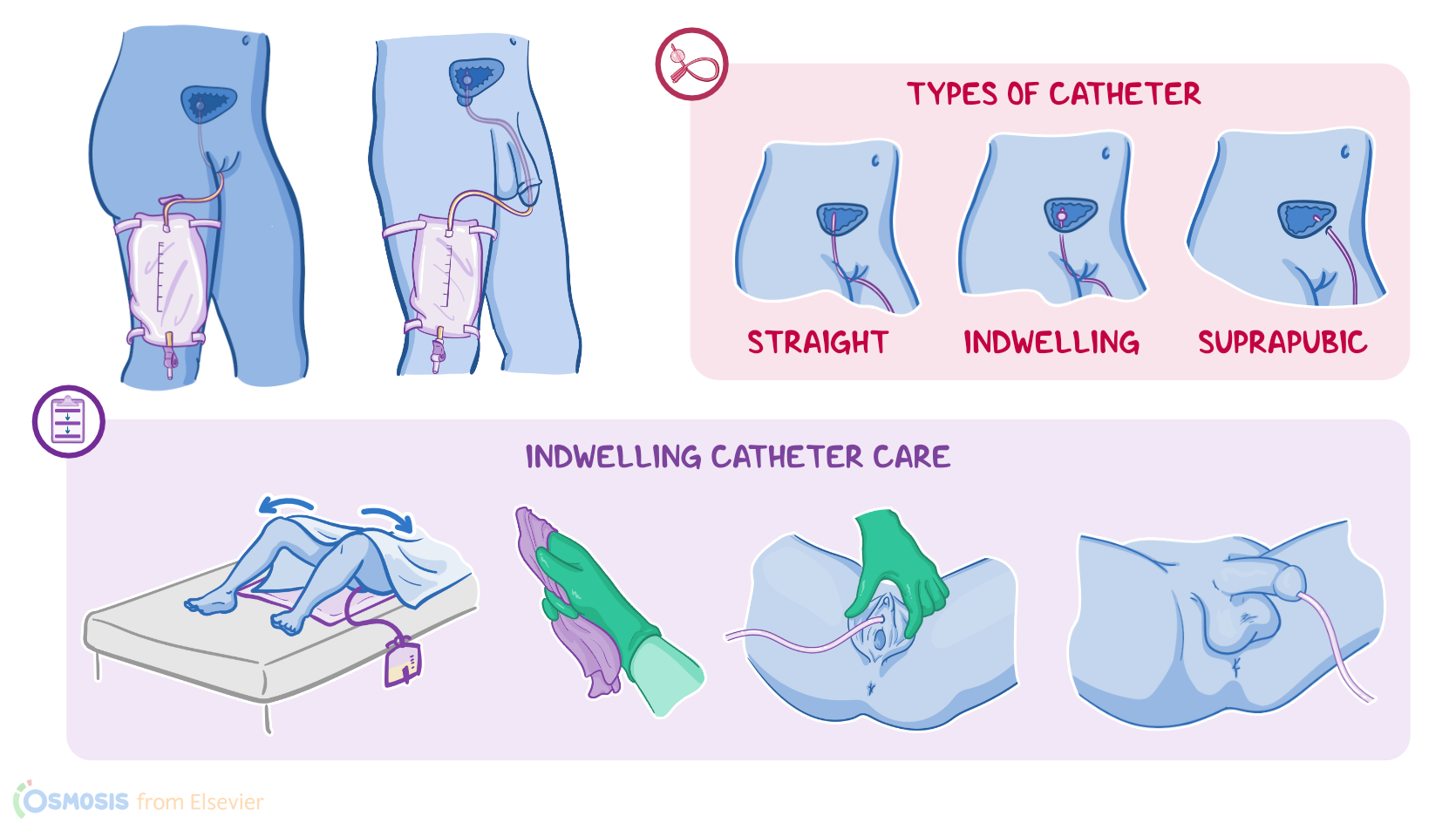
TYPES OF CATHETERS
  • Straight catheter 
    • Inserted through urethra into bladder 
    • Removed after urine is drained 
  • Indwelling catheter 
    • Also called Foley or retention catheter 
    • Inserted through urethra into bladder 
    • Remains in place for continuous drainage 
    • Connected to a drainage bag 
  • Suprapubic catheter 
    • Inserted through surgical incision above pubic bone 
    • Enters bladder directly through abdominal wall

PARTS OF AN INDWELLING CATHETER
  • Balloon 
    • Inflated inside bladder to hold catheter in place 
  • Tubing 
    • Connects catheter to drainage bag 
    • Double lumen catheter 
      • One lumen for urine drainage 
      • One lumen to inflate balloon 
    • Triple lumen catheter 
      • One for urine drainage 
      • One for balloon inflation 
      • One for bladder irrigation 
  • Bladder irrigation 
    • Helps prevent blood clots 
    • Common after prostate surgery

COMMON CARE TIPS
  • Respect patient privacy 
    • Close room door
    • Draw bedside curtain 
  • Preparation 
    • Unclip catheter tubing 
    • Avoid pulling or tugging catheter
  • After care is complete 
    • Re-secure catheter tubing 
    • Ensure tubing has no kinks 
    • Make sure patient is not lying on tubing 
  • Drainage bag positioning 
    • Always keep bag below bladder level 
      • Prevents backflow of urine into bladder

ROUTINE INDWELLING CATHETER CARE
  • Preparation  
    • Lock bed wheels for safety 
    • Lower side rail on working side 
    • Flatten the bed by lowering head section 
    • Fill wash basin with comfortably warm water 
    • Cover over bed table with paper towels 
    • Place basin soap towels and washcloths on table 
  • Patient setup 
    • Don clean gloves 
    • Place waterproof pad under patient’s buttocks 
    • Cover patient with bath blanket 
    • Expose only the genital area 
    • Ask patient to bend knees and open legs 
    • Assist if patient cannot do this alone 
  • Perineal care 
    • Wrap washcloth around one hand 
    • Wet with warm water and apply soap 
    • For biological female patients 
      • Use other hand to separate labia 
      • Wipe from top of vulva to anus 
      • Use a clean part of washcloth for each swipe 
      • Rinse and dry thoroughly 
    • For biological male patients 
      • If circumcised: start at top of penis 
      • If uncircumcised: retract foreskin gently 
      • Wash in circular motion down to base 
      • Rinse and dry thoroughly 
      • Reposition foreskin if retracted 
  • Catheter care 
    • Clean catheter in circular motion 
    • Start near urinary meatus and move outward 
    • Clean about 10 cm (4 inches) of tubing 
  • After care 
    • Remove gloves and assist patient to supine position 
    • Ensure clothing and linens are clean 
    • Raise side rails and head of bed

EMPTYING A URINE DRAINAGE BAG
  • Supplies  
    • Clean gloves 
    • Paper towels 
    • Graduate container 
    • Alcohol wipes 
  • Procedure steps 
    • Put on clean gloves 
    • Place graduate on floor under drainage bag 
    • Unhook and unclamp the drainage spout 
    • Allow urine to drain fully into graduate 
    • Check for kinks and ensure full drainage 
    • Clean spout with alcohol wipe 
    • Re-clamp and reattach spout to holder 
    • Measure and record urine volume 
    • Empty graduate into toilet 
    • Remove gloves and perform hand hygiene

REPORTING AND DOCUMENTATION
  • Notify HCP:
    • Changes in urine color, clarity, or odor 
    • Blood or particles in the urine 
    • Urine not flowing freely through tubing 
    • Patient reports pain burning or irritation 
    • Redness swelling or discharge at insertion site 
    • Urine leaking from catheter or tubing 
  • Documentation  
    • Record date and time of procedure 
    • After routine catheter care 
      • Note condition of skin around insertion site 
    • After emptying drainage bag 
      • Record urine color, volume, and quality 
      • Include any abnormal findings


Transcript

Watch video only

A urinary catheter is a tube that goes into the bladder that drains urine. This is commonly used in a variety of situations, such as before, during, or after an operation, in order to keep the bladder empty. It’s also used to accurately measure the amount of urine produced by critically ill clients or clients receiving IV therapy, inclients with wounds or pressure ulcers that need to be protected from contact with urine, in clients with urinary obstruction or retention, or to collect sterile urine samples. Catheter care is essential for preventing catheter-associated urinary tract infections, called CAUTIs, because an indwelling catheter is a pathway for bacteria to move up from the perineum into the bladder. This is important because, during normal urination, the urine flow acts as a natural way to “flush” bacteria out of the urinary tract.

Now, the most common types of urine catheters are straight, indwelling, and suprapubic catheters. Both straight and indwelling catheters are inserted into the bladder through the urethra, but the difference is that a straight catheter is removed once the urine is drained, while an indwelling urinary catheter, also called Foley catheter or retention catheter, remains in the bladder and lets the urine drain continuously into a drainage bag. With the suprapubic catheter, “supra-” means above and “pubic” refers to the pubic bone, so it is inserted into the bladder through a surgical incision made above the pubic bone.

Let’s focus on the indwelling catheter. This consists of a soft balloon that is inflated inside the bladder to keep the catheter from slipping out and a length of tubing, which connects the catheter with a drainage bag for collecting urine. Indwelling catheters may have two or three lumens. In double-lumen indwelling catheters, one is for urine drainage and the other one is used to inflate the balloon. In triple-lumen indwelling catheters, the additional lumen is used to regularly deliver irrigation fluid into the bladder. This can help prevent blood clots from forming, which is important in certain cases, like after a prostate surgery.

Before we talk about how to provide the best catheter care, here are some general considerations. Remember to close the room’s door and bedside curtain and respect the client’s privacy. Before beginning the procedure, unclip the catheter tubing from the bed linens. When caring for a client, make sure you do not pull or tug on the catheter. When you are finished, secure the catheter tubing again and make sure that it doesn’t have any kinks and that the client is not lying on top of it. You also need to make sure that the drainage bag is placed below the level of the bladder to prevent the urine from flowing back into the bladder. Okay, for routine indwelling catheter care, start by making sure that the wheels on the bed are locked and the side railings on the working side are down. Inform the client about the procedure before beginning and answer any questions related to the procedure. Lower the head of the bed so that the bed is flat. Fill the wash basin with water and check that the temperature is comfortably warm. Cover the over-bed table with paper towels and use it to place the basin together with soap, towels, and washcloths. Next, put your gloves on, position a waterproof bed pad under the client’s buttocks to protect the bed linens, and cover them with a bath blanket, exposing only the genital area. Ask them to open their legs and bend their knees, if they can; if not, help them to do so. Wrap a washcloth around one hand, wet it with warm water, and apply soap.

Now, if the client has a vagina, use your other hand to separate the labia. Next, move the washcloth downwards from the top of the vulva towards the anus. Remember to use a different part of the washcloth with each swipe and repeat until the area is clean. Then make sure to rinse and dry the washed areas rigorously.