Hypospadias and epispadias: Nursing
Hypospadias and epispadias are congenital conditions associated with an abnormal position of the urethral opening. In hypospadias, the urethral opening is located along the underside of the penis, on its ventral surface; while in epispadias the urethral opening is positioned along the upper side of the penis, on its dorsal surface.First, let’s cover some basic physiology and embryology of the male external genitalia.
Around the 8th week of pregnancy, the testes start to produce testosterone, which is an androgen responsible for masculinization of the external genitalia.
So, in the genital tubercle, urogenital sinus, urogenital folds, and labioscrotal swellings, testosterone is converted to a more potent form called dihydrotestosterone or DHT for short.
In the urogenital sinus, it stimulates the formation of the bladder, prostate, bulbourethral glands, and the part of the urethra outside of the penis.
On the flip side, in the urethral folds, it stimulates the formation of the ventral shaft of the penis and the penile urethra.
Finally, dihydrotestosterone makes the urethral folds and the labioscrotal swellings fuse on the midline in order to form the ventral shaft of the penis, the penile urethra and the scrotum, respectively.Now, the exact cause of hypospadias and epispadias is still unknown, but some theories suggest they might be associated with abnormal levels of androgens and estrogens.
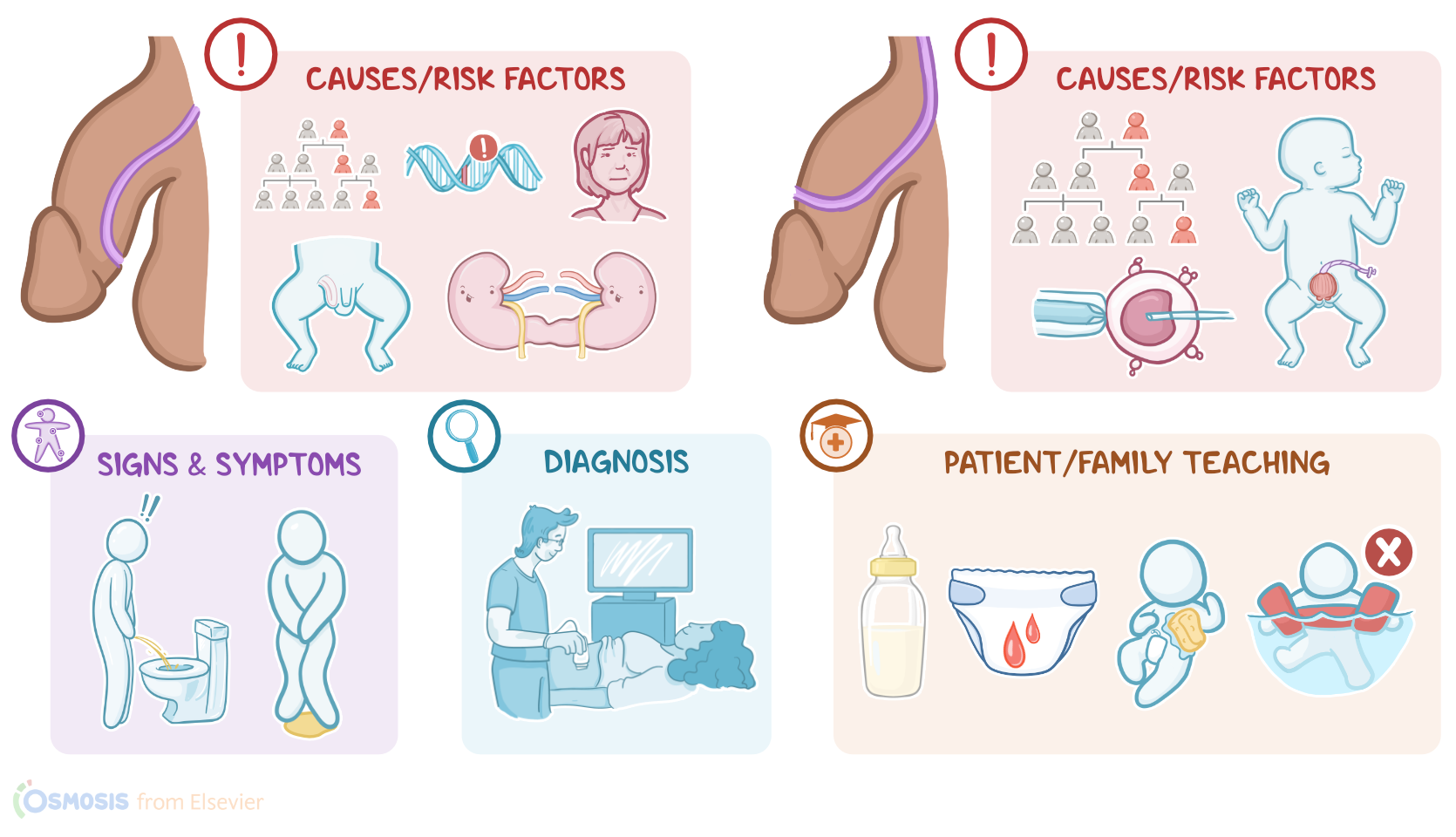
Important risk factors for hypospadias include family history, genetic mutations, maternal age over 35 years, maternal hypertension or diabetes, and maternal exposure to tobacco smoke or pesticides.Additionally, clients with some congenital conditions have a higher incidence of hypospadias than others.
These include inguinal hernia; which occurs when an internal organ, like intestines, protrudes through the inguinal canal; cryptorchidism, which refers to the absence of one or both testes from the scrotal sac; and chordee, or abnormal downward or upward curvature of the penis.
Hypospadias is also associated with renal congenital malformations, like renal agenesis, or the absence of one or both kidneys; horseshoe kidney, or fused kidneys; or ureteropelvic junction obstruction.
On the flip side, important risk factors for epispadias include family history, and assistive reproductive technologies, or ARTs for short.
Epispadias can also be associated with a congenital abnormality, called bladder exstrophy, which is where the bladder protrudes outside of the abdomen due to an abdominal wall defect.Now, pathology-wise, in clients with hypospadias, the urethral folds fail to meet up and close adequately, eventually leaving the urethral opening along the ventral side of the penis.
Based on the location of the urethral opening, hypospadias can be defined as glanular, or near the head of the penis; midshaft, or located in the middle of the penis; and penoscrotal, at the penis root, where the penis and scrotum come together.
On the other hand, clients with epispadias have a malpositioned genital tubercle that grows towards the rectal area instead of the head.
Based on the location of the urethral opening, epispadias can be defined as glanular, or near the head of the penis; penile, or located along the penile body; and penopubic, which are found at the root of the penis.
Finally, both hypospadias and epispadias can cause serious complications like erectile dysfunction and infertility.Alright, let’s switch gears and discuss clinical manifestations.
Clients with hypospadias present with an abnormal urethral opening along the ventral surface of the penis. On the other hand, clients with epispadias present with an abnormal urethral opening along the dorsal surface of the penis.
Other important clinical manifestations of hypospadias and epispadias include problems when aiming the stream of urine and urinary incontinence.Diagnosis of hypospadias and epispadias is based on the client’s history, physical assessment and detection of an abnormal urethral opening along the ventral or dorsal surface of the penis.
Prenatal diagnosis is also possible via an ultrasound, which usually shows a small, blunted penis. An ultrasound is also useful for detecting other anomalies commonly associated with hypospadias such as cryptorchidism, or other urologic malformations.
Treatment of hypospadias and epispadias requires surgical reconstruction of the urethra. This is indicated within the first 2 years of life and includes closure of the abnormal urethral opening and opening of the new one on the tip of the glans.
A surgeon can use the foreskin to reconstruct the urethra, therefore circumcision should not be performed in clients with hypospadias or epispadias.
After the reconstruction, some clients might present with postoperative complications like meatal stenosis, or stenosis of the urethral opening, urethral strictures, and subsequent obstruction of the urine flow.Okay, when caring for a client with hypospadias, your priority goals of nursing care are to provide postoperative care and monitor for complications.
Now, when providing postoperative care for your client, provide routine care and monitor for complications related to the procedure.
Encourage fluid intake to promote flow of urine, which will help prevent occlusion of the catheter; and closely monitor the amount of urine output.
Report to the healthcare provider if there is no urine output for one hour, as this could indicate the presence of an occlusion.
Now, to keep the urethral incision from being contaminated with stool, use the double diapering method to separate urine output from stool output.
Start by placing an appropriately sized diaper on your client, and then gently guide the catheter over the top of the diaper.
Then, ensure the catheter has no kinks or twists, and place a larger diaper over the existing diaper, and secure the catheter so it drains into the larger, outer diaper.
Remember to not cut a hole in the smaller diaper for the catheter since the absorbable beads can spill out and cause a clog in the catheter.
When providing diaper care, change the outside diaper when it’s wet, and change both diapers when there’s stool. Next, assess for pain using a facility approved pediatric pain scale, and administer analgesics as prescribed, as well anticholinergics to prevent bladder spasms.
Also ensure they receive the prescribed dose of antibiotics before discharge home.Okay, moving on to client and family teaching.
Begin by explaining how hypospadias occurs when the urethral opening is not in the usual place at the tip of the penis. Review proper administration of the prescribed medications including analgesics, anticholinergics, and antibiotics.
Finally, emphasize the importance of regular follow up appointments to ensure a successful recovery.Then, teach them how to care for their child at home.
Let them know it’s important for them to encourage fluid intake in order to maintain adequate urine output. And tell them it is normal for the urine to be pinkish for several days.
Instruct them to seek medical attention immediately if they notice bright red blood in the urine.Then, review the double-diapering method, and give them an opportunity to practice doing a diaper change.
Instruct them to give their child sponge baths until the catheter is removed. Also talk to them about the importance of encouraging their child to engage in quiet activities like coloring, reading, or playing with puzzles, and to avoid any activity that involves straddling such as ride-on toys.
Swimming or playing in a sandbox should also be avoided. Finally, instruct them to contact their healthcare provider right away if they notice signs of infection, like fever or cloudy, foul-smelling urine.Alright, as a quick recap… Hypospadias and epispadias are congenital conditions where there’s abnormal placement of the urethral opening.
In hypospadias, the urethral opening is on the underside, or ventral surface of the penis, while in epispadias the urethral opening is on the upper side, or dorsal surface.
Both conditions can cause problems with aiming the stream of urine, urinary incontinence, and can cause complications like erectile dysfunction and infertility.
During fetal development, with hypospadias, the urethral folds fail to meet up and close adequately, leaving the urethral opening on the ventral side of the penis.
With epispadias, on the other hand, there’s usually a malpositioned genital tubercle that grows toward the rectal area, rather than the head of the penis.
Risk factors for hypospadias include family history, genetic mutations, maternal age over 35, and maternal exposure to some substances and medications.
Clients with congenital conditions like inguinal hernias, cryptorchidism, and chordee have a higher incidence of hypospadias.
Additionally, hypospadias is associated with renal congenital malformations such as renal agenesis, horseshoe kidney, and ureteropelvic junction obstruction.
Diagnosis is based on history, physical assessment, and detection of an abnormal urethral opening on the ventral or dorsal surface of the penis.
An excretory urogram, also known as an intravenous pyelogram, can be used to visualize the urogenital tract and the presence of associated congenital abnormalities.
Treatment requires surgical reconstruction of the urethra within the first 2 years of life. Nursing management goals include providing postoperative care and monitoring for complications.
Client and family teaching includes care at home and
| HYPOSPADIAS AND EPISPADIAS | ||
| KEY POINTS | NOTES | |
| DEFINITION |
| |
| PHYSIOLOGY |
| |
| CAUSES AND RISK FACTORS |
| |
| PATHOPHYSIOLOGY |
| |
| SIGNS AND SYMPTOMS |
| |
| DIAGNOSIS |
| |
| TREATMENT |
| |
| MANAGEMENT OF CARE |
| |
| PATIENT AND FAMILY TEACHING |
| |
No notes for this video yet
Try adding a note below