Intracranial aneurysm: Nursing
Introduction0:00–0:23
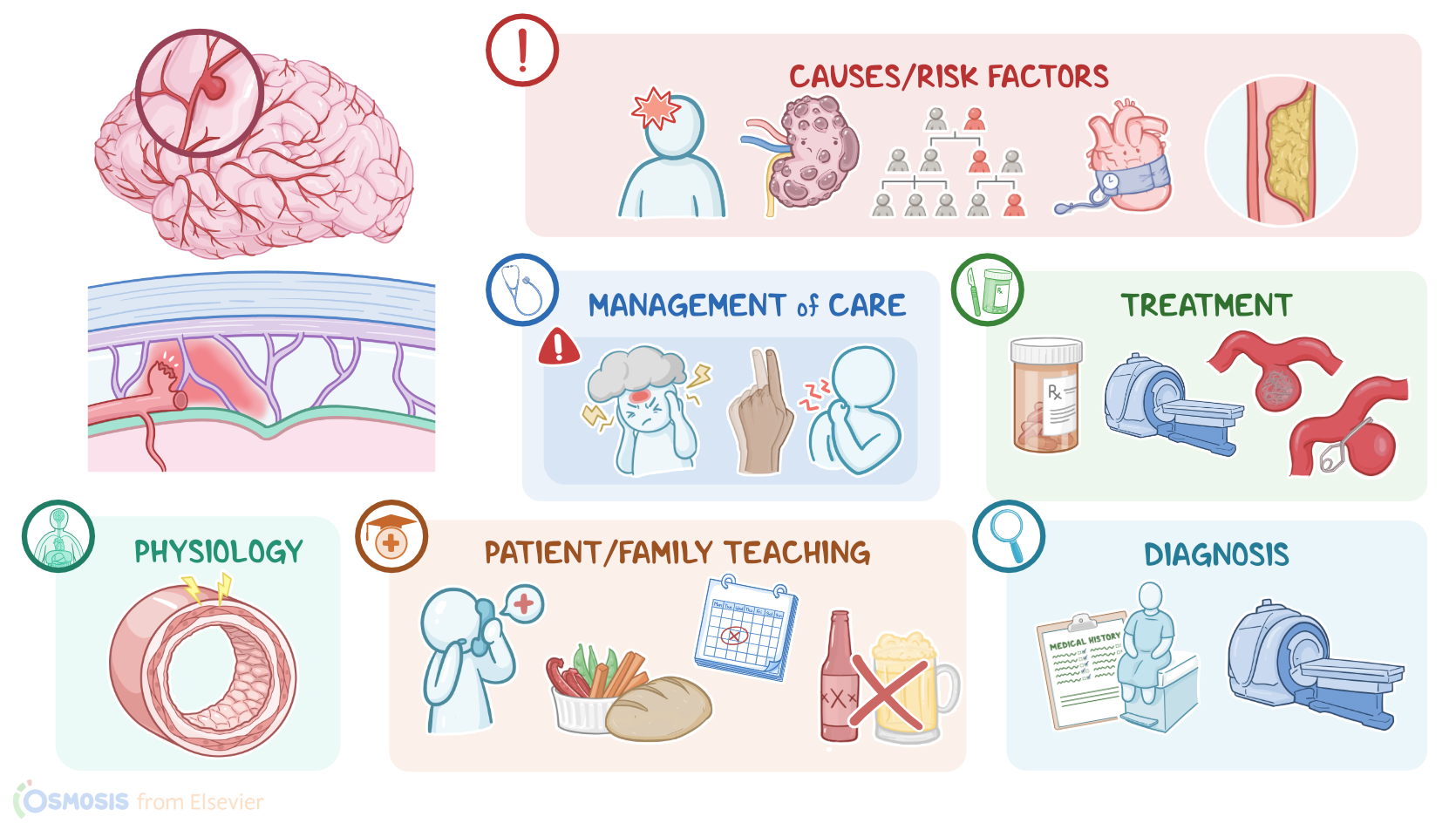
Aneurysms are abnormal dilations in a blood vessel that form in weakened areas of the blood vessel walls. Aneurysms can happen to any blood vessel in your body, including the cerebral vessels, in which case they’re called intracranial or cerebral aneurysms.Alright, let’s go over some physiology.
Physiology0:23–1:17
There are three major types of blood vessels: arteries, veins, and capillaries. Normally, blood flows from large arteries into medium and then small arteries called arterioles, which in turn carry the blood to capillary beds.
All arterial vessels have three layers: from outside in, there’s tunica externa or the adventitia layer, which has loose connective tissue, and sometimes, vasa vasorum or vessels that supply the artery; then tunica media or the media layer, which contains some elastic tissue and smooth muscle that allow the arteriole to dilate or constrict in response to local conditions; and finally the endothelium, which consists of a single layer of endothelial cells on top of a layer of connective tissue, called lamina propria.
Alright, now the main cause of intracranial aneurysms is weakness in the walls of cerebral blood vessels, which can be due to injury to the blood vessel wall.
Causes & risk factors1:17–2:27
Genetic disorders, like Ehlers-Danlos and Marfan syndromes, impairs the body’s ability to synthesize connective tissue proteins like fibrillin or collagen, which lead to weakened blood vessel walls and result in aneurysm formation.In terms of risk factors for intracranial aneurysms, modifiable ones include hypertension, atherosclerosis, and cigarette smoking, as well as alcohol and cocaine use.
Now, non-modifiable risk factors include age between 40 and 60, family history of aneurysms or stroke, and being assigned female at birth.
Clients with polycystic kidney disease, and fibromuscular dysplasia are also at an increased risk for intracranial aneurysm formation.Now, the pathology of intracranial aneurysms starts when there’s too much stress on the tunica media of the artery, which weakens the vessel wall and allows blood flow to get turbulent.
Physiology2:27–4:13
This stretches the elastic lamina, as well as tunica externa, causing the blood vessel wall to weaken. And when this happens, the blood vessel wall struggles to contain the pressure of the blood pushing against the walls so the diameter of the blood vessel lumen increases.
Over time, the bulging blood vessel can compress brain tissue or nearby nerves.The most common type of intracranial aneurysms in adults is a saccular aneurysm where a section of the arterial wall balloons out and forms a sack.
These are also known as berry aneurysms because they look like a berry hanging from a stem. On the other hand, fusiform aneurysms form when an entire segment of an artery is dilated, so that part of the artery balloons out.The main complication of intracranial aneurysms is aneurysm rupture.
An aneurysm that forms on the circle of Willis causes a subarachnoid hemorrhage where the blood accumulates in the subarachnoid space between the brain and the arachnoid mater of the meninges.
Ruptured aneurysm deeper in the brain can cause intracerebral hemorrhage which can lead to ischemic strokes. Finally, another complication of intracranial aneurysms is blood clot formation, which is due to the stagnation of blood in the extra lumen space caused by the aneurysm itself.
Given enough time, the blood clot might become so big it blocks off the entire blood vessel, or it could break into smaller pieces called emboli and get wedged in a smaller blood vessel.
Both cases lead to ischemic stroke. Okay, now clients with small, unruptured intracranial aneurysms are typically asymptomatic, whereas those with a large unruptured intracranial aneurysm may present with headaches.
Clinical manifestations4:13–6:17
Focal neurological deficits can develop based on location of the aneurysm and what nerves they compress. For example, compression of cranial nerve III can lead to drooping eyelid, dilated pupil, and the eye deviating downwards and outwards.
Compression of cranial nerve VII can cause facial numbness or pain. In cases of ruptured intracranial aneurysm that leads to subarachnoid hemorrhaging, symptoms are typically more severe and include thunderclap headache, which is a sudden, severe headache described by clients as the worst headache in their life.
Loss of consciousness is another common symptom. Other key symptoms of a subarachnoid hemorrhage include those caused by blood pooling in the subarachnoid space and irritating the meninges.
This can cause nausea, vomiting, sensitivity to light, and stiff neck. Intracerebral hemorrhage is more likely to cause sudden onset headaches along with stroke-like symptoms with focal neurological defects depending on the location of the ruptured aneurysm and the resulting ischemia.
Next, the two most commonly used signs that indicate meningeal irritation are the Kernig sign and Brudzinski sign. They are also used to diagnose meningitis.
For the Kernig sign, the client lies flat in the supine position with their hip and leg flexed at 90 degrees. The clinician will then extend the leg, and pain indicates the test is positive.
The Brudzinski sign also starts with the client in the supine position, and the clinician will put their hand behind the client's head and gently flex the neck so the chin reaches towards the chest.
If neck flexion causes the client’s hips and knees to flex, that’s a positive test. Diagnosis of intracranial aneurysms starts with the client’s history, and physical assessment, followed by imaging tests including cerebral angiography, CT scan, MRI, and magnetic resonance angiography, or MRA for short.
Diagnosis6:17–6:55
In many cases, diagnosis occurs after rupture or incidentally when a client gets an imaging study for another reason. However, screening tests with MRA should be done for people with a family history of intracranial aneurysm and those with a disorder like Marfan syndrome or polycystic kidney disease that predispose them to aneurysm formation.
Treatment of small or asymptomatic intracranial aneurysms involves antihypertensive medications to control blood pressure, in addition to close monitoring of the growth of the aneurysm with frequent CT scans.
Treatment6:55–7:38
On the other hand, symptomatic aneurysms typically require surgical treatment, which involves clipping or coiling. Clipping refers to the placement of a clip at the base of the aneurysm, in order to limit blood flow, and prevent rupture.
Coiling involves placing a coil into the aneurysm, which closes off the aneurysm and prevents its rupture. Finally, the treatment of a ruptured aneurysm is focused on treating the associated complications, such as subarachnoid hemorrhage.
Alright, let’s look at the nursing care you’ll be providing for a client with an unruptured intracranial aneurysm. Your priority nursing goals are to manage their blood pressure, provide pain relief, and monitor for signs of rupture.Begin your interventions by assisting your client into a semi-Fowler position.
Management and care7:38–9:00
Then, institute aneurysm precautions, by providing your client with a calm, low-stimulation environment, dimming the lights, and reducing noise.
Whenever possible, limit invasive procedures and interventions like respiratory treatments or suctioning that may cause the client to cough which increases the risk of rupture.
Assess their baseline level of consciousness, blood pressure, and pain; and administer the prescribed analgesics and antihypertensives.During care, monitor for signs of rupture.
Immediately report to the healthcare provider if the client has signs and symptoms of a ruptured aneurysm such as severe headache; altered level of consciousness; vision changes like diplopia, photophobia, or loss of vision; neck stiffness, or sudden onset of nausea or vomiting.
Maintain the client’s airway, provide oxygen and respiratory support as indicated, and prepare to transport them for emergency surgical intervention.Alright, let’s move on to client and family teaching.
General client and family teaching9:00–10:34
Start by explaining that an intracranial aneurysm occurs when part of a blood vessel in their brain has become weak and dilated, and that it can rupture and bleed into their brain.
Emphasize the importance of attending all follow up appointments for routine imaging and monitoring.Then, teach them how they can decrease the risk of rupture.
Let them know that one of the most important things they can do to prevent rupture is to keep their blood pressure under control.
Teach them about their prescribed antihypertensive medication, and instruct them to take it exactly as directed. Then, review needed lifestyle modifications, including eating a healthy, low sodium, low saturated fat diet that contains plenty of fruits, vegetables, and whole grains; regular physical activity; and maintaining a healthy body weight.
Stress the importance of avoiding blowing their nose hard or straining when having a bowel movement. Advise them to limit alcohol intake, to avoid caffeine, and to check with their healthcare provider before taking any over-the-counter medications and supplements.
Lastly, provide counseling for smoking cessation, as needed.Finally, instruct them to seek emergency medical care immediately if they develop symptoms that indicate the aneurysm has ruptured, including a sudden, severe headache; nausea and vomiting; changes in vision, or altered consciousness.Alright, as a quick recap….
Review10:34–11:47
Intracranial aneurysms are abnormally dilated cerebral blood vessels that can form because of injury to the blood vessel wall, infection, or due to genetic conditions.
Focal neurological deficits can also occur based on the location of the aneurysm. If the aneurysm ruptures, manifestations can include a thunderclap headache, nausea, vomiting, light sensitivity, stiff neck, and altered levels of consciousness.
Two signs that can indicate meningeal irritation are the Kernig and Brudzinski signs. Depending on the size of the aneurysm and the severity of the client’s symptoms, treatment may involve blood pressure management and continued monitoring of the growth of the aneurysm with imaging, or surgical intervention to clip or coil the aneurysm.
Your priority goals are to manage their blood pressure, provide pain relief, and monitor for signs of rupture. Client and family teaching is focused on learning about their condition, lifestyle modifications, and recognizing when to seek emergency care.
| INTRACRANIAL ANEURYSM | ||
| KEY POINTS | NOTES | |
| DEFINITION |
| |
| PHYSIOLOGY |
| |
| CAUSES AND RISK FACTORS |
| |
| PATHOPHYSIOLOGY |
| |
| SIGNS AND SYMPTOMS |
| |
| DIAGNOSIS |
| |
| TREATMENT |
| |
| MANAGEMENT OF CARE |
| |
| PATIENT AND FAMILY TEACHING |
| |
No notes for this video yet
Try adding a note below