Lyme disease: Nursing process (ADPIE)
Client Report0:00–0:29
Jacob Myers is a 32-year-old male who presents to his primary care provider after discovering a painless bulls-eye looking rash on his thigh that has gotten bigger over the past three days.
He also reports symptoms of fatigue, fever, chills, muscle aches along with joint pain and stiffness that started three days after he returned from a week-long camping trip.
The provider suspects that Jacob has Lyme disease. Lyme disease is an infectious disease that’s caused by a bacterial species called Borrelia, most often Borrelia burgdorferi.
Pathology0:29–5:27
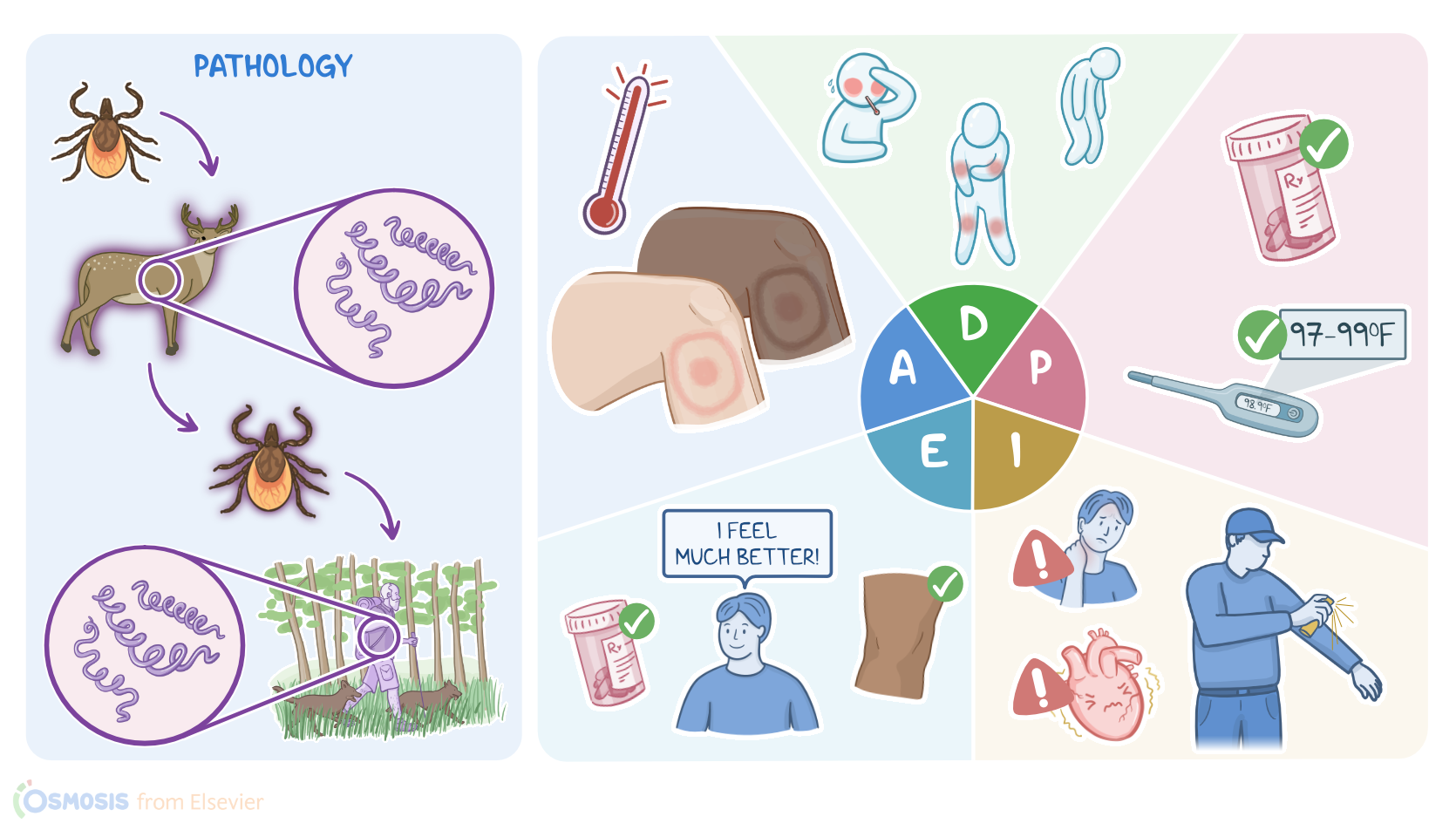
The Borrelia species are all spirochetes, which means that they are long, thin, and spiral-shaped.Now, Lyme disease is a zoonotic disease, meaning that it can infect a wide range of animals, including deer, cattle, and rodents, but it isn’t known to spread directly from animals to humans, but instead it needs a vector, meaning some sort of intermediate organism to spread from the animal to the human.
In Lyme disease, the vector is the Ixodes tick, which is often found in wooded areas, thick brush, marshes, and tall grass.
Now, the transmission of Lyme disease starts when the Ixodes tick feeds on the blood from an infected animal host. If this tick then feeds on the blood from a human, it will transmit the bacteria with their saliva.
Once the bacteria is in a human's bloodstream, it can disseminate to distant tissues, particularly the skin, joints, and heart, causing inflammation and damage.Now, there are some factors that may put a client at risk of Lyme disease, such as outdoor activities in wooded or grassy areas, like hiking and hunting, as well as some occupations like landscaping, farming, and railroad work.
The risk is also increased when clients wear clothing that exposes the skin. In addition, Lyme disease is more common during spring and summer, as ticks typically prefer warm temperatures.Now, symptoms of Lyme disease can progress through three stages.
The first is called the early localized stage, which starts within 1 month of the tick bite. Clients in this stage might report flu-like symptoms like fever, headache, fatigue and lymphadenopathy, as well as muscle or joint pain.
A characteristic symptom of the early localized stage of Lyme disease is erythema migrans, which is a painless, red skin lesion that slowly expands over a few days around the site of the tick bite, developing a bulls-eye shape.
Now, if the disease is not treated at its first stage, the bacteria can disseminate to places like the joints, heart, and brain.
The second stage of Lyme disease is the early disseminated stage which usually occurs within weeks to months from the initial infection, and can cause complications like arthritis, most often involving the knees, wrists, and ankles.
This is called transient migratory arthritis, which is when arthritis resolves in one joint and moves to affect another.
Another complication at this stage is carditis, or inflammation of the heart, which increases the risk for arrhythmias, such as atrioventricular block, where electrical impulses can’t pass from the atria to the ventricles.
Finally, the early disseminated stage can also cause neurological complications like meningoencephalitis and facial nerve palsy, where there’s a weakness on one side of the face.Ultimately, clients can reach the third stage of Lyme disease, also called the late disseminated stage, which usually develops months or sometimes even years after the initial infection.
The third stage typically presents with chronic arthritis, as well as neurological manifestations like chronic encephalopathy, gait abnormalities, fatigue, memory loss, and personality changes.
Finally, the third stage of Lyme disease can cause damage to peripheral nerves, which manifests as pain, numbness, and muscle weakness mainly involving the limbs.
Now, diagnosis of Lyme disease is typically based on history and physical examination. Diagnosis can be confirmed with blood tests, which look for antibodies against Borrelia.
This starts with enzyme-linked immunosorbent assay, or ELISA, and is then confirmed with Western blot. The diagnosis is confirmed only when both tests come back positive.
However, it’s important to keep in mind that these tests can initially give false-negative results, as the development of antibodies to a detectable level, called seroconversion, may take up to 8 weeks.
In addition, blood tests would show elevated inflammatory markers like erythrocyte sedimentation rate, or ESR for short.
Other tests include electrocardiography, or ECG, to assess for cardiac complications, as well as a lumbar puncture if meningitis is suspected.Now, the standard treatment of Lyme disease involves the use of antibiotics, and the choice depends on the disease stage.
For the early localized stage, the preferred antibiotic of choice is doxycycline, and the antibiotic of choice for the early and late disseminated stages is ceftriaxone.
Finally, supportive care can be provided as needed for complications, such as a temporary pacemaker for clients with arrhythmias, while those with arthritis may take NSAIDs to reduce the pain.As you begin your assessment, Jacob tells you about his recent camping trip when he found a tick on his thigh.
Assessment5:27–6:12
He pulled it off and didn’t think about it until later when he saw a large rash on his thigh that looked like a bulls-eye.
He says the rash has gotten bigger over the past three days and that it is painless. You notice the rash is raised along the edges and flat in the middle.
His vital signs are temporal temperature 101 F or 38.3 C, heart rate 100 beats per minute, respiratory rate 18 breaths per minute, blood pressure 122/78 mmHg, SpO2 99% on room air, and pain 5/10 located mostly in his joints.After performing your assessment, you formulate your nursing diagnoses which include elevated body temperature related to infectious process; fatigue related to illness; pain related to joint inflammation; and readiness for enhanced health management related to new therapeutic treatment regimen.
Diagnosis6:12–6:29
Now it is time to plan goals of care for Jacob. By his follow-up appointment in 2 weeks, Jacob’s temperature will be within normal limits; he will report less fatigue and joint pain and stiffness; and Jacob will adhere to his treatment regimen and incorporate ways to prevent Lyme disease when spending time outdoors.
Planning6:29–6:49
Alright, now it is time to begin implementing your plan of care for Jacob. The physician prescribes the antibiotic doxycycline.
Implementation6:49–7:35
You instruct him to take each dose with a full glass of water and to finish the entire course, even if he feels better after a few days.
For his joint stiffness, pain, and fever, the physician recommends an NSAID like ibuprofen. You stress the importance of letting his physician know if he experiences problems such as neck stiffness, increased joint pain, lightheadedness, or palpitations.
Finally, you review how to prevent tick bites on future camping trips by making sure his skin is sufficiently covered, and by using insect repellent with DEET as well as checking his whole body for ticks in areas where ticks are likely to be found.
Evaluation7:35–8:01
Two weeks later, Jacob is back for his follow-up appointment and you evaluate how he is doing. He states that he completed the entire course of doxycycline and that he feels much better.
His temporal temperature is 98.9 F or 37.1 C and he rates his pain at 2/10 located in his joints. He tells you he is a lot more conscientious of ticks when outdoors and during camping trips.
Summary8:01–8:40
Alright, as a quick recap … 32-year-old Jacob Myers came to his primary care provider after finding a large bulls-eye rash on his thigh.
Your assessment revealed that Jacob had fever, joint pain and stiffness and fatigue. Your nursing diagnoses included elevated body temperature; fatigue; pain; and readiness for enhanced health management.
Your interventions included providing prescriptions for the antibiotic doxycycline and ibuprofen, along with teaching about his treatment regimen and strategies to prevent future tick bites.
After treatment, you evaluated Jacob’s response to your interventions.
| LYME DISEASE | ||
| KEY POINTS | NOTES | |
| PATIENT REPORT |
| |
| PATHOPHYSIOLOGY |
| |
| DIAGNOSIS AND TREATMENT |
| |
| ASSESSMENT |
| |
| NURSING DIAGNOSES |
| |
| PLANNING |
| |
| IMPLEMENTATION |
| |
| EVALUATION |
| |
No notes for this video yet
Try adding a note below