Macular degeneration: Nursing
Introduction0:00–0:25
Macular degeneration is an eye condition in which the part of the retina that is responsible for clear vision, called the macula, degenerates.
This causes blurred or reduced central vision, and is typically related to aging. There are two main types of macular degeneration: dry or nonexudative, which is the most common one; and wet or exudative.Okay, but first, a bit of physiology.
Physiology0:25–1:12
The middle vascular layer is called the uvea and consists of the iris, pupil, ciliary body, and choroid. Finally, the neural layer consists of the retina, with its own outer pigmented layer, and an inner neural layer that’s composed of photoreceptor cells, called rods and cones, which convert light into neural signals that travel via the optic nerve to the brain for visual processing.Now, there’s an oval spot in the middle of the posterior retina, called the macula, which contains the highest concentration of cones and is the part of the retina that offers the highest visual acuity.Alright, now, even though the exact cause of macular degeneration is still unknown, several risk factors have been identified.
Causes & risk factors1:12–1:32
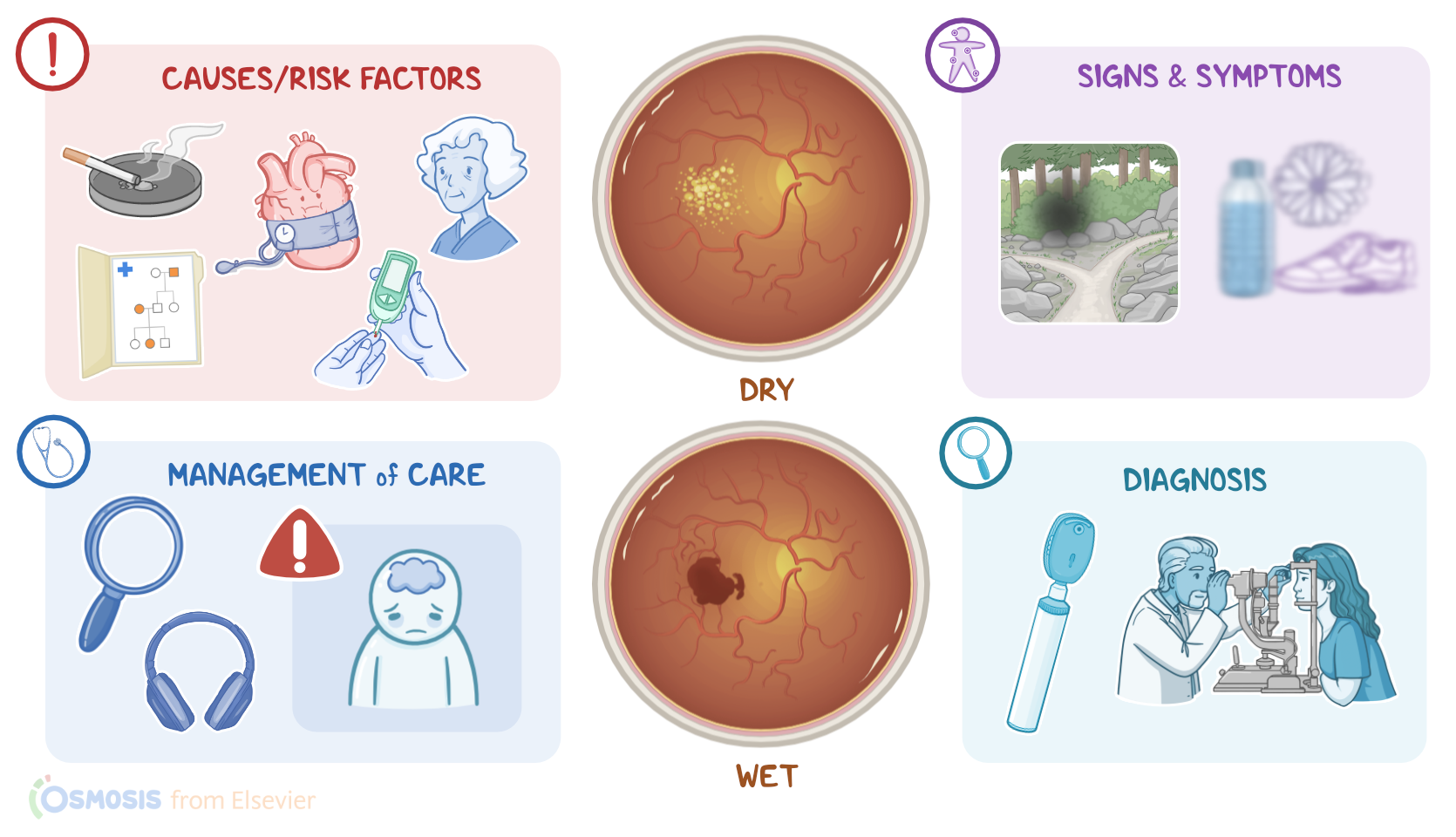
Modifiable risk factors include smoking, diabetes, hypertension, and hyperlipidemia, whereas non-modifiable risk factors include aging and a family history of macular degeneration.
Now, let’s look at the pathology of macular degeneration. Dry macular degeneration typically develops slowly over time and is characterized by yellowish extracellular deposits of waste materials, known as drusen, that build up between the choroid and the retinal pigment epithelium.
Pathology1:32–2:04
In terms of signs and symptoms, clients with macular degeneration typically present with blurry and distorted vision, poor night vision, as well as scotomas or missing areas of vision.
Clinical manifestations2:04–2:23
Eventually, clients can develop central vision loss and become legally blind, even though their peripheral vision remains intact.
The diagnosis of macular degeneration starts with the client’s history and physical assessment, followed by ophthalmoscopy and slit lamp biomicroscopy to examine the retina.
Diagnosis2:23–3:10
In dry macular degeneration, this shows the drusen, whereas in wet macular degeneration, retinal bleeding, and edema can be seen.
Other diagnostic tests include the Amsler grid test, which is basically a grid that has a small central dot and might help better define the areas of the visual field that are missing.
In addition, optical coherence tomography can be used to take cross-section pictures of the retina. Fluorescein angiography can be used to show the newly formed abnormal blood vessels in wet macular degeneration.
Treatment3:10–3:49
Now, treatment varies depending on the type of macular degeneration. For dry macular degeneration there’s no cure, so treatment focuses on slowing down vision loss.
Maintaining a healthy diet, as well as multivitamin and antioxidant supplements has been shown to help. On the other hand, wet macular degeneration can be treated with intraocular injection of anti-VEGF medications like ranibizumab, that inhibit the formation of new blood vessels, or ocular photodynamic therapy along with a light-sensitive drug called verteporfin.
Finally, laser photocoagulation therapy can be also done to seal off the leaking blood vessels.Alright, let’s take a look at the nursing care you will provide for a client with macular degeneration.
Management and care3:49–5:08
Priority nursing goals include promoting independence and safety despite decreased visual acuity, and to support the client with the psychological challenges that come with progressive vision loss.Beginning with your assessment, review the results of their visual acuity screening and other diagnostic tests, and ask them how their vision impairment has affected their daily activities like reading, watching television, toileting, grooming, preparing meals, and driving.
Then, collaborate with your client and the case manager to coordinate care and connect them with resources including vision rehabilitation services; adaptive equipment to maximize existing vision, such as magnifying lenses, hand held magnifiers, large print materials, audiobooks; transportation services; and home safety inspection to eliminate hazards.Then, assess how the client is coping and determine if they have a support system at home.
Allow the client to express their feelings about the condition and its impact on their ability to engage in daily activities, and help them to find positive coping strategies.
If they have signs of depression or suicidal ideation, report this to their health care provider immediately.Now, moving on to client and family teaching.
General client and family teaching5:08–6:47
Begin by explaining how macular generation causes impaired vision, and review the treatment plan. If your client is receiving treatment with VEGF inhibitors, explain how they are injected into the eye to prevent new blood vessels from forming.
Let them know that they will need to repeat their treatments every four to six weeks, and stress the importance of keeping all of their follow-up appointments.Then teach them that they can slow the progression of the disease by incorporating healthy lifestyle choices into their daily routine.
If your client smokes, advise them to stop smoking right away, and be sure to provide a referral for smoking cessation counseling.
Also, stress the importance of wearing sunglasses to protect them from UVA and UVB light, and let them know that maintaining a healthy diet rich in vitamins C, E, beta-carotene, and lutein can be helpful.
Teach them that citrus fruits are high in vitamin C, yellow and orange fruits and vegetables are rich in beta-carotene, and leafy greens like spinach and kale are high in vitamin E and lutein.Also talk to them about the importance of environmental modifications to promote safety.
Let them know the home health nurse will be visiting to ensure their home is free from hazards such as poorly lit areas, stairs, uneven walkways, loose area rugs, and cluttered pathways.Finally, teach your client how to use the Amsler grid.
Instruct them to use it each day to monitor for visual changes. Advise them to contact their healthcare provider right away if they notice any changes in their vision, or if any new visual problems develop.Alright, as a quick recap….
Macular degeneration is an eye condition when the retina degenerates causing blurred central vision. While the exact cause is unknown, risk factors that have been identified include smoking, diabetes, hypertension, aging, hyperlipidemia, and family history.
Review6:47–8:04
On the other hand, wet macular degeneration progresses rapidly, and is characterized by abnormal blood vessels behind the retina that leak intravascular fluid and blood.
Treatment options for wet macular degeneration include intraocular injections of anti-VEGF medications, ocular photodynamic therapy, and laser photocoagulation therapy.
Nursing care is focused on promoting independence in performing activities of daily living and providing psychological support.
Client and family teaching includes understanding the disease process, slowing disease progression through healthy lifestyle modifications, safety measures, and when to contact the healthcare provider.
| MACULAR DEGENERATION | ||
| KEY POINTS | NOTES | |
| DEFINITION |
| |
| PHYSIOLOGY |
| |
| CAUSES AND RISK FACTORS |
| |
| PATHOLOGY |
| |
| SIGNS AND SYMPTOMS |
| |
| DIAGNOSIS |
| |
| TREATMENT |
| |
| MANAGEMENT OF CARE |
| |
| PATIENT AND FAMILY EDUCATION |
| |
No notes for this video yet
Try adding a note below