Nutrition - Oral: Nursing skills

Nutrition - Oral: Nursing skills

Watch later

Watch later

Physical assessment - Skin, hair, and nails: Nursing
Pressure injury: Nursing process (ADPIE)
Physical assessment - Nose, mouth, and throat: Nursing
Gastrointestinal system anatomy and physiology
Physical assessment - Abdomen: Nursing
Nutrition - Oral: Nursing skills
Urinary incontinence - Stress: Nursing process (ADPIE)
Blood components
Complete blood count (CBC) - White blood cells (WBC) and differential: Nursing
Complete blood count (CBC) - Red blood cells (RBC): Nursing
Anemia - Iron-deficiency: Nursing
Vital signs - Pain: Nursing skills
Physiology of pain: Nursing
Critical care - Pain assessment: Nursing
Case study - Acute pain: Nursing
Medication administration - Parenteral: Nursing pharmacology
Angiotensin-converting enzyme (ACE) inhibitors: Nursing pharmacology
Beta-adrenergic blockers: Nursing pharmacology
Calcium-channel blockers: Nursing pharmacology
Angiotensin II receptor blockers (ARBs): Nursing pharmacology
Diuretics - Thiazide, thiazide-like, loop, and potassium-sparing diuretics: Nursing pharmacology
Medical asepsis: Nursing skills
Wound healing
Surgical asepsis and sterile technique: Nursing skills
Stroke: Nursing process (ADPIE)
Hip fractures: Nursing
Case study - Hip fracture: Nursing
Acute compartment syndrome: Nursing process (ADPIE)
Fractures: Nursing process (ADPIE)
Drug reconstitution: Nursing pharmacology
Hydration
Monitoring fluid intake and output: Clinical skills notes
Shock - Hypovolemic: Nursing
Case study - Hypovolemic shock: Nursing
Medication administration - Intravenous: Nursing pharmacology
Electrolyte balance - Overview: Nursing
Complete metabolic panel (CMP) - Sodium: Nursing
Complete metabolic panel (CMP) - Potassium: Nursing
Complete metabolic panel (CMP) - Calcium: Nursing
Urinary retention: Nursing
Benign prostatic hyperplasia (BPH): Nursing process (ADPIE)
Pyelonephritis: Nursing
Case study - Pyelonephritis: Nursing
Case study - Healthcare-associated infection (HAI): Nursing
Hygiene - Urinary catheter care: Nursing skills
Condom catheters: Clinical skills notes
Urinary catheters and routine indwelling catheter care: Clinical skills notes
Intestinal obstruction: Nursing
Diarrhea: Nursing
Removing indwelling catheters: Clinical skills notes

Notes

NUTRITION - ORAL

KEY POINTS
NOTES
DEFINITION
  • Nurses prepare patients for meals
  • Serve food
  • Assist with eating
  • Some patients have issues with chewing, swallowing
    • Follow a special diet

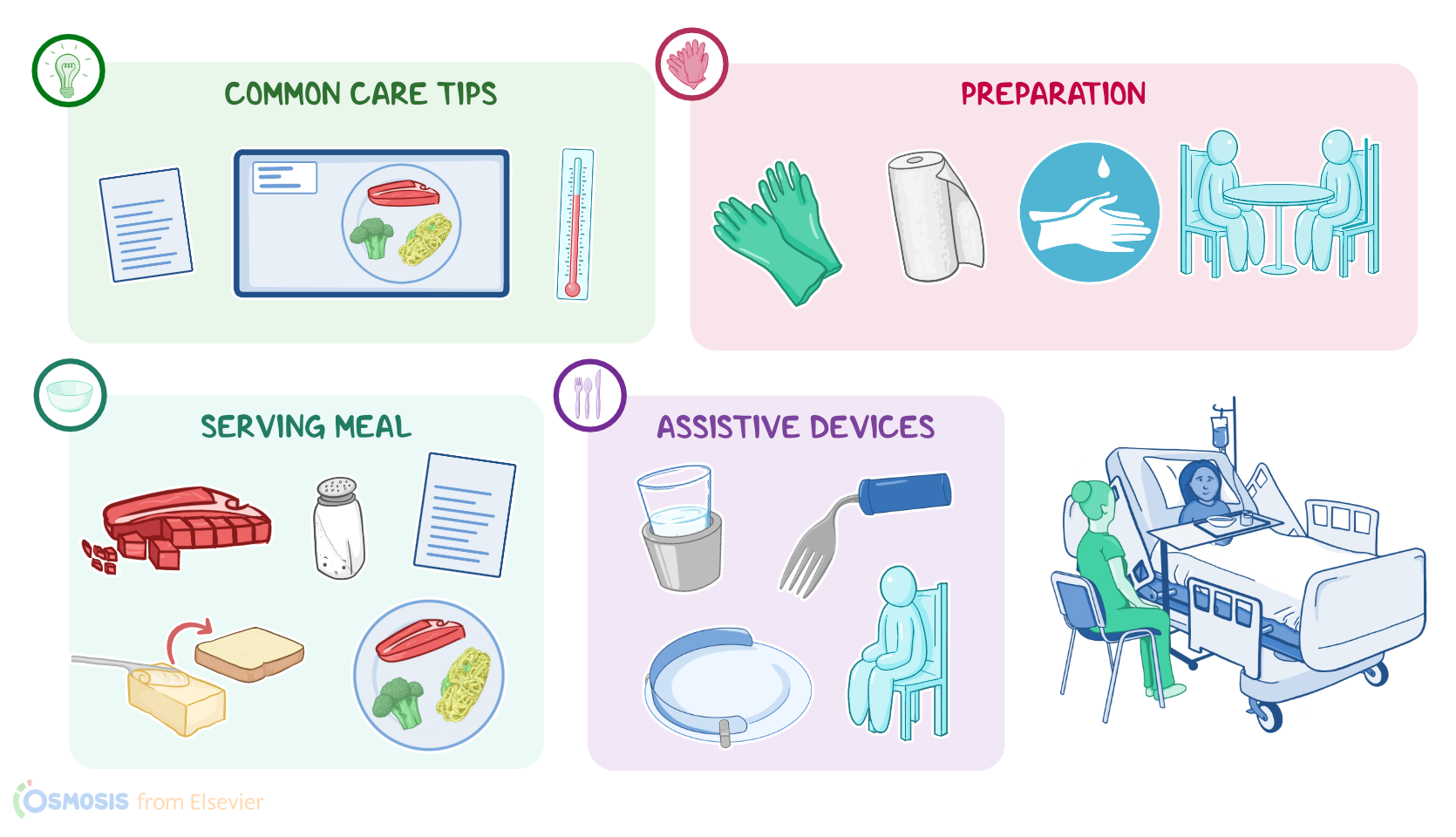
COMMON CARE TIPS
  • Check name on the tray matches patient's identification card/bracelet 
  • Ensure meal served follows nutrition orders
  • Serve food as soon as it’s ready
  • Create friendly atmosphere
  • Encourage patient participation

PREPARATION
  • Supplies
    • Gloves
    • Paper towels
  • Assist patient with hand hygiene
  • Apply assistive devices as needed
  • Ensure environment is clean and calm
  • Position patient upright
  • Patients with dysphagia
    • Thicken liquids  
      • Add thickener slowly to liquid 
      • Stir until desired consistency is reached 
      • Let sit for a few minutes to thicken 
    • Types of consistencies 
      • Nectar like
      • Honey like
    • Precautions 
      • Don't add ice or condiments after thickening 
      • Hot liquids thicken more as they cool 
      • Avoid ice cream or anything that melts 

SERVING A MEAL
  • Meal preparation and setup 
    • Ask if patient wants clothing protector 
      • Help apply protector if needed 
    • Position tray and items within easy reach 
    • For bedbound patients use over bed table 
    • Uncover food and open containers 
    • Unwrap silverware and assist as needed 
    • Help cut food or add condiments if needed 
  • Support for vision impairment 
    • Describe food and its position on plate 
    • Use clock face method for orientation 
  • Assistive devices 
    • Plate guards 
    • Angled utensils 
    • Cup holders 
  • Prevent aspiration  
    • Keep patient upright during and after eating 

FEEDING A PATIENT WHO CANNOT ASSIST
  • Preparation 
    • Lock bed wheels  
    • Lower side rail on working side 
    • Sit in chair facing patient at eye level 
    • Ask patient about preferred food order 
  • Feeding technique 
    • Fill one third of spoon before each bite 
    • Tell patient what food is being served 
    • Offer fluids every few bites 
    • Check temperature of fluids before serving 
    • Use straws if needed 
  • Special considerations 
    • For patients with dysphagia, serve liquids slowly 
    • For stroke patients, direct food to unaffected side 
    • Allow time to chew and swallow
    • Wipe hands mouth and chin, as needed 
    • Encourage eating but never force

FINISHING THE MEAL
  • Remove tray and clothing protector 
  • Assist patient with oral and hand hygiene 
  • If in community dining area 
    • Help patient return to their room 
  • If eating in room/bed
    • Replace any soiled linens 
    • Raise side rails on both sides 
    • Adjust bed and head of bed height 
    • Ensure bed wheels are locked 
  • Prevent aspiration 
    • Keep patient upright for at least 1 hour

NURSING IMPLICATIONS
  • Check diet order before serving meals 
  • Ensure tray matches prescribed diet 
  • Common diet types 
    • Thickened liquids: easier to swallow 
    • Full liquid: juice milk broths gelatin 
    • Pureed: smooth foods like mashed potatoes or eggs 
    • Mechanical soft: rice cooked vegetables soft meats 
    • Soft: includes pasta casseroles and mechanical soft foods 
    • Regular: no dietary restrictions 
    • Post-meal monitoring and documentation 
  • Notify HCP: 
    • Appetite changes are observed 
    • Patient eats less than 70 % of meal 
    • Patient reports nausea 
    • Signs of aspiration  
      • Coughing 
      • Choking
      • Gagging
      • Breathing difficulty 
  • Documentation  
    • Date and time of meal 
    • Total food and fluid intake 
    • Any abnormal findings or symptoms

Transcript

Watch video only

As a nurse, you will need to prepare clients for their meals, serve them food, and depending on their needs, assist them in eating. Since clients can have different nutritional needs or might have issues with chewing or swallowing, the diet ordered for your client will be tailored to their specific needs.

Now, before we talk about how to do these things, here are some general considerations. Always check that the name on the tray matches the identification card or bracelet of the client and that the meal served follows the nutritional guidelines for that particular client. Make sure to serve food as soon as it’s ready so that serving temperature is optimal. Try to create a friendly atmosphere, keep them company, and help them as much as they need, while encouraging them to participate as much as possible.

Okay, so, when preparing a client for their meal, first gather the supplies you’ll need, including gloves, and paper towels. Next, assist the client with hand hygiene. Then, if they use eyeglasses, hearing aids, or dentures, check that those devices are properly positioned. Finally, check where they’ll be eating and make sure the room is free from disturbing sights, odors, or sounds.

If available, the best location to eat for many clients is a community dining room, because it provides your clients with the opportunity to socialize. Whether in a dining room or a private room, position them in a chair or wheelchair so they’re upright; if they’re in bed, raise the head of the bed, so they’re as upright as possible. Clean and adjust the over-bed table to a suitable height.

Some clients might also have dysphagia, meaning difficulty swallowing. This is often caused by nervous system conditions, like stroke or head trauma or tumors in the mouth or esophagus, blocking the passage of food. In these cases, the health care provider could order all liquids, like soup, to be thickened, making them less hard to swallow.

To do that, start adding a thickener to the liquid as slowly as possible until you reach the wanted consistency. This could vary from nectar-like consistency which resembles fruit nectar and is easily pourable, to honey consistency which is slightly thicker and less pourable. Let the liquid sit for a couple of minutes for the thickener to achieve the ideal effect. Avoid adding ice or any condiments like vinegar or lemon juice afterwards because that could change the consistency again.

Remember to check and readjust the consistency of hot liquids regularly because they tend to become thicker as they cool. Avoid offering additional water or anything that could melt, like ice cream. Make sure that all liquids provided to the client throughout the day have also been thickened.

Now, when serving a meal, start by asking the client if they want to use a clothing protector to keep their clothes stain-free and help them put one on if necessary. Then, make sure to position the tray as well as napkins or assistive devices within easy reach; for a person eating in bed, this means on the over-bed table. Uncover the food, open any container, and unwrap the silverware. Depending on the needs of the client, you may also need to help them cut solid food into small pieces, apply butter or cheese on the bread, and add salt or various spices to the food. This should be based on their preferences but also their nutritional guidelines.

For certain clients with vision problems, it may also be helpful to let them know what food is being served and how it’s positioned. One technique is the clock face method, where you pretend the plate is the face of a clock with six o'clock being closest to the client. Typically, the protein, like meat or fish, is positioned at 6 o’clock; vegetables at 2 o’clock; and carbohydrates, like rice or pasta, at 11 o’clock.