Pediatric interventions - Overview: Nursing

Last updated: May 31, 2024

Pediatric interventions - Overview: Nursing

NUR 231 Peds

NUR 231 Peds

Vital signs - Pediatric pain: Nursing skills
Childhood oral health: Information for patients and families (The Primary School)
Case study - Pediatric asthma: Nursing
Hirschsprung disease: Nursing
Hirschsprung disease: Year of the Zebra
Pediatric psychosocial needs during illness and hospitalization: Nursing
Medications for respiratory syncytial virus (RSV): Nursing pharmacology
Medication administration - Intravenous critical care: Nursing pharmacology
Medication administration - Safety principles: Nursing pharmacology
Pediatric interventions - Overview: Nursing
Medication administration - Pediatric: Nursing pharmacology
Childhood nutrition and obesity: Information for patients and families (The Primary School)
Failure to thrive (FTT): Nursing
Vaccination and herd immunity
Hypoplastic left heart syndrome: Year of the Zebra 2024
Congenital heart defects - Acyanotic: Nursing
Tonsillitis: Nursing process (ADPIE)
Otitis media: Nursing
Laryngotracheobronchitis (LTB) and croup: Nursing process (ADPIE)
Bronchiolitis and respiratory syncytial virus (RSV): Nursing process (ADPIE)
Respiratory alkalosis
Respiratory acidosis
Gastroesophageal reflux disease (GERD): Nursing process (ADPIE)
Case study - Gastroesophageal reflux disease (GERD): Nursing
Neonatal sepsis: Nursing
Urinary tract infections (UTIs): Nursing process (ADPIE)
Case study - Grief and loss: Nursing
Case study - Head injury: Nursing
Case study - Pediatric urinary tract infection: Nursing
Cerebral palsy: Nursing
Case study - Cerebral palsy: Nursing
Down syndrome (Trisomy 21)
Immunodeficiency disorders - Secondary: Nursing
Ventricular septal defect
Edwards syndrome (Trisomy 18)
Atrial septal defect
Child maltreatment: Nursing
Case study - Child maltreatment: Nursing
Case study - Pediatric diabetes mellitus type 1: Nursing
Puberty and Tanner staging
Case study - Pediatric eczema: Nursing
Clubfoot: Nursing
Impetigo: Nursing
Assessment of gestational age: Nursing
Growth and development - Infant: Nursing
Growth and development - Preschool-age: Nursing
Growth and development - Toddler: Nursing
Growth and development - School-age: Nursing
Growth and development - Adolescent: Nursing
Kawasaki disease: Nursing

Notes

PEDIATRIC INTERVENTIONS - OVERVIEW

KEY POINTS
NOTES
DEFINITION
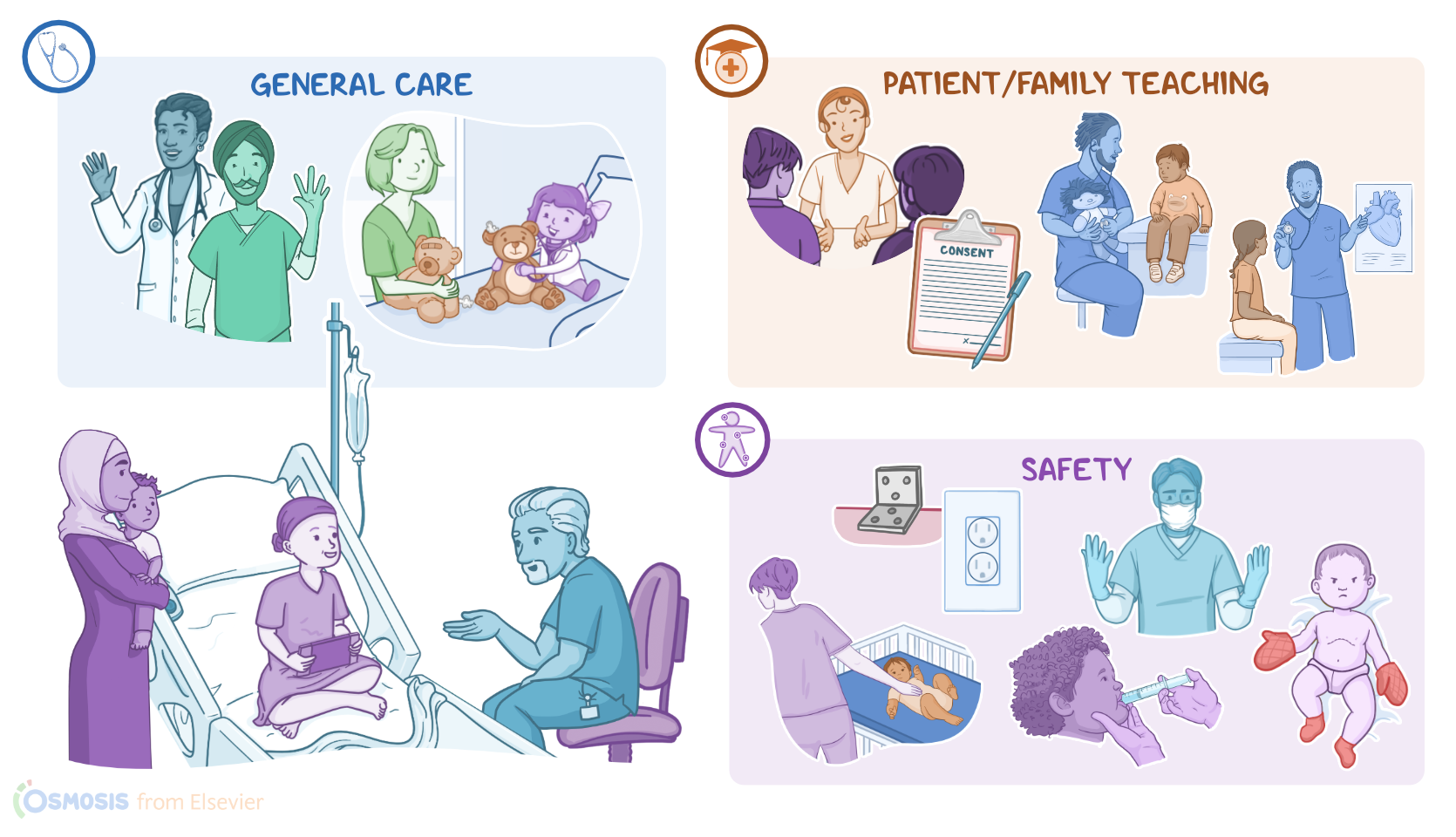
  • Pediatric patients who are hospitalized require individualized care based on developmental level

GENERAL CARE
  • Establish rapport and trust 
    • Use therapeutic communication
      • Calm tone of voice 
      • Active listening 
      • Open body language 
    • Explain plan of care 
      • Avoid medical jargon
      • Use age-appropriate, non-threatening language 
      • Introduce the health care team 
      • Collaborate with the child life specialist 
    • Verify informed consent and assent 
      • Verify HCP has explained
        • Condition 
        • Treatment plan and alternatives 
        • Risks and benefits 
        • Witness signatures 
        • Reinforce information 
        • Involve the child and obtain assent when appropriate 
      • Teaching strategies 
        • Use visual aids or props: 
        • Dolls or stuffed animals for younger children 
        • Provide detailed explanations for adolescents 

SAFETY
  • Age-specific safety 
    • Infants (≤1 year) 
      • Keep crib siderails raised and secure 
      • Maintain hand contact when crib is open 
      • Place infant on back to sleep 
      • No toys or blankets in crib 
    • Toddlers 
      • Cover electrical outlets 
      • Keep window blinds and cords out of reach 
      • Dispose of small objects  
      • Secure furniture 
    • Infection control 
      • Perform hand hygiene 
      • Use clean or sterile technique as indicated 
      • Implement transmission-based precautions if indicated
      • Educate child and caregivers 
        • Handwashing 
        • Specific infection control measures
    • Restraints 
      • Assess thoroughly before use 
      • Try alternatives first 
        • Encourage caregiver presence 
        • Move child closer to nurse’s station 
        • Offer diversional activities
      • If necessary 
        • Use least restrictive restraint 
        • Monitor and reassess frequently per facility policy 
    • Medications
      • Follow safe medication administration principles 
      • Use pediatric dosing protocols: 
      • Based on weight (kg) or body surface area 
      • Double-check calculations with another nurse 

Transcript

Watch video only

Pediatric patients who are hospitalized require individualized care based on their developmental level. As the nurse caring for a hospitalized child, you’ll prepare them and their caregivers for procedures while promoting their comfort and safety.    

When providing care, begin by establishing rapport and trust with the child and their caregivers. You can do this by using therapeutic communication skills, like speaking in a calm tone, listening actively, and practicing therapeutic body language, like sitting down and leaning forward toward your patient.  

When explaining the plan of care, remember to avoid words that can cause confusion or fear. So, instead of using medical jargon like “edema,” you can describe a swollen body part as being “puffy.” Likewise, instead of “shot” when talking about an injection, you can use less threatening language like “medicine under the skin.”  

You can also ensure your patient and caregivers are familiar with other members of the health care team and their role in the child’s care. Lastly, be sure to collaborate with the child life specialist, who can provide therapeutic play activities that can decrease fear and anxiety in children and their families.   

Now, before your patient undergoes a procedure, you’ll need to ensure that informed consent is obtained from their caregiver, by verifying that the health care provider has explained the condition, proposed treatment plan, treatment alternatives, as well as potential risks and benefits of the procedure. As the nurse, you’ll witness the signatures on the consent form and reinforce the information provided by the health care provider. Also be sure to include the child in the discussion, and obtain their assent, as appropriate.  

During teaching, you may use a doll or stuffed animal to show a younger child where electrodes are placed or where their surgical dressing will be; whereas, with an adolescent, you can provide them with detailed information, since they’re typically eager to receive health teaching

Sources

  1. "Wong’s essentials of pediatrics. (11th ed.)" Elsevier (2022)
  2. "Wong’s nursing care for infants and children. (11th ed.)" Elsevier (2019)