Physical assessment - Skin, hair, and nails: Nursing
1,342views
Notes
| PHYSICAL ASSESSMENT - SKIN, HAIR, AND NAILS | ||
| KEY POINTS | NOTES | |
| DEFINITION |
| |
| GETTING STARTED |
| |
| ANATOMICAL LANDMARKS |
| |
| METHODS OF ASSESSMENT |
| |
| INSPECTION |
| |
| PALPATION |
| |
| NURSING IMPLICATIONS |
| |
Transcript
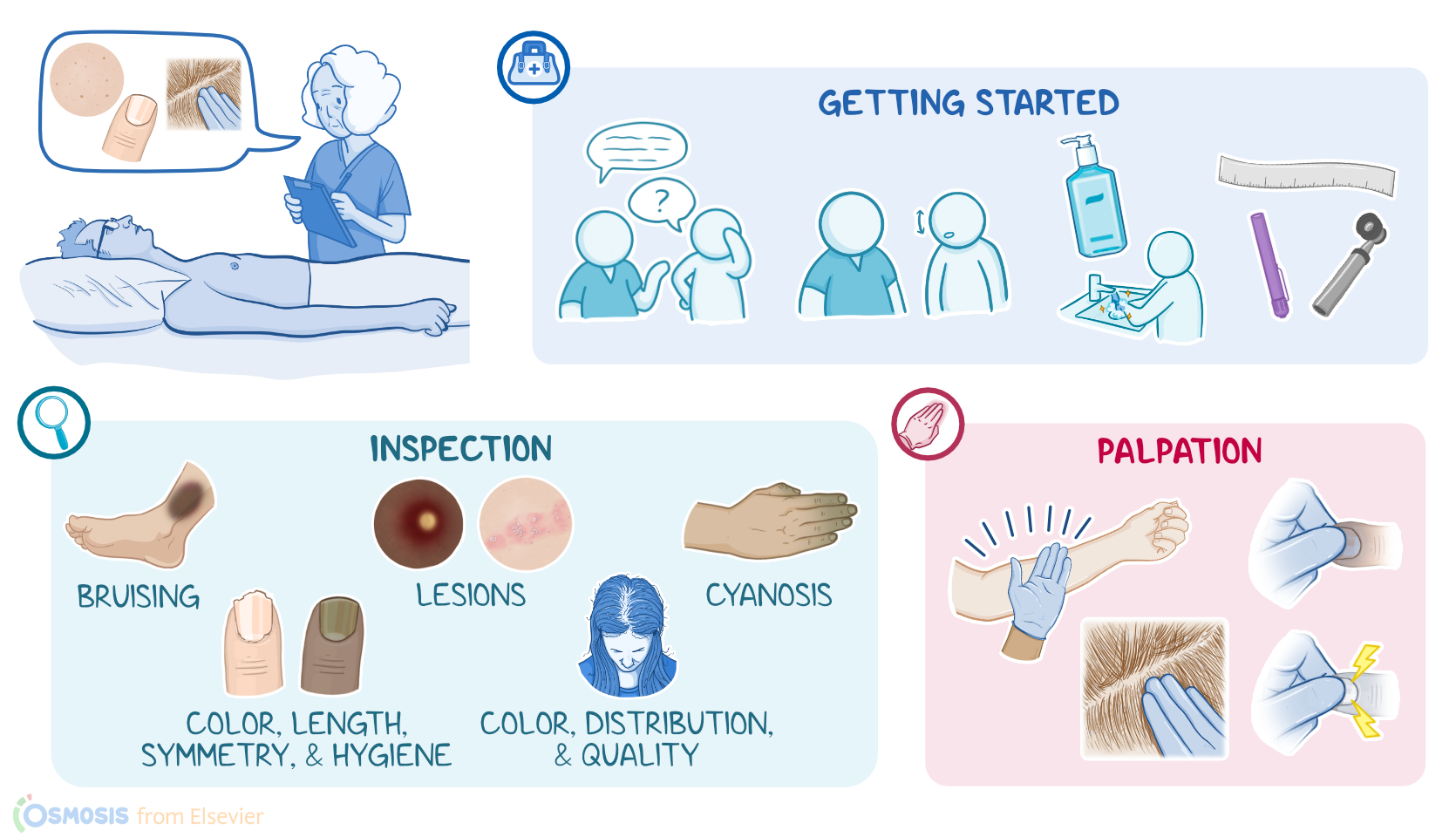
Assessment of the skin, hair, and nails should be completed as part of a comprehensive client assessment or as a part of a focused exam when a client is experiencing issues that affect the integumentary system, such as hair loss or skin irritation. Let’s review the process of completing an assessment of the skin, hair, and nails.
Okay, the supplies you’ll need for your assessment include a flexible ruler, penlight, a magnifying lens or dermatoscope, and a good source of light.
Then, prepare for the exam by ensuring your client is in a comfortable position, that your hands and stethoscope are warm, and that the temperature in the room is comfortable. Provide privacy by closing the door and curtains, properly draping your client, and only exposing areas of their body as needed to perform your examination.
Before getting started, explain the procedure to your client and be sure to answer any questions they might have before obtaining verbal consent. Then, perform hand hygiene and collect your supplies.
There are no specific landmarks for skin and hair, but the nails do have landmarks such as the nail plate or body, lunula, cuticles, the lateral folds and the proximal nail fold. Locating the anatomical landmarks of the nails will help guide your assessment. The methods of skin, hair and nails assessment include inspection and palpation.
Alright, first, you should start with a general inspection of the skin, which should be intact and have a uniformity of color without areas of discoloration or the presence of lesions. Be sure to also check any area that is not commonly visible, such as the axillae, perineum, and between the toes.
During your inspection, note the thickness of the skin, which will vary depending on the body area. For example, calluses can appear on hands and feet due to frequent use, whereas the skin of the eyelids will be thin and delicate.
Also note your client’s skin color, which normally ranges from various shades of black, brown, and tan, to shades of white and pink. These variations in pigmentation are due to factors like genetics and sun exposure. You should always consider these natural variations in skin color and tone when assessing your client, especially when looking for localized skin changes.
For example, let's look at rashes. In clients with light skin, they appear pinkish-red, but in clients with dark skin, look for areas of hyperpigmentation or a purplish tone.
Likewise, when assessing for bruising, in darker skin, look for deep blue or even a black tone. With lighter skin look instead for purple, blue, or even green in clients.
When assessing for a pressure injury, lighter skin will blanch, or turn white, when pressure is applied. In dark skin, however, blanching will not always occur, so you should look for areas that are shiny, indurated, or taut instead.
When assessing for cyanosis in a client with light skin, you’ll look for blue or purplish coloring. On the other hand, in clients with dark skin, cyanosis can appear as a grayish or whitish discoloration which can be more easily seen in the mucous membranes, lips, conjunctiva, and nail beds. In clients with a more olive complexion, cyanosis can take on a gray or greenish hue.
Another abnormal skin color finding is a yellow discoloration of the skin which can indicate liver disease. This finding is often better visualized in the sclera and palms in clients with darker skin. Lastly, remember that the palms of the hands and soles of the feet are lighter in clients with darker skin, so inspection of these areas may assist in detecting widespread skin changes.
Now, some lesions you may see during inspection include macules, papules, plaques, vesicles, bullae, and pustules.
First, a macule is a flat lesion, usually less than 1 centimeter wide and is a different color from the rest of the skin. Examples include freckles and petechiae, which are tiny spots of bleeding under the skin. Next, a papule is a raised, firm demarcated lesion that’s less than 1 centimeter wide. Examples of papules are warts and elevated nevi, or moles.
Plaques are raised, firm and coarse lesions that are larger than 1 centimeter wide, as seen in clients who have psoriasis or seborrheic dermatitis. Then there are vesicles, which are raised, superficial lesions filled with serous fluid. These are also typically less than 1 centimeter in size, and they appear in clients with chickenpox or shingles.
A bulla is a vesicle that is greater than 1 cm, and a common example is a blister. Lastly, you might visualize pustules, which are elevated lesions, similar to vesicles, but instead of serous fluid, they are filled with pus. The most common pustule occurs in clients with acne.