Precocious puberty: Nursing
Introduction0:00–0:21
Puberty is the natural process of sexual maturation where an individual becomes sexually mature. When puberty begins too early, it’s called precocious puberty, and this generally means puberty has started before the age of 8 in those assigned female at birth, and 9 in those assigned male.
Let’s start with some physiology. Puberty is normally under the control of the hypothalamus-pituitary-gonadal axis.
Physiology0:21–1:33
It begins when the hypothalamus starts releasing gonadotropin-releasing hormone, or GnRH for short, which travels to the nearby pituitary gland to stimulate the release of two gonadotropin hormones into the blood.
These are luteinizing hormone, or LH, and follicle-stimulating hormone, or FSH. These two hormones then signal the ovaries and testes to release sex hormones, mostly estrogen and progesterone in those assigned females at birth, and testosterone in those assigned males at birth.
The increase in sex hormones triggers the maturation of the sex organs and the development of secondary sexual characteristics, including the appearance of facial and pubic hair, breast development, and voice changes, among others.
Now, on average, puberty begins around age 10 and a half in those assigned female at birth, and 11 and a half in those assigned male.
Generally speaking, puberty lasts for about 4 years, but this can vary quite a lot depending on factors such as race, genetic background, and geographical region.Okay, precocious puberty can occur because of central factors that involve the brain, hypothalamus, and pituitary gland; or because of peripheral causes that involve the ovaries, testicles, or adrenal glands.
Causes & risk factors1:33–2:41
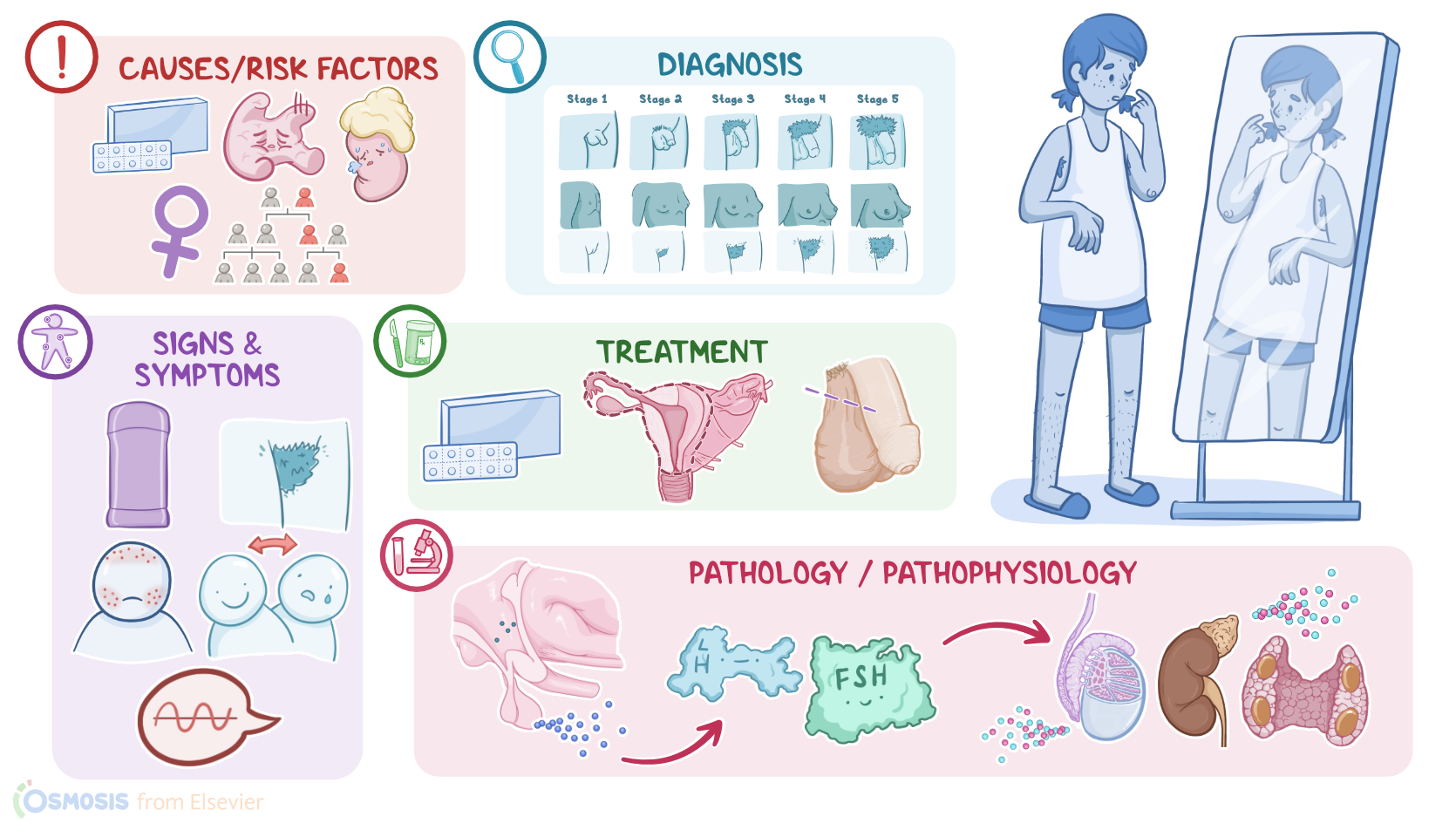
So, common causes of central precocious puberty include brain tumors or brain trauma. Most of the time, however, there’s no identifiable cause, and it’s simply called idiopathic central precocious puberty, and it’s influenced by factors like when a parent began puberty, as well as an individual's weight.
Conversely, causes of peripheral precocious puberty include sex hormone-secreting ovarian or testicular tumors, genetic conditions like McCune-Albright syndrome, which causes excessive endocrine stimulation and hormone secretion; hypothyroidism or congenital adrenal hyperplasia; or use of exogenous sex hormones from medications and creams.
Finally, risk factors for precocious puberty include being assigned female at birth, black race, obesity, as well as family history of precocious puberty.
Okay, now let’s discuss the pathology of precocious puberty. Central precocious puberty results from early maturation of the hypothalamic-pituitary-gonadal axis.
Pathology2:41–3:23
This causes the hypothalamus to release GnRH prematurely, which stimulates the pituitary gland to release LH and FSH. These hormones then stimulate the gonads to release sex hormones, which ultimately leads to precocious puberty.
On the flip side, peripheral precocious puberty results from the overproduction of sex hormones from the gonads or the adrenal glands; as well as dysfunction of other endocrine glands, without the premature release of GnRH from the hypothalamus.
Clinical manifestations3:23–4:11
Alright, now, clinically, the key feature of precocious puberty is early sexual maturation, and it often causes a lot of emotional distress because children can feel social pressures that come along with sexual maturity.
Clinical manifestations include the development of secondary sexual characteristics, like pubic hair and facial hair, breast enlargement, and voice changes; as well as sex organ maturity.
Finally, precocious puberty is associated with an accelerated growth rate, which may result in the premature fusion of the epiphyseal or growth plates, leading to short adult stature.
The diagnosis of precocious puberty starts with the client’s history and physical assessment. Clients can be evaluated using the Tanner scale, which represents a predictable set of steps that individuals go through as they become sexually mature.
Diagnosis4:11–4:52
In clients with precocious puberty, the Tanner scale shows signs of early maturation that don’t match the usual stage of peers of their age.
Next, hormonal lab tests, including serum levels of LH, FSH, and sex hormones, can help distinguish between central and peripheral causes, and imaging studies, like an ultrasound or MRI can be used to look for structural abnormalities in the brain and gonads.Treatment of precocious puberty depends on the underlying condition.
Treatment4:52–5:21
For clients with central precocious puberty, treatment typically involves using gonadotropin-releasing hormone analogues, which can suppress the hypothalamic-pituitary-gonadal axis and slow down the progression of puberty.
On the other hand, treatment for peripheral precocious puberty depends on the cause. In some cases, surgery might be needed to remove a tumor or cyst from the ovaries or testicles.Alright, as a quick recap...
Precocious puberty is when puberty starts before the age of 8 in those assigned female at birth, and before 9 in those assigned male.
Review5:21–6:15
Precocious puberty can occur because of central or peripheral causes, but more often than not, a cause is not identified, in which case it’s termed idiopathic precocious puberty.
Clinical manifestations include the development of primary and secondary sexual characteristics, as well as adult-like body odor, acne and behavioral changes.
The Tanner scale can show signs of early maturation, and hormonal lab tests, including serum levels of LH, FSH, and sex hormones, can help distinguish between central and peripheral causes.
For clients with central precocious puberty, typical treatment involves using gonadotropin-releasing hormone analogues. For peripheral precocious puberty, treatment depends on the underlying cause.
| PRECOCIOUS PUBERTY | ||
| KEY POINTS | NOTES | |
| DEFINITION |
| |
| PHYSIOLOGY |
| |
| CAUSES AND RISK FACTORS |
| |
| PATHOPHYSIOLOGY |
| |
| SIGNS AND SYMPTOMS |
| |
| DIAGNOSIS |
| |
| TREATMENT |
| |
No notes for this video yet
Try adding a note below