Preventative care for women: Nursing
Introduction0:00–0:24
Preventative health care refers to screenings that can identify diseases in the early stages, so they can be treated before they progress.
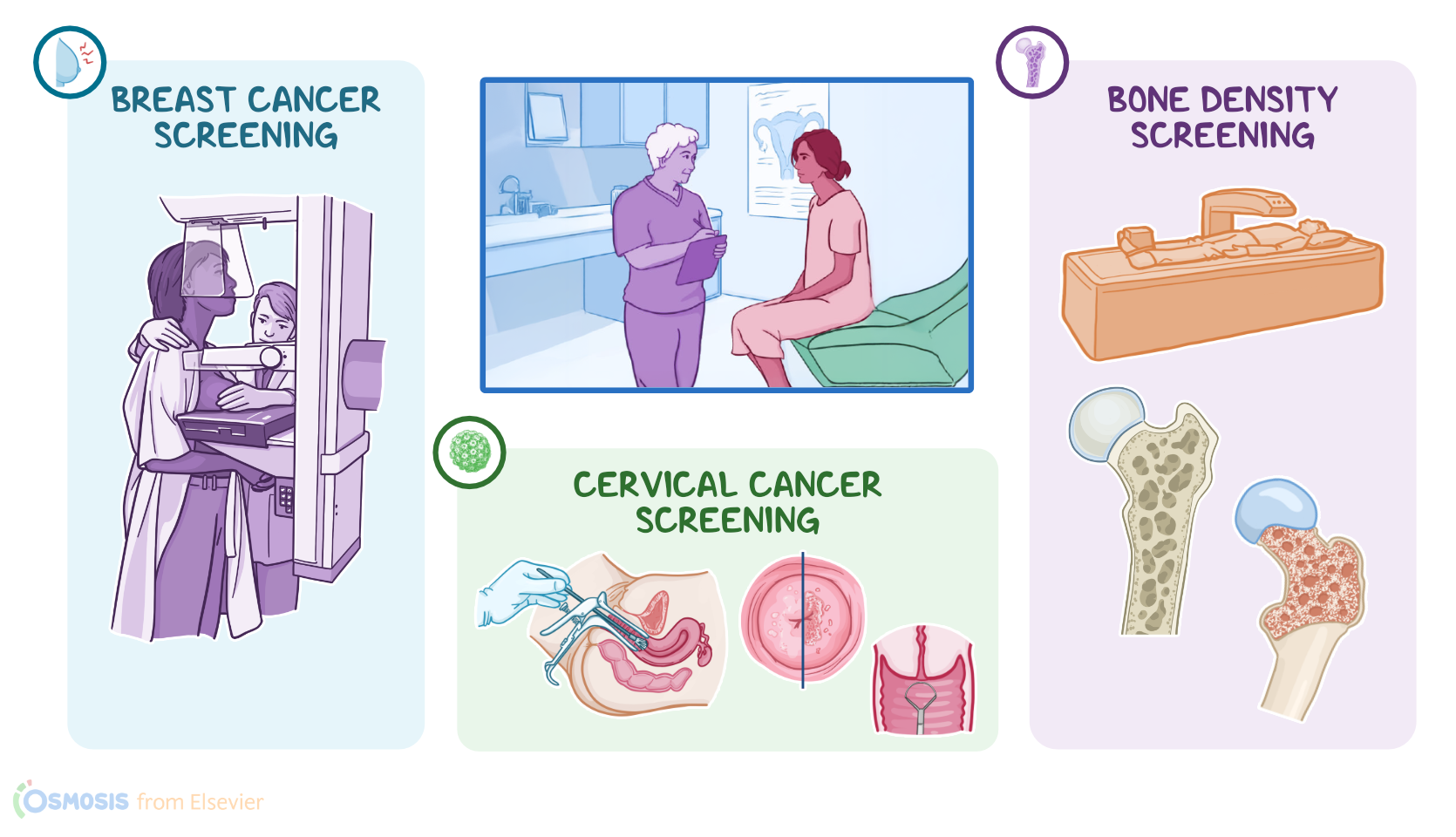
Common preventative screenings for patients assigned female at birth include mammograms for breast cancer; Papanicolaou, or Pap, tests for cervical cancer; and bone density tests for osteopenia and osteoporosis.
Mammograms screen for breast cancer and involve taking X-rays of the breasts. Patients typically start mammograms around age 45 but can be started earlier or later, depending on risk factors, like a positive family history of breast cancer or certain genetic mutations, like BRCA1 or BRCA2.
Breast Cancer Screening0:24–1:15
When teaching your patient who's having a mammogram, explain that the procedure involves the compression of the breast tissue between two plates while an X-ray is taken.
Reassure them that the procedure uses a very low dose of radiation and that it causes brief discomfort. Be sure to recommend that they schedule their mammogram after their menstrual period when their breasts are less swollen and sensitive.
Cervical Cancer Screening1:15–2:36
Screening for cervical cancer involves the Papanicolaou, or Pap test, which screens for cervical cancer by swabbing the cervix during a pelvic examination and looking for abnormal cervical cells and testing for human papillomavirus, or HPV test, which detects strains of HPV, including the high-risk strains that may cause cervical cancer.
When Pap and HPV tests are done together, it's known as co-testing. Screening for cervical cancer should begin at age 21 and occur every three years until age 30.
Then at age 30, testing can be done every five years. For patients with small-grade changes to cervical cells, testing should occur more frequently whereas those with high-grade cervical cell changes should have the cells removed through loop electrosurgical excision procedure, or LEEP, which is when a thin wire loop is used to remove the abnormal cells.
When teaching your patient about cervical cancer screening, be sure to explain that it involves a pelvic examination, where a vaginal speculum is used to view the cervix, and then a brush is used to gently scrape cells off the cervix.
Remind them to abstain from sexual intercourse for at least 48 hours before the examination and to avoid using any vaginal medication or sprays on the day of the exam, since these can interfere with the test results.
Now, bone density tests use dual-energy X-ray absorptiometry, or DEXA for short, to measure the density of bones. Bone density tests are used to screen for osteopenia and osteoporosis, which are conditions associated with below normal bone density.
Bone Density Screening2:36–3:51
Osteoporosis differs from osteopenia in that the bone density loss is more advanced, leading to an increased risk of fractures.
Bone density tests are recommended after menopause, since the loss of hormones increases the risk of bone mineral loss. Other patients who may benefit from bone density testing include those who smoke, those who have used corticosteroids for a long time, or those who have a family history of osteoporosis.
In addition, a sedentary lifestyle and an inadequate diet that’s deficient in protein, calcium, and vitamin D can also increase the risk of decreased bone density.
When teaching your patient who’s scheduled for a bone density test, let them know that the test uses very low-dose X-ray beams while they are lying on a padded table.
Remind them to wear comfortable clothing that does not have any metal zippers or buttons. If your patient is taking calcium supplements, instruct them to not take them 24 hours before the test.
Alright, as a quick recap...Preventative health care refers to screenings that can identify diseases in the early stages, so they can be treated before they progress.
Review3:51–4:12
Common preventative screenings for patients assigned female at birth include mammograms for breast cancer; Papanicolaou, or Pap, tests for cervical cancer; and bone density tests for osteopenia
| PREVENTATIVE CARE FOR WOMEN | ||
| KEY POINTS | NOTES | |
| DEFINITION |
| |
| BREAST CANCER SCREENING |
| |
| CERVICAL CANCER SCREENING |
| |
| BONE DENSITY SCREENING |
| |
- "Maternity and women’s care. (12th ed.)" Elsevier (2020)
- "Foundations of maternal-newborn & women’s health nursing. (8th ed.)" Elsevier (2024)
No notes for this video yet
Try adding a note below