Prostate cancer: Nursing
Introduction0:00–0:15
Prostate cancer is a malignant tumor that originates in the prostate gland and is the most common cancer and the second most common cause of cancer death among clients assigned male at birth.
Now, let’s quickly review the anatomy and physiology of the prostate gland. The prostate is a small gland that sits under the bladder and in front of the rectum.
Physiology0:15–1:19
It can be divided into four zones. The peripheral zone, which is the outermost posterior section and is the largest of the zones, containing about 70% of the prostate’s glandular tissue.
Moving inward, the central zone contains about 25% of the glandular tissue. Then there is the transitional zone, which contains around 5% of the glandular tissue, and lastly is the periurethral zone, surrounding the prostatic urethra.
Now, the prostate gland secretes the prostatic fluid, which is a slightly alkaline, milky fluid that has nutrients that nourish the sperm, enhance its movement, and help it survive in the acidic environment of the vagina.
To do that, the prostate cells rely on stimulation from androgens for survival, such as testosterone produced by the testes.All right, now prostate cancer is typically caused by a genetic mutation in a prostate cell, such as a mutation in breast cancer genes 1 and 2, also known as BRCA1 and BRCA2 genes.
Causes & Risk factors1:19–2:02
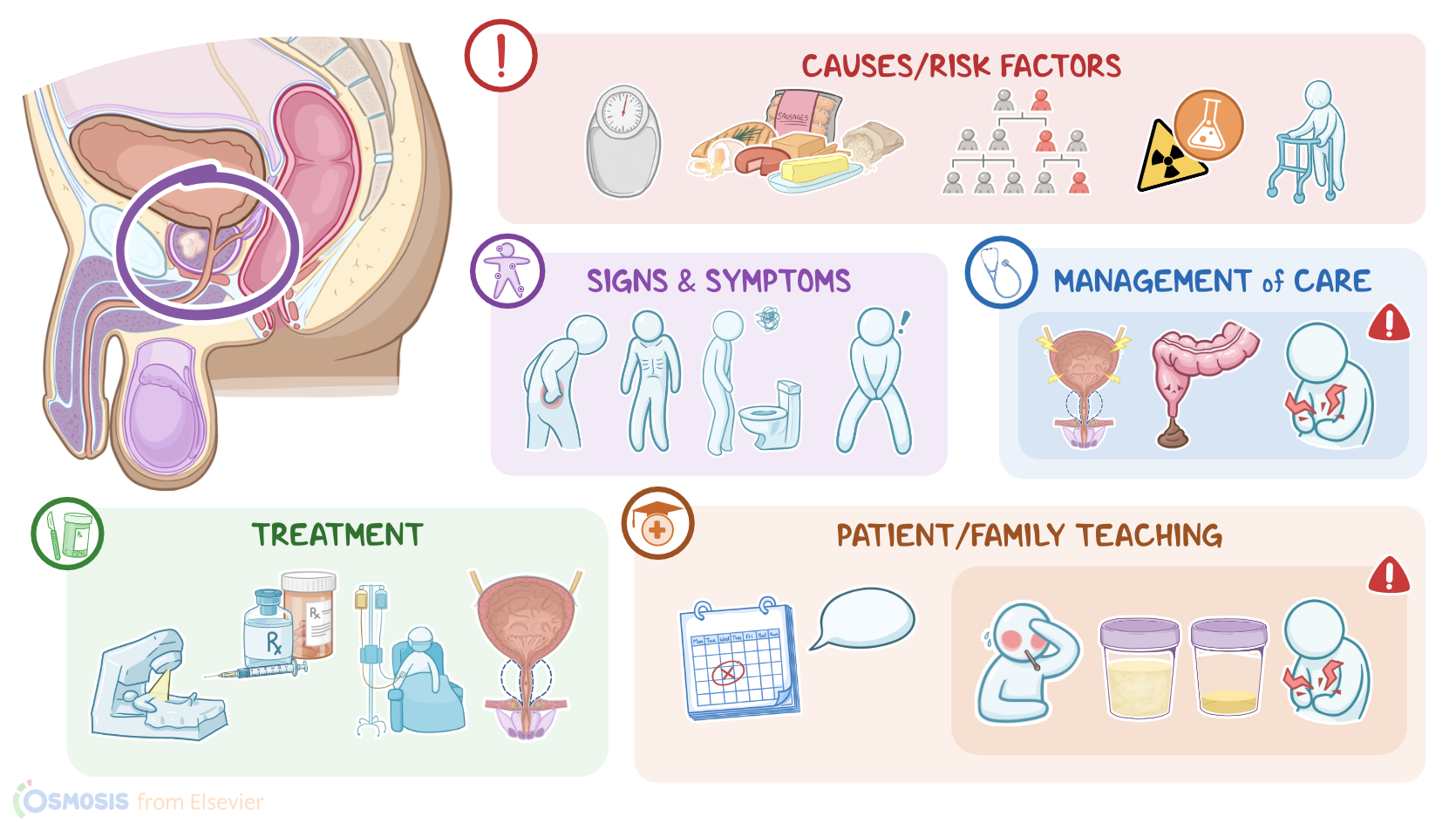
These mutations may arise from a variety of risk factors. Non-modifiable risk factors include advanced age, having a family history of prostate cancer, as well as being Black.
On the other hand, modifiable risk factors include obesity, a diet high in animal fat and low in fiber and vegetables, and long-term exposure to ionizing radiation or certain chemicals, such as benzene and toluene.So, once a prostate cell becomes mutated and cancerous, it starts dividing uncontrollably, forming a tumor mass.
Pathology2:02–2:48
Early on, prostate cancer cells depend heavily on androgens for survival, but eventually, the cancer cells mutate and find a way to keep multiplying without relying on androgens.
Overall, prostate cancer cells have a relatively slow rate of growth compared to other types of cancers. However, as they grow they can lead to enlargement of the prostate gland and constriction of the prostatic urethra.
Eventually, cancerous cells start invading neighboring tissues, and may even spread to nearby lymph nodes or metastasize to distant organs, such as the bones of the axial skeleton.In the early stages, prostate cancer typically causes no symptoms.
Clinical manifestations2:48–3:36
That’s because the majority of prostate cancers arise in the posterior peripheral zone, which is far away from the urethra.
As a result, these tumors can grow quite large before they cause problems with urination. Over time, if the tumor does compress or invade the urethra or bladder, it can cause difficulty urinating, bleeding, and pain with urination and ejaculation.
If the cancer metastasizes to bones, like the vertebrae or pelvis, clients can experience hip or lower back pain, and it can also lead to weight loss.Diagnosis of prostate cancer starts with history and physical assessment, which includes digital rectal examination, or DRE for short.
Diagnosis3:36–5:08
Normally, the prostate feels soft and rubbery; while with prostate cancer, the prostate could feel firm, and nodules are often palpated.
But if the tumor arises elsewhere, like in the anterior peripheral zone, then the tumor would be out of reach during the digital rectal exam.
Another approach is to use either a transrectal ultrasound or an MRI to image the prostate. Prostate cancer can also cause an elevation in tumor markers like prostate specific antigen or PSA for short.
But ultimately, confirmation of the diagnosis of prostate cancer requires a prostate biopsy; and based on how abnormal the cancer cells appear under the microscope, the Gleason Score is used to assess the cancer’s malignancy grade into low, medium, or high.
Pelvic MRI and bone scans are also done to look for metastases. Lastly, the cancer is staged by combining the TNM system that looks at the extent of the primary tumor, and whether it has spread to lymph nodes or metastasized; as well as the PSA level at the time of diagnosis; and the Gleason score.In terms of treatment, when the tumor is confined to the prostate and hasn’t metastasized, surgical excision of the prostate, also known as prostatectomy, is frequently done.
Treatment5:08–6:28
This is often accompanied by radiation therapy and hormonal therapy, which includes the use of androgen receptor blockers or inhibitors of androgen synthesis.
Less commonly, an orchiectomy can be performed, where the testes are removed in order to reduce prostate stimulation from androgens.
Sometimes clients with low-stage non-metastatic prostate cancer might decide to undergo active surveillance instead since prostatectomy can cause certain complications, like damaging the prostatic plexus, resulting in erectile dysfunction, as well as urinary incontinence.
Active surveillance includes routine tumor marker measurement as well as digital rectal examination and imaging, to ensure that the prostate cancer remains confined to the prostate.
If the tumor has metastasized, however, treatment options include chemotherapy, and hormonal therapy; as well as radiation therapy, which can however, cause complications like radiation proctitis, characterized by damage and inflammation of the rectum.
Management and care6:28–8:17
All right, let’s talk about nursing care for a client with prostate cancer. The priority goals are to manage your client’s symptoms, monitor for complications related to treatments, and promote quality of life.
When caring for a client who has undergone a prostatectomy, be sure to implement routine postoperative interventions, and monitor them closely for complications related to the procedure.
Administer the ordered IV fluids, and perform bladder irrigation to remove blood clots from the bladder and promote drainage.
Keep a close eye on your client’s urinary output and amount of bleeding present. Report to the healthcare provider if you notice signs of urinary retention, such as urine output of less than 30 mL per hour; or an increase in bright red blood and clots.
If bladder spasms occur, irrigate the bladder to remove existing clots, assist your client with relaxation techniques, and administer the prescribed antispasmodic and analgesic medications.
If spasms continue despite treatment or if their pain is unrelieved with medication, report these findings to the healthcare provider.
Now, if your client is being treated with external beam radiation, or EBRT for short, be sure to assess them for localized skin reactions, and report to the healthcare provider if you find manifestations of radiation-induced proctitis, including rectal urgency and cramping, as well as rectal leakage.
General client and family teaching8:17–11:19
Finally, coordinate with the oncology case manager to ensure that any services the client needs, such as home health care, hospice care, or palliative care, are available for the client.
All right, let’s move on to client and family teaching. Begin by explaining how the cancer affects the prostate gland, along with urinary and sexual function.
Review the plan of care and the treatments, explaining how they are based on the extent of the cancer, as well as the client’s physical condition and preferences.
If your client is participating in active surveillance, stress the importance of keeping all of their follow-up appointments with their healthcare provider, so their cancer progression can be monitored through PSA testing and DRE exams.Now, if your client underwent surgery and is being discharged home with an indwelling urinary catheter, demonstrate how to care for the drainage system, and remind them to keep the drainage bag anchored to the upper thigh, and to always keep it lower than the bladder.
Instruct your client to contact their healthcare provider if they notice any signs of infection, such as redness or swelling around the catheter insertion site, urine that becomes cloudy or has a strong odor; a fever of 100.4 F or 38 C; blood in the urine; as well as any signs of urinary retention, like an absence or decrease in the amount of urine in the bag.
Reassure your client that the home healthcare nurse will also be visiting regularly to assist with the drainage bag. Lastly, remind them to increase their fluid intake.For your client who has undergone ERBT or brachytherapy, let them know that urinary frequency and diarrhea can occur, as well as acute radiation cystitis, which can manifest as pain and blood in their urine.
Explain that the cystitis should subside several weeks after treatment. In addition, advise them to notify their healthcare provider if they experience any symptoms of radiation-induced proctitis, which includes rectal urgency, cramping, and leakage of feces.
If your client is receiving androgen deprivation therapy, teach them how the medication can help decrease the size of the tumor, and instruct them on safe self-administration of the medication.
In addition, go over common side effects, including decreased libido, erectile dysfunction, hot flashes, and gynecomastia.
Finally, when teaching clients who have undergone either a radical prostatectomy or radiation therapy, let them know that the side effects of these procedures include erectile dysfunction, loss of the ability to ejaculate, and urinary incontinence.
Review11:19–12:42
For these problems, encourage them to take their prescribed phosphodiesterase type 5 inhibitor medications, and confirm they have referrals to a urologist, a physical therapist for pelvic floor training, as well a psychologist for a sexual consultation.
All right, as a quick recap… Prostate cancer is a malignant tumor that originates in the prostate. Non-modifiable risk factors include advanced age, having a family history of prostate cancer, and black race.
On the other hand, modifiable risk factors include obesity, a diet high in animal fat and low in fiber and vegetables, as well as long-term exposure to certain chemicals.
Initially, a client with prostate cancer may not have any symptoms, but as the disease progresses, they may experience difficulty urinating, painful urination or ejaculation,
| PROSTATE CANCER | ||
| KEY POINTS | NOTES | |
| DEFINITION |
| |
| PHYSIOLOGY |
| |
| CAUSES AND RISK FACTORS |
| |
| PATHOPHYSIOLOGY |
| |
| SIGNS AND SYMPTOMS |
| |
| DIAGNOSIS |
| |
| TREATMENT |
| |
| MANAGEMENT OF CARE |
| |
| PATIENT AND FAMILY TEACHING |
| |
No notes for this video yet
Try adding a note below