Psoriasis: Nursing
Introduction0:00–0:15
Psoriasis is a chronic autoimmune disease that primarily causes skin inflammation, and is typically characterized by well circumscribed erythematous patches topped with white silvery scales.Now, let’s go over some physiology.
Physiology0:15–1:32
Normally, the skin is divided into three layers, the epidermis, dermis, and hypodermis. The hypodermis is made of fat and connective tissue that anchors the skin to the underlying muscle.
Just above the hypodermis is the dermis, which contains hair follicles, nerve endings, glands, blood vessels, and lymphatics.
And just above the dermis is the epidermis, which itself has multiple cell layers that are composed of developing cells called keratinocytes.
Keratinocytes start their life at the lowest layer of the epidermis, called the stratum basale, or basal layer, which continually divide and produce new keratinocytes.
As keratinocytes in the stratum basale begin to mature, they migrate into the next layers, called the:stratum spinosum, stratum granulosum, stratum lucidum, and finally, the stratum corneum, which is the uppermost and thickest epidermal layer.
As new keratinocytes push up into the stratum corneum, older dead cells are sloughed off forming skin flakes or dandruff.
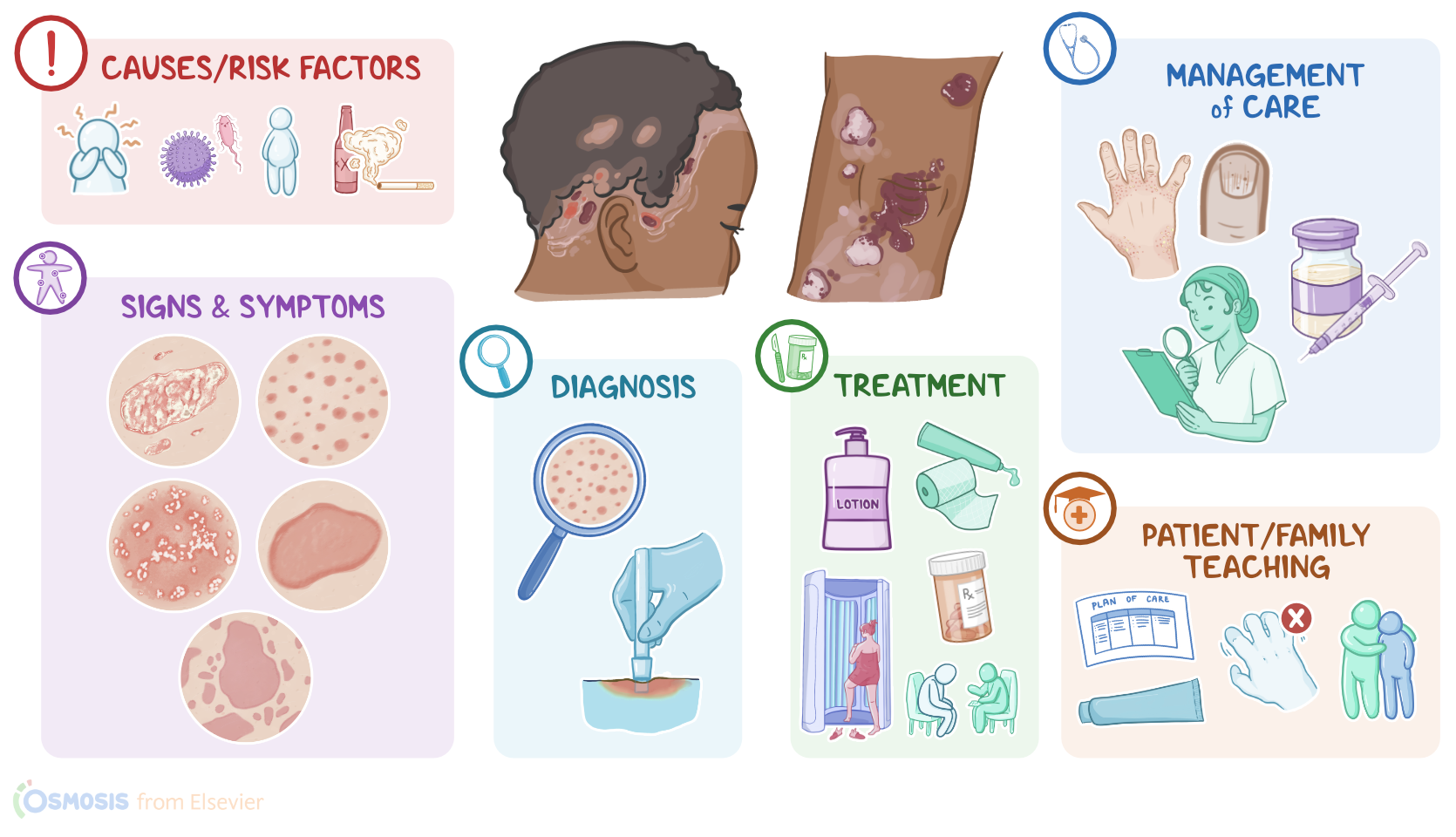
In this way, the thickness of the epithelium remains constant, with a regulated turn-over of keratinocytes.Now, there isn’t a single cause of psoriasis, but rather it’s a multifactorial disease, with a combination of genetic predisposition and environmental risk factors and triggers; these include stress, traumatic insults, infection, and obesity, smoking, alcohol use, and taking certain medications like antimalarials or lithium.Regardless of what triggers the disease, there’s an abnormal inflammatory process that causes dilation of the blood vessels at the border between the dermis and epidermis.
Causes & risk factors1:32–1:54
Pathology1:54–2:46
This attracts immune cells, which infiltrate into the epidermis, causing chronic damage to the skin. As a result, keratinocytes begin to proliferate excessively and mature abnormally.
Over time, as keratinocyte proliferation outpaces sloughing off, these cells begin to pile up. This hyperproliferation thickens the epidermal layers, particularly the stratum corneum and stratum spinosum; but thins out the stratum basale.
In addition, the immature keratinocytes don’t adhere to each other properly, causing breaks in the epidermis. This weakens the skin and results in the formation of a psoriatic plaque, with the characteristic scaling and erythema.Typically, clients with psoriasis have periods of exacerbations called flares, and periods of remission during which there are few or no symptoms.
Clinical manifestations2:46–3:14
Now, according to its cutaneous manifestations, psoriasis can be classified into five main subtypes, including chronic plaque psoriasis, guttate psoriasis, inverse psoriasis, pustular psoriasis, and erythrodermic psoriasis.
Chronic plaque psoriasis is the most common type of psoriasis. Clients typically present with well circumscribed, raised, erythematous patches from the underlying dilated blood vessels, and these patches are topped with white silvery scales.
Chronic plaque psoriasis is the most common type of psoriasis3:14–5:18
In clients with skin of color, the additional melanin can make the lesions appear purple or brown with grayish scales.Psoriasis lesions might be itchy or painful, and if the scales are picked off, the underlying blood vessels can get injured, causing localized spots of bleeding, called an Auspitz sign.
Chronic plaque psoriasis usually involves the scalp, elbows, and knees, as well as the lower back and groin. On the other hand, guttate psoriasis typically appears as small, red, dark purplish or hypopigmented, individual spots on the trunk and limbs, and is often triggered by a streptococcal infection.
Next, inverse psoriasis appears as smooth and shiny red or purplish lesions that lack scales; these typically form within skin folds, such as in the under arms, behind the knees, or the groin area.
Pustular psoriasis appears as areas of red or purplish skin with small, white pustules, which are filled with pus formed from dead immune cells; these lesions are usually tender and form on the hands and feet.Finally, erythrodermic psoriasis is usually the most severe subset, and appears as fire-red or dark purplish scales that can cover a large body surface area; these lesions are often extremely itchy and painful, and the skin may fall off in large sheets.
Now, in addition to these cutaneous manifestations, clients with psoriasis may present with additional findings, such as nail abnormalities like pitting and discoloration; as well as dactylitis, or severe inflammation of the fingers and toes; and some may develop psoriatic arthritis.Now, the diagnosis of psoriasis primarily involves the client’s history and physical assessment.
There are no specific laboratory tests for psoriasis, but in certain cases, a skin biopsy can be done to confirm the diagnosis.Although there’s no cure for psoriasis, certain treatment options can be used to help mitigate some of the symptoms and improve the client’s quality of life.
Diagnosis5:18–5:34
Treatment is chosen based on the severity of the disease, as well as the efficacy and response to treatment, and affordability.
Treatment5:34–7:05
Initial treatment typically includes moisturizers and emollients to help clear psoriatic plaques and minimize itchiness, as well as topical immunosuppressants like corticosteroids to dampen the inflammatory response.
Other topical treatment options can include anthralin or tar preparations, as well as topical retinoids like tazarotene, topical vitamin D like calcipotriene, or other topical immunosuppressants like tacrolimus and pimecrolimus.
In addition, clients can also be treated with light therapy, such as ultraviolet B or UVB phototherapy, or psoralen plus ultraviolet A or PUVA photochemotherapy, which act on the keratinocytes by inducing DNA damage and halting their proliferation.
More severe cases of psoriasis can be treated with systemic medications, such as antimetabolites like methotrexate, systemic retinoids like acitretin, or biologic agents like etanercept, adalimumab, infliximab, and secukinumab.
Finally, clients experiencing negative psychosocial effects may benefit from psychological counseling for emotional support.All right, let’s look at the nursing care you’ll provide for a client with psoriasis.
The main goals of your nursing care are to enhance and maintain skin integrity and improve quality of life. Start by performing a baseline skin assessment.
Make note of the characteristics, size, location of the affected area, and the presence of irritation, blistering, or itching.
If the client is receiving phototherapy, check the skin for ultraviolet light burns, blistering, or pain. It’s also important to monitor your client for signs of a secondary skin infection, such as increased redness, swelling, or drainage; if your client develops any of these signs, be sure to report it to a healthcare provider right away.
Management and care7:05–8:14
Next, assess your client for psoriatic arthritis by checking the joints for swelling and inflammation. Then check the nails for pitting, thickening, and yellow discoloration of the nail bed.
If your client is prescribed methotrexate, be sure to review their latest laboratory test results in order to assess their hepatic function before and during therapy.
All right, let’s move onto client and family teaching. First, reassure your client that psoriasis isn’t contagious.
Then, explain that there are certain triggers that can cause a psoriasis flare; these can include increased stress, injury to the skin, hormonal changes, illness or infections, smoking, alcohol use, and certain medications, as well as changes in the weather.
General client and family teaching8:14–10:14
Encourage your client to track their symptoms, so they can identify their specific triggers and learn to avoid them. Teach your client about their treatment plan, and advise them to take their prescribed medications as directed.
Let them know that they should refrain from scratching the affected area, reinforce the need to keep it moist with the prescribed lubricants or moisturizers, and remind them to wear loosely-fitting clothes made from a material that doesn’t irritate their skin.
In addition, prompt your client to notify their healthcare provider right away if they notice the affected area becomes red, swollen, warm, or if it produces a purulent discharge.If your client is receiving phototherapy, stress the importance of always wearing protective goggles during therapy, in order to help prevent cataracts.
Also, be sure to tell your clients with skin of color, that phototherapy can cause increased pigmentation in the exposed areas, and reassure them that their skin will often return to its original color several months after treatment is complete.
After treatment, let your client know that their skin can be very sensitive to light, so it’s important to stay out of direct sunlight as much as possible, as well as to wear protective clothing and sunglasses, and apply sunscreen when they need to be outdoors.
Finally, be sure to provide emotional support to your client by encouraging them to express their feelings, and providing them with resources to local psoriasis support groups.
All right, as a quick recap… Psoriasis is an autoimmune condition where immune cells cause inflammation in the epidermis, which results in chronic skin damage and keratinocyte hyperproliferation.
Certain triggers like stress can increase the inflammatory response, leading to flares. This can lead to various skin lesions like scales, plaques, or pustules.
In addition, there could be nail pitting and thickening, as well as psoriatic arthritis. The diagnosis is typically based on history and physical assessment, and the treatment is based on the severity of the disease.
Review10:14–11:49
Initial treatment includes a variety of topical lotions and emollients that moisturize the skin and decrease itchiness. Next, topical corticosteroids or other immunosuppressants can reduce inflammation, while light therapy like PUVA can reduce keratinocyte proliferation.
Lastly, systemic medications like antimetabolites, systemic retinoids, or biologic agents are reserved for the most severe cases resistant to other forms of treatment.
Nursing care should focus on enhancing and maintaining skin integrity. Establish a baseline of the client’s skin condition and monitor for worsening symptoms, as well as for signs of a secondary infection that needs to be reported right away.
Client education should focus on teaching them to recognize and avoid their psoriasis triggers, how to manage their symptoms and prevent complications, and providing emotional support.
skin condition and monitor for worsening symptoms as well. As for signs of the secondary infection that needs to be reported right away.
Client education should focus on teaching them to recognize and avoid their psoriasis triggers how to manage their symptoms and prevent complications and providing
| PSORIASIS | ||
| KEY POINTS | NOTES | |
| DEFINITION |
| |
| PHYSIOLOGY |
| |
| CAUSES AND RISK FACTORS |
| |
| PATHOPHYSIOLOGY |
| |
| SIGNS AND SYMPTOMS |
| |
| DIAGNOSIS |
| |
| TREATMENT |
| |
| MANAGEMENT OF CARE |
| |
| PATIENT AND FAMILY TEACHING |
| |
No notes for this video yet
Try adding a note below