Trigeminal neuralgia: Nursing process (ADPIE)
Client Report0:00–0:29
For the past 3 weeks, Eliza Fitter, aged 65, has been experiencing excruciating painful attacks on the right side of her face several times each day.
The pain is often triggered while eating, drinking, and brushing your teeth. Eliza presents to her physician's office, where she is diagnosed with trigeminal neuralgia.
Pathology0:29–4:02
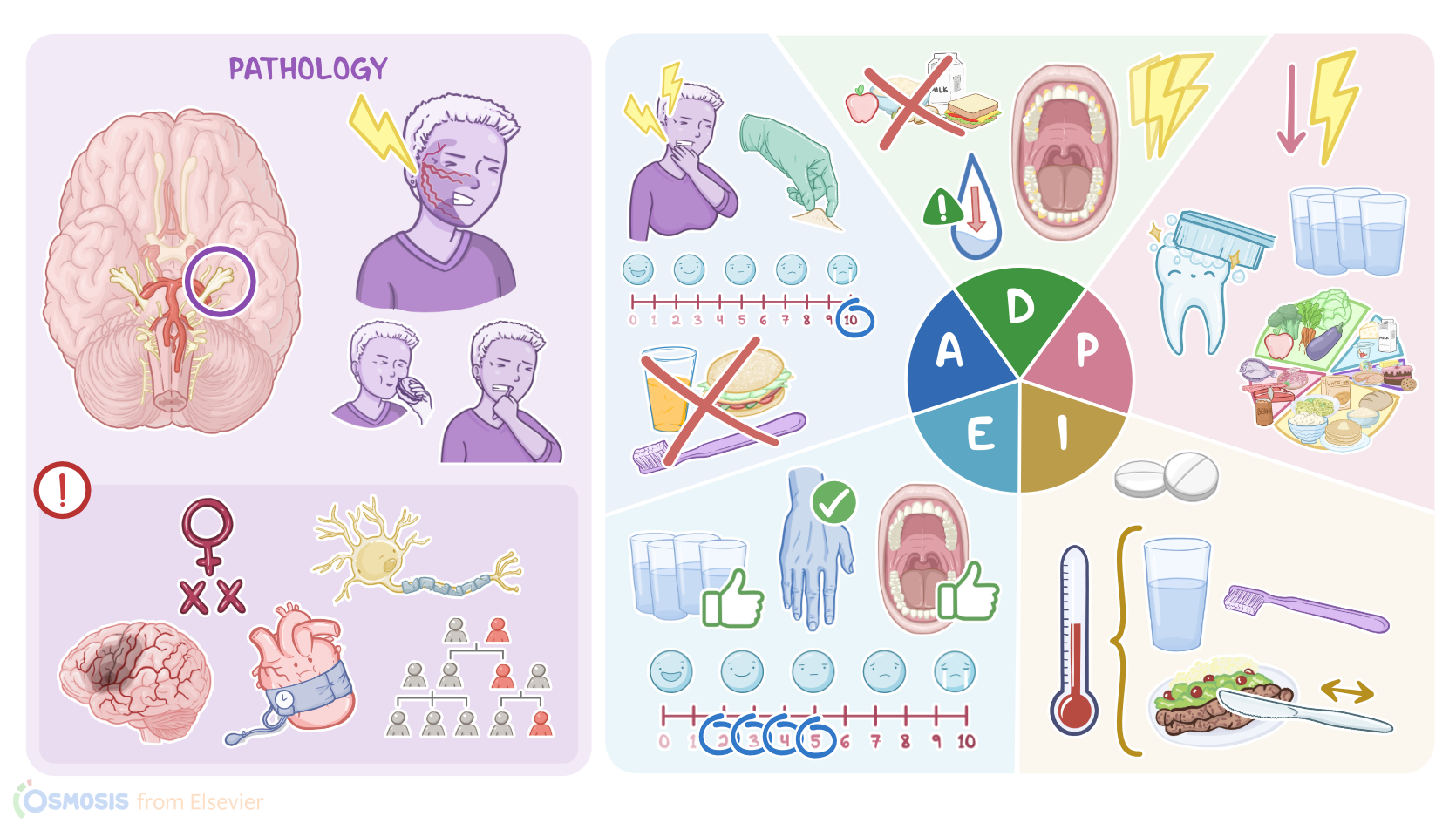
Trigeminal neuralgia, also known as tic doleu, is a neuropathic pain condition that involves the trigeminal, or 5th cranial nerve, which supplies sensory information to the skin and mucous membranes of the face, as well as motor information for the muscles of mastication.
And because of that, pain can often be triggered by chewing, brushing the teeth, shaving, or even just smiling. Now the exact cause of trigeminal neuralgia is not well-known, but it's thought to be associated with vascular compression of the trigeminal nerve root.
Some risk factors include female sex, increased age, and family history, as well as disorders like hypertension, multiple sclerosis, a brain stem tumor, an aneurysm, or a previous stroke.
Now, the main symptom of trigeminal neuralgia is a sudden, excruciating, sharp pain, similar to an electric shock. Typically, the pain is unilateral and involves the lower face from the corner of the mouth to the jaw, although in some clients, it can also involve the area around the nose, cheek, and above the eye.
The pain occurs in paroxysmal attacks that generally last from a few seconds up to 2 minutes and may recur after just minutes, as often as 100 times per day.
As a consequence, trigeminal neuralgia can be incapacitating and interfere with the client's daily activities, like eating, sleeping, or communicating.
In the long-term, the pain could be so unbearable that it may lead to mental health disorders like depression, and some clients may even consider suicide.
Diagnosis of trigeminal neuralgia mainly relies on history, since neurological examination is typically normal. There is no specific laboratory or imaging test, but sometimes they can be done to rule out other disorders such as rheumatic conditions, tumors, or aneurysms.
Treatment is aimed at relieving the pain and improving the client's quality of life. The medications of choice to treat trigeminal neuralgia include anti-seizure medications like carbamazepine, while alternative options include phenytoin, gabapentin, and baclofen.
If none of these medications are effective in relieving the pain, a peripheral nerve block can be done, where an anesthetic is injected to block sensation from the trigeminal nerve, giving temporary pain relief.
If all treatment options fail, the client may consider surgical treatment, which includes procedures like microvascular decompression, where the trigeminal nerve is separated from nearby arteries that may be compressing it.
Percutaneous rhizotomy where one or more branches of the trigeminal nerve is cut to remove all facial sensation, or gamma knife radiosurgery to deliver radiation at the proximal trigeminal root disrupting the pain signal to the brain.
OK, let's get back to assess your client Eliza. You enter her room, introduce yourself, wash your hands, and confirm her identity.
Assessment4:02–5:48
You ask Eliza how she is feeling today, and she states she has been experiencing stabbing pain shooting from the corner of her mouth to the angle of her jaw.
She describes the pain as severe and episodic, starting with what feels like a sensation of electrical shocks with crescendos in less than 20 seconds to excruciating discomfort felt deep in her face.
On a pain scale of 0 to 10, she rates her pain a 10 during an episode. Eliza states the pain is excruciating and incapacitating during each episode, but does not experience any pain in between episodes.
She explains she is reluctant to eat, drink, or brush her teeth because these trigger the painful episodes. Her vital signs are temporal temperature 98.4 °F or 36.9 °C.
Heart rate 95 BPM and regular. Respiratory rate 18 breaths per minute with clear lung sounds bilaterally.
BP 120/85 millimeters of mercury, and oxygen saturation 98% on room air. Her oral mucous membranes are dry, and you notice the presence of debris and discoloration on her teeth.
You gently pinch the skin over her sternum and note her skin tergur is decreased. You document your assessment findings before leaving the room.
Diagnosis5:48–6:14
Based on the assessment data you collected, the nursing diagnoses include acute pain related to irritation of the trigeminal nerve.
The physician has diagnosed Eliza with trigeminal neuralgia, so now you make a plan to achieve some important treatment goals.
Planning6:14–6:48
Eliza will report a decrease in acute pain as evidenced by her verbalizing a decrease in episodes and a pain rating of 2 or below on a scale of 0 to 10.
She will increase her nutritional and fluid intake to maintain hydration and prevent further weight loss. And finally, she will resume routine oral hygiene.
Implementation6:48–7:58
Next, you implement the plan of care. Eliza is started on the anti-seizure medication, carbamazepine to manage your pain.
You teach Eliza to call the office if she experiences fever, sore throat, rash, ulcers in the mouth, easy bruising, pale stools, dark urine, or jaundice.
Next, you explore additional measures to manage pain during episodes, such as decreasing environmental stimuli and relaxation techniques.
To increase her nutritional status, you encourage Eliza to eat small, frequent meals that are high in calories and protein.
She should select food she enjoys that are easy to chew. Food and liquids should be at room temperature, since hot and cold temperatures can trigger pain.
Lastly, you stress the importance of regular oral hygiene for overall good health and suggest she try a small, soft bristle toothbrush and warm water rinses to help maintain oral health.
One week later, Eliza returns for her follow-up appointment. Since starting on carbamazepine, she has had 3 episodes with her pain level ranging from 2 to 5 out of 10.
Evaluation7:58–8:37
She is still cautious while eating, though she's been able to maintain her fluid intake. You note that her skin turgur is normal and her mucous membranes are moist.
Oral hygiene has also improved, though Eliza says she can tolerate brushing her teeth just once per day. Eliza will continue to be monitored and re-evaluated regularly, and adjustments to her plan of care will be made as needed.
Alright, as a quick recap, trigeminal neuralgia is a neuropathic pain condition that involves the trigeminal or 5th cranial nerve.
Summary8:37–9:50
It leads to painful episodes described as sudden, excruciating, sharp pain, similar to an electric shock. Treatment is aimed at pain management and improving the client's ability to participate in normal activities of daily living and self-care.
Anti-seizure medications like carbamazepine are commonly used to treat trigeminal neuralgia. Your assessment revealed Eliza was experiencing excruciating facial pain.
Your nursing diagnoses were acute pain and imbalanced nutrition, fluid volume deficit, and imperiled oral mucous membrane integrity.
The goals you identified when planning care for Eliza included a decrease in acute pain, maintaining nutritional and fluid intake, and improved oral hygiene.
Eliza will continue to be monitored through follow-up appointments. Interventions will continue to be implemented and evaluated to determine if her goals are being met.
| TRIGEMINAL NEURALGIA | ||
| KEY POINTS | NOTES | |
| PATIENT REPORT |
| |
| PATHOPHYSIOLOGY |
| |
| DIAGNOSIS AND TREATMENT |
| |
| ASSESSMENT |
| |
| NURSING DIAGNOSES |
| |
| PLANNING |
| |
| IMPLEMENTATION |
| |
| EVALUATION |
| |
- "Trigeminal neuralgia: basic and clinical aspects" Current Neuropharmacology (2020)
- "The Molecular Basis and Pathophysiology of Trigeminal Neuralgia" Int J Mol Sci (2022)
- "Trigeminal neuralgia: An overview from pathophysiology to pharmacological treatments" Mol Pain (2020)
- "Schwann cells and trigeminal neuralgia" Mol Pain (2020)
- "Trigeminal neuralgia: a practical guide" Practical Neurology (2021)
- "Harrison’s Principles of Internal Medicine, 21st edition" McGraw Hill / Medical (2022)
- "Robbins & Kumar Basic Pathology, 11th edition" Elsevier (2022)
- "Trigeminal neuralgia: current approaches and emerging interventions" Journal of Pain Research (2021)
No notes for this video yet
Try adding a note below