Vital signs - Blood pressure (BP): Nursing skills
Introduction0:00–0:37
As a healthcare professional, you will need to measure your patient's BP. BP refers to the force that the blood exerts on the walls of the arteries.
Now, a BP measurement has two values. The first and the highest is the systolic BP, which is the force that the blood exerts on the walls of the arteries during systole or when the heart contracts to pump blood through the body.
The second one is the diastolic BP, which is the pressure on the walls of the arteries during diastole or when the heart relaxes and refills with blood between heartbeats.
Now, maintaining normal BP is essential to ensure that tissues around the body are receiving an adequate amount of oxygen and nutrients from the blood.
Importance of Maintaining Normal Blood Pressure0:37–1:40
If BP gets too low, the brain, heart and other vital organs might stop functioning normally because they're not getting enough blood.
In contrast, BP thats too high can create a serious problem for the blood vessels and the organs they supply just like a garden hose that's always under high pressure.
In the long term, blood vessels may develop tiny cracks and tears. This can lead to serious problems like myocardial infarctions or heart attacks, strokes or brain attacks and aneurysms or bulges of a weakened blood vessel wall.
Increased BP can damage small blood vessels like those seen in the kidney and eyes, leading to kidney failure and vision loss.
Chronic increased BP also makes it hard for the heart to pump blood out against the increased pressure. Over time, the heart gets overworked and this can lead to heart failure.
There are several factors that determine what a persons BP is at any given time. The first factor is the cardiac output, which is the total volume of blood.
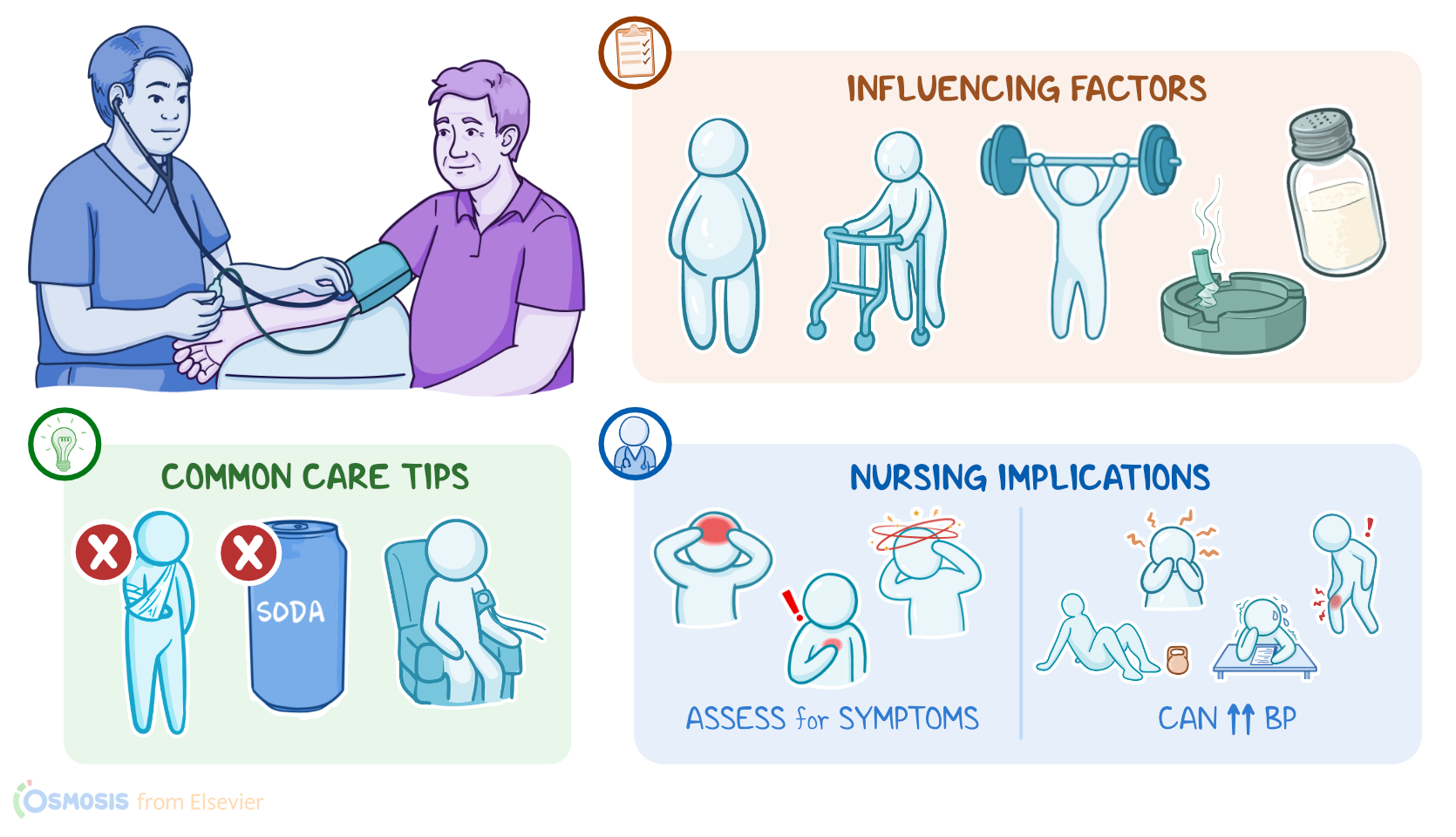
Factors Influencing Blood Pressure1:40–3:14
The heart ejects in one minute. The cardiac output depends on the heart rate or the number of times the heart BPM and the stroke volume or the volume of blood.
The left ventricle ejects with every heartbeat, stroke volume. In turn is affected by factors like preload or how much blood the ventricle can fill with before it contracts the contractility or how forcefully the heart contracts with each beat as well as afterload or the amount of resistance the ventricles must overcome to push blood out of the heart.
So left ventricular afterload is affected by aortic pressure, valve diseases and systemic vascular resistance. Focusing for a minute on systemic vascular resistance.
This is the resistance from systemic blood vessels to blood flow. In other words, how readily blood vessels allow blood to flow through them.
Now, systemic vascular resistance is mainly affected by changes in the vessel lumen, which is determined by vasodilating and vasoconstricting factors.
The relationship between the systemic vascular resistance and cardiac output as a whole is what determines BP. Let's look at some other factors that can influence BP.
BP can vary between sexes. Since sex hormones like estrogen can have a protective effect on BP.
Physiological Values3:14–4:20
It's also important to recognize that BP in any patient is highly variable. This means BP readings often differ by the time of day where they're typically higher in the morning and lower following a meal.
Also, the readings may vary by the season and by other factors. For example, they may increase with physical activity, fear or pain and decrease when the person is lying down.
One last important variation to remember is that a person's BP may be higher in a healthcare setting than it is at home.
Sometimes referred to as white coat hypertension. In adults and Children aged 13 years and older BP should be below 120 systolic and below 80 diastolic normal BP for younger Children is based on biological sex, age and height and should be between the 50th and 90th percentile for these criteria when diagnosing hypertension on the other hand, a simplified range of normal BP values can be used to decide which Children need a repeat BP measurement or further evaluation of their BP.
These ranges are based on age. So for school age Children, 6 to 12 years old, normal systolic BP is 97 to 120 millimeters of mercury and diastolic BP is 57 to 80 millimeters of mercury.
Hypertension, Hypotension, and Orthostatic Hypotension4:20–5:06
Preschoolers from age 3 to 5 normally have a systolic BP of 89 to 112 millimeters of mercury and a diastolic BP of 46 to 72 millimeters of mercury.
Toddlers from 1 to 2 years old have a normal systolic BP of 86 to 106 millimeters of mercury and a diastolic pressure of 42 to 63 millimeters of mercury.
Finally, infants under one year of age normally have the lowest BP which ranges from 72 to 104 millimeters of mercury systolic and 37 to 56 millimeters of mercury diastolic.
Common Care Tips5:06–6:45
So, hypertension is defined as persistently higher than normal values of BP, which in adults and Children aged 13 years and older means 130 millimeters of mercury or more for the systolic BP or 80 millimeters of mercury or more for the diastolic BP in Children under age 13 years, hypertension is diagnosed if measurements are persistently above the 95th percentile for their age.
On the other hand, hypotension for adults is when BP falls below 90 mmhg for the systolic or 60 of mercury for the diastolic.
Now, defining hypotension in Children is a bit more complex. It's based on the systolic BP and age and there are some important cutoffs to keep in mind in neonates.
A systolic BP of less than 60 millimeters of mercury is considered hypotension in infants. It is less than 70 millimeters of mercury.
For Children, 1 to 10 years of age, it's less than 70 plus the child's age multiplied by two. And for Children, over 10 years old, a systolic BP of less than 90 millimeters of mercury is considered hypotensive.
A variant of that is orthostatic hypotension, which is when BP falls. When a person goes from a lying down position to a standing position.
This is more common in the elderly and these patients could experience lightheadedness and fainting also known as syncope when they stand or sit up due to decreased blood flow to the brain.
Now, when measuring a patient's BP, there are some common tips to keep in mind, do not take the BP on an arm that's injured in a cast or is on the same side as a mastectomy.
Measuring Blood Pressure with a Manual Sphygmomanometer6:45–9:28
Now, for an accurate measurement, ensure that the patient is in a comfortable position with their legs uncrossed feet flat on the floor and their back supported, they should be calm, should not be talking and check to make sure they haven't recently consumed caffeine or smoked.
It's also important to choose the proper cuff size for the patient. An overly small cuff causes the BP to read too high.
While an overly large cuff causes the BP to read too low. The width of the cuffs bladder should amount to about 40% of the circumference of the upper arm and the length of the cuffs bladder should amount to about 80% of the circumference of the upper arm.
Most cuffs have markings printed on the inside that indicate if the cuff is the correct size. When placed on the patients arm, the arm should also be rested at the heart level.
If it's too low, the BP might read higher than it really is. If it's too high, the BP might be lower than it really is.
Finally, when placing the cuff on the patient's arm, make sure to wrap it snugly against the patient's arm. Having the right foot on the arm is crucial for getting an accurate BP reading a cuff that's too tight or too loose can make the reading too high before taking a patients BP.
It's important to consider how often the BP should be checked as well as the patients. Previous BP.
Critically ill patients might need their BP checked more often like multiple times an hour. While those who are in stable condition might need to be checked.
Less often you can then gather the supplies you'll need including a BP gauge or manual sphygmomanometer. A stethoscope and alcohol wipes.
Remember to also practice hand hygiene. Start by identifying your patient informing them about the procedure and answering any questions related to the procedure.
The patient should be either supine or seated comfortably with their legs uncrossed feet flat on the floor for at least five minutes.
Before taking a measurement disinfect the earpieces, diaphragm and bell of the stethoscope with alcohol wipes. Before placing the cuff, ask the patient to remove any clothing covering the upper arm and support the arm at heart level with the patient's palm facing up, use two fingers to palpate and identify the brachial artery on the inner side of the elbow and wrap the deflated cuff snugly around the arm.
The bladder of the cuff should be centered directly over the brachial artery with the lower edge of the cuff ending about 2.5 centimeters or about one inch above the antecubital crease.
Make sure the arrow on the cuff is also aligned with the brachial artery. Place the diaphragm or bell of the stethoscope over the artery, ensuring a tight seal, using gentle pressure and place the earpieces in your ears, quickly inflate the cuff to 20 to 30 mmhg above the patients usual systolic BP slowly deflate the cuff at a rate of about 2 to 3 mmhg per second, when you hear two consecutive beats, read the pressure on the gauge.
Measuring Blood Pressure with an Automated Sphygmomanometer9:28–10:24
What you are hearing is the phase one Korotkoff sound. And the reading on the gauge is the systolic BP.
As you continue to deflate the cuff, the sound will begin to muffle and this is the phase four Korotkoff sound, then it will disappear entirely.
And this is the phase five Korotkoff sound. The reading on the gauge when the sound disappears entirely, is the diastolic BP, you can then fully deflate the cuff, remove it from the patient's arm and take the earpieces of the stethoscope off.
Finally assist the patient into a comfortable position. Disinfect the stethoscope with alcohol wipes and practice hand hygiene.
Nursing Implications10:24–11:38
So far, we've discussed the manual approach to measuring BP. However, your facility may use an electronic BP cuff also known as an automated sphygmomanometer.
The procedure is almost the same. However, youll only need the sphygmomanometer, inform the patient about the procedure before beginning and answer any questions related to the procedure, practice hand hygiene and assist the patient into a comfortable position.
Expose the patient's arm and wrap the cuff over the same site as previously described, ensuring the bladder of the cuff is centered over the brachial artery.
However, instead of manually inflating and deflating the device. While you listen for the Korotkoff sounds, just select the appropriate mode and activate the device.
The measurement will then be visible on the display screen if an abnormal measurement is obtained, consider repeating the procedure with the manual approach.
Now, as a healthcare professional, there are a few things you should look for when measuring a patient's BP. If you obtain a BP reading, that's out of range recheck, the BP in the opposite arm, taking a repeat BP in the same arm, less than five minutes after the first reading can falsely elevate the BP reading.
Review11:38–13:16
If the pressure remains out of range, check the patient for symptoms. Also, if you have problems taking the measurement or if you suspect the equipment might be faulty, ask someone for help, finally document the date and time you did the procedure, the BP reading the location and the method it was taken along with your observations.
All right. As a quick recap, obtaining a patient's BP is important to detect abnormally high values which could indicate hypertension or low values, which could indicate hypotension.
You can take a patients BP using a manual sphygmomanometer and a stethoscope to do this, wrap the cuff snugly around the patient's arm and place the stethoscope over the brachial artery inflate the cuff and begin slowly deflating it at a rate of about 2 to 3 millimeters of mercury per second.
When you first hear two consecutive beats, read the pressure on the gauge. This is the phase one Korotkoff sound which corresponds to the systolic BP, continue deflating until the sound disappears entirely.
This is the phase five Korotkoff Sound which corresponds to the diastolic BP. Otherwise, you can take the patient's BP using an electronic or automated sphygmomanometer for abnormal readings.
Take the BP again, check the patient for symptoms and ask for help with any issues or concerns. Finally document the BP reading along with your observations.
| VITAL SIGNS - BLOOD PRESSURE (BP) | ||
| KEY POINTS | NOTES | |
| DEFINITION |
| |
| IMPORTANCE OF MAINTAINING A NORMAL BP |
| |
| INFLUENCING FACTORS |
| |
| PHYSIOLOGICAL VALUES |
| |
| PATHOLOGIES |
| |
| COMMON CARE TIPS |
| |
| MEASUREMENT WITH A MANUAL SPHYGMOMANOMETER |
| |
| MEASUREMENT WITH AN AUTOMATED SPHYGMOMANOMETER |
| |
| CLINICAL IMPLICATIONS |
| |
- "Part 12: Pediatric Advanced Life Support: 2020 American Heart Association Guidelines for Cardiopulmonary Resuscitation and Emergency Cardiovascular Care. " Circulation (2020;142(16_suppl 2): S524-S556. )
- "2025 AHA/ACC/AANP/AAPA/ABC/ACCP/ACPM/AGS/AMA/ASPC/NMA/PCNA/SGIM Guideline for the Prevention, Detection, Evaluation, and Management of High Blood Pressure in Adults: A Report of the American College of Cardiology/American Heart Association Joint Committee on Clinical Practice Guidelines. 152, e1-e105. " Circulation (2025)
- "Subcommittee on Screening and Management of High Blood Pressure in Children. Clinical Practice Guideline for Screening and Management of High Blood Pressure in Children and Adolescents. 140(3): e20171904. " Pediatrics (2017)
- "Wong’s clinical manual of pediatric nursing (9th ed.). ISBN: 978-0-323-75476-7 " Elsevier (2024)
- "Seidel's Guide to Physical Examination. 10th ed. 79-92. Chapter 6. " Elsevier (2023)
- "Excess pressure as an analogue of blood flow velocity. 39(3):421-427. " J Hypertens (2021)
- "Seidel’s Guide to Physical Examination: An Interprofessional Approach. 10th edition. ISBN: 978-0-323-76183-3 " Elsevier (2022)
- "Blood pressure and the new ACC/AHA hypertension guidelines. 30(3):160-164. " Trends Cardiovasc Med. (2020)
- "Ambulatory Blood Pressure Monitoring to Diagnose and Manage Hypertension. 77(2):254-264. " Hypertension (2021)
- "Clinical Nursing Skills and Techniques. 10th edition. ISBN: 978-0-323-70863-0 " Mosby (2021)
- "Blood pressure targets and management during post-cardiac arrest care. 189:109886. " Resuscitation (2023)
No notes for this video yet
Try adding a note below