Vital signs - Oxygen saturation (SpO2): Nursing skills
Introduction0:00–0:40
As a healthcare professional, you will help provide safe care to patients who have or are at risk for hypoxemia or low levels of oxygen in the blood.
These patients require pulse oximetry or pulse ox for short, which is a noninvasive easy and pain free method of measuring the percentage of hemoglobin that's saturated with oxygen.
This is known as the saturation of peripheral oxygen or SP two for short, a normal SP two usually indicates that the amount of oxygen traveling through the bloodstream to the tissues is enough to meet the needs of the body.
How It Works0:40–1:11
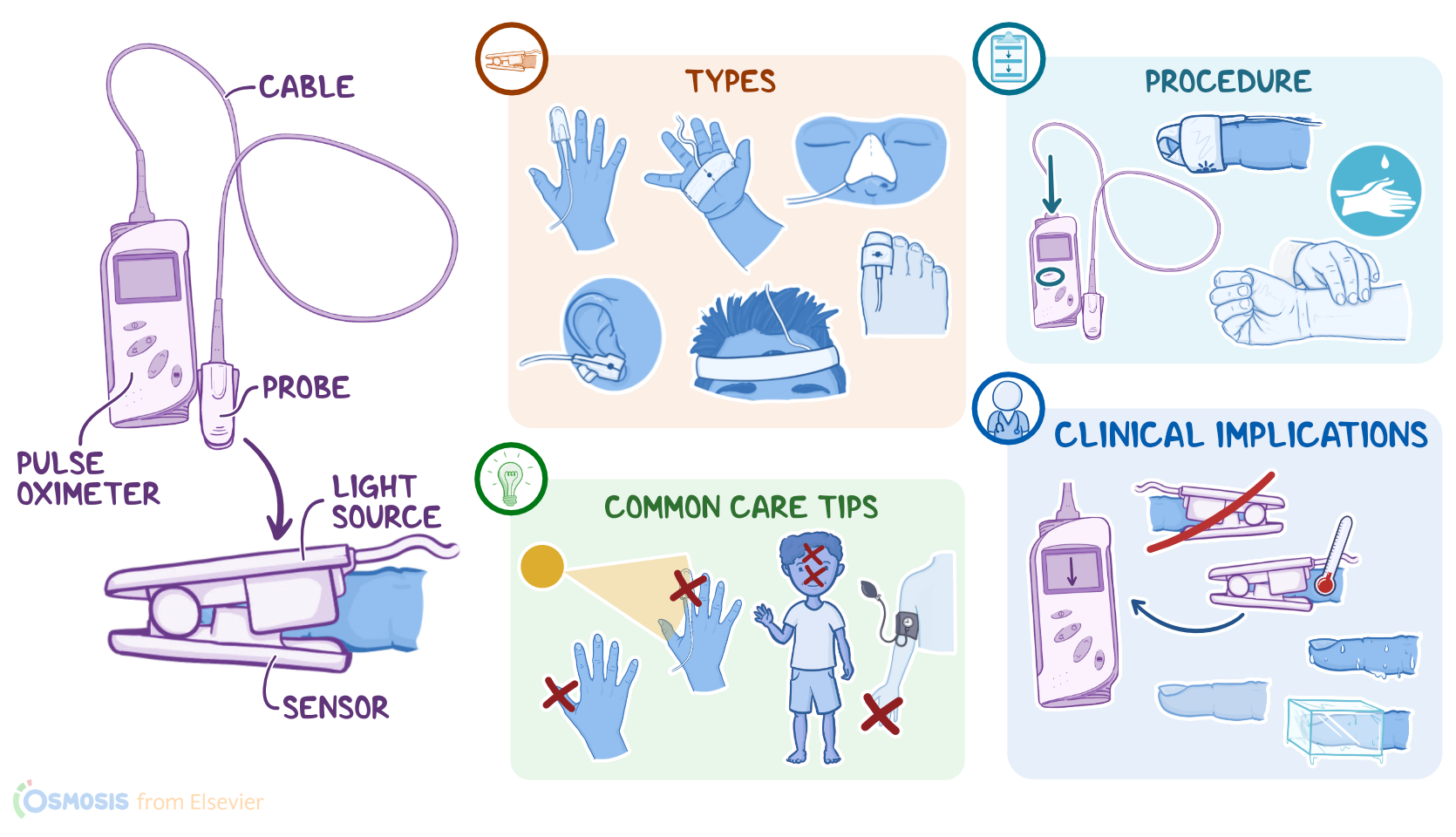
Now, a pulse oximeter consists of a probe which is attached by a cable to a pulse oximeter. The probe has a light source on one side and a photodetector or sensor on the other side.
So when it gets clipped onto a body part, two different wavelengths of light shine through the tissues on one side. And on the other side, the sensor detects how much of each wavelength has been absorbed by the arterial blood in the tissues.
Pulse Oximeter Probes & Sites1:11–2:26
The principle is that when hemoglobin is bound to oxygen, it absorbs a different wavelength of light than when it's not bound to oxygen.
So the percentage of hemoglobin bound to oxygen can be calculated by the device. Now, there are several types of probes depending on the site where they can be placed.
The most commonly and easily used ones are digit probes which can fit onto a finger or a toe. There are also earlobe probes which attach to the patient's ear less commonly if the digits or earlobes are inaccessible.
A pulse oximetry probe can be applied across the forehead and secured with a headband. Both earlobe and forehead probes tend to be more accurate than digit probes.
In cases when blood flow to the extremities is compromised or if the patient moves their hands or feet frequently creating motion artifacts.
There are also sensor pads that can be used on several different sites including an adult's nose bridge and a newborn's palms or soles.
Now, pulse oximeter probes can be disposable or reusable and they also come in two types, adhesive and clip sensors. In general, adhesive sensors are better for younger Children or if you need to place the sensor on an earlobe nose bridge or toe clip sensors are good for spot checking.
Normal & Low SpO2 Values2:26–3:51
A patient's oxygen saturation but are not the best for continuous monitoring, especially in Children because they are very easy to take off.
Now, an sp two of 95% or greater is typically considered normal. Anything below that is usually considered low for most patients.
But if it falls below 90%. It can get really dangerous for the patient.
This may occur in patients with various lung conditions that interfere with gas exchange, meaning movement of oxygen and carbon dioxide between the blood lungs and tissues.
In other cases, though readings can be low, despite adequate systemic oxygenation because of poor blood flow to the extremities, which makes it hard for the pulse oximeter to pick up a proper signal.
Now, this could be due to peripheral vascular disease, which happens when one of the arteries supplying the extremities becomes narrowed as well as hypotension or low BP, hypothermia or decreased body temperature, certain medications as well as peripheral edema or accumulation of fluid and swelling of the limbs.
Common Care Tips3:51–5:26
Another important situation to consider when interpreting a pulse ox reading is that patients with carbon monoxide poisoning can have a normal pulse ox reading but still be deficient in oxygen.
This is because the pulse oximeter can't distinguish between oxygenated hemoglobin and carboxyhemoglobin, which is hemoglobin bound to carbon monoxide.
Therefore, in carbon monoxide poisoning, the pulse oximeter value can appear normal but the true saturation of oxygen is much lower.
Readings can also be inaccurate. Meaning that false signals are generated when they shouldn't be due to motion artifacts.
Like when the patient is shivering or restless. If the patient is wearing nail polish or if bright light such as sunlight is shining on the probe, making it harder to measure the oxygen saturation.
First. Here are some common care tips to keep in mind in general, depending on the condition of the patient, pulse oximetry can be used intermittently, meaning that you can go and check the patient's sp two at certain times or continuously or the patient is continuously connected to the pulse oximeter.
In the latter case, an alarm can notify you if the SP two falls below a certain level or if the probe falls off. If the patient is a child, remember that they tend to move around a lot.
Procedure5:26–7:03
So it might be best to place the probe on their toe. Otherwise you may get inaccurate readings.
Also avoid using forehead or nose probes with these patients. Children especially neonates have delicate skin and can be easily injured.
So remember to protect their skin check under the probe regularly for skin breakdown and routinely place the probe in a different spot.
In all cases, make sure to use the appropriate probe for those sites. If the patient is restless or moving too much, encourage them to stay, still, try to hold their limbs steady or simply place the probe in a different spot before clipping on a finger probe.
Check for the presence of nail polish or artificial fingernails and remove them if possible in general, never place the probe on a thumb.
Also don't put the probe on the same limb as a BP cuff. Otherwise the probe reading will be inaccurate whenever the cuff inflates finally to get the clearest reading, avoid exposure of the probe to direct bright light.
Ok. So when caring for a patient who needs pulse oximetry, first, gather the supplies you'll need including the pulse oximeter and the type of probe that best fits your patient's needs.
Start by identifying your patient then determine which sensor monitoring site will be used. Other important considerations are whether the SP two needs to be measured continuously or intermittently where to set the alarm limits.
Nursing Implications7:03–8:08
How often the PO two should be checked as well as the patient's previous baseline. Sp two inform the patient about the procedure before beginning and answer any questions related to the procedure.
You should then perform hand hygiene when placing the probe, be sure to avoid placing it on skin that is not intact. If you're using an adhesive sensor, make sure that the two sides of the probe are opposite each other.
Plug the probe into the oximeter and turn it on next, listen for audible beeps and check the waveform on the oximeter screen.
Review8:08–11:35
If not readjust the probe until it does. If SP O2 is measured continuously, be sure the alarm is on check the integrity of the skin under the probe every two hours and move the probe to another spot every four hours for intermittent monitoring, turn the oximeter off, remove the probe from the patient, either clean it if it's reusable or discard it in the appropriate manner.
If it's disposable and perform hand hygiene, OK. When caring for a patient who is being monitored with pulse oximetry, there are a few things you should look for such as a low S po two value, meaning below 95% or below a value specific for the patient.
If the SP O2 value is low, try placing the probe in a new position like from the left hand to the right hand. If the probe is placed on a cold or poorly perfused extremity, it can cause low readings.
Also observe the skin integrity color and moisture at the site where the probe is placed. If there's skin breakdown irritation or the skin is pale or damp, another site should be chosen if you have repositioned the probe and the reading continues to be low check the patient for symptoms.
Also, if you had problems taking the measurement or if you suspect the equipment might be faulty, ask someone for help, make sure to take the appropriate next steps for your patient's situation.
If their pulse ox continues to measure low, finally, remember to document the date time sp two reading and any observations you made while caring for a patient with pulse oximetry.
All right. As a quick recap pulse oximetry is a noninvasive easy way to measure the saturation of peripheral oxygen or SP two.
For most patients, a normal value for SP two is 95% or greater. While lower values may indicate pulmonary or other oxygenation problems.
Inaccurate readings can be due to poor blood flow to the extremities, motion artifacts, nail polish and exposure to light.
A pulse oximeter includes a probe that can be attached to the digits, earlobes, forehead, palms or soles of an infant or the nodes.
Probes can be reusable or disposable and secured with a clip or adhesive. As a healthcare professional.
You are responsible for placing the probe on the appropriate site using an appropriate probe for the site, observing the skin integrity, color moisture and temperature and recognizing and responding to low sp two values or any unusual signs or symptoms.
Finally remember to document the po two reading along with your observations.
| VITAL SIGNS - OXYGEN SATURATION | ||
| KEY POINTS | NOTES | |
| INTRODUCTION |
| |
| HOW IT WORKS |
| |
| PULSE OXIMETER PROBES AND SITES |
| |
| SpO2 VALUES |
| |
| COMMON CARE TIPS |
| |
| PROCEDURE |
| |
| CLINICAL IMPLICATIONS |
| |
- "Clinical nursing skills & techniques (11th ed.). ISBN 978-0-443-10718-4 " Elsevier (2025)
- "Physical examination and health assessment (9th ed.) ISBN: 978-0-323-80984-9 " Elsevier (2024)
- "Oxygen metabolism and oxygenation of the newborn. " Semin Fetal Neonatal Med. (2020;25(2):101078. )
- "Advanced Health Assessment & Clinical Diagnosis in Primary Care. ISBN 978-0323832069 " Elsevier (2023)
- "The value of vital sign trends in predicting and monitoring clinical deterioration: A systematic review. " PLOS ONE (2019;14(1):e0210875)
- "Drug-induced interstitial lung disease during cancer therapies: expert opinion on diagnosis and treatment. " ESMO Open. (2022;7(2):100404. )
- "Impact of Early and Regular Mobilization on Vital Signs and Oxygen Saturation in Patients Undergoing Open-Heart Surgery. " Braz J Cardiovasc Surg. (2021;36(4):506-514. Published 2021 Aug 6. )
- "Fundamentals of nursing (10th ed.). ISBN 978-0323810340 " Elsevier (2021)
No notes for this video yet
Try adding a note below