Vital signs - Pulse: Nursing skills
Introduction0:00–0:22
In order to deliver oxygenated blood to our organs and tissues. As a healthcare professional, you need to be able to obtain a pulse and determine its characteristics including the pulse rate, rhythm and amplitude.
You can calculate the pulse rate by counting the number of pulsations felt over an artery in one minute. This should be equal to the heart rate or the number of times the heart BPM.
Normal and Abnormal Pulse Rate0:22–1:30
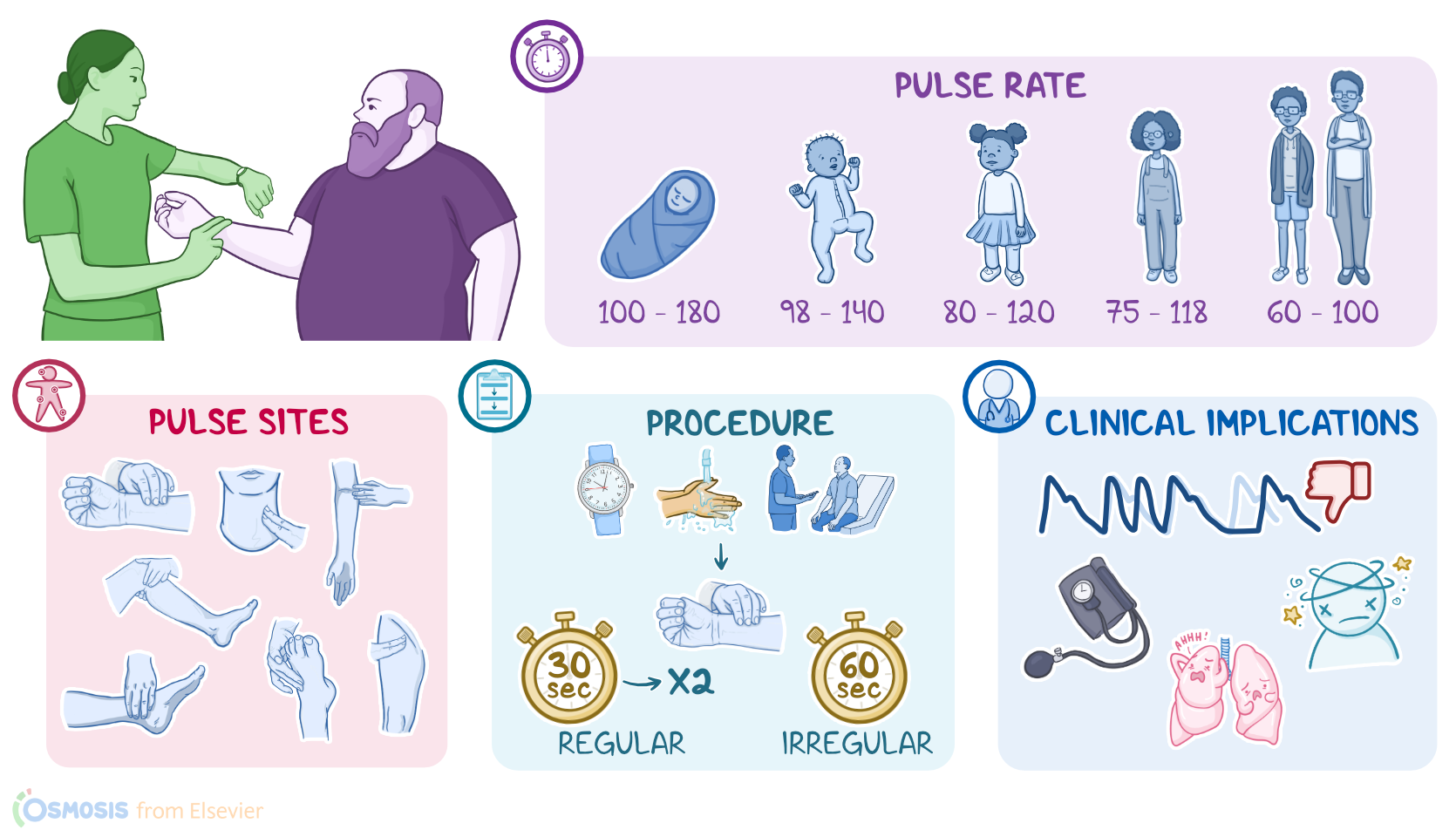
The normal pulse rate varies among different age groups and individual patients. So for adults and adolescents, 12 years of age or older, the awake rate is typically between 6100 for school age Children, between six and 12, it's 75 to 118.
For preschoolers from 3 to 5, it's 80 to 120 toddlers aged one and two years old have a normal pulse rate of 98 to 140. Finally, infants under one year of age normally have the fastest pulse rate, which ranges from 100 to 180 BPM.
Besides age, the pulse rate can also be influenced by many factors including sleep, physical activity, body temperature, emotions, like anger, fear or stress, medications or even the weather.
So, tachycardia is when the pulse rate is faster than the normal range or over 100 BPM. For an adult.
Normal and Abnormal Pulse Rhythm1:30–1:56
Tachycardia can occur in response to factors like strenuous exercise, fever, pain, anxiety, or certain medications. In contrast, bradycardia means that the pulse rate is too slow or less than 60 BPM for an adult and can be due to heart problems or various medications.
Another important characteristic is the pulse rhythm, which is normally regular, meaning that the intervals between the beats are equal in an irregular rhythm.
Normal and Abnormal Pulse Amplitude1:56–2:53
The beats don't follow an even tempo and some of them might even be skipped. It's also useful to note whether the irregularity happens in a predictable way or unpredictable way.
A predictable or regularly irregular pulse is one that follows the same pattern every time. An example of this is sinus arrhythmia, which is a benign finding where the heart rate increases in rate on inspiration and decreases in rate on expiration.
If on the other hand, the pulse is irregular in an unpredictable pattern. It's called an irregularly irregular rhythm and can be the result of a heart problem such as atrial fibrillation.
Pulse, amplitude or force refers to how strong or full the pulse is and reflects the amount of blood that's pushed against the arterial wall with each heartbeat, a weak thready or feeble pulse is typically considered an emergency and could be an indication of low blood volume like when a patient is bleeding excessively or a serious heart problem leading to poor perfusion like a blockage of one of the heart's arteries.
Pulse Sites2:53–3:08
In contrast, a bounding pulse refers to a pulse that's stronger than normal and indicates increased blood flow to the area.
Obtaining a Pulse3:08–5:07
A two plus pulse is considered normal. A one plus pulse is diminished and is often described as weak and thready and a pulse that's absent or not palpable is graded as zero.
The pulse can be felt as a thumping sensation in arteries that are located near the skin surface. This includes the radial carotid brachial, femoral popliteal posterior tibial and dorsalis pedis arteries before taking your patient's pulse.
It's important to consider how often the patient's pulse should be measured as well as the patients previous pulse rate and measurement site, then gather the supplies you'll need including a watch with a second hand or a timer, start by identifying your patient informing them about the procedure and answering any questions related to the procedure.
Remember to also practice hand hygiene. Now, the radial pulse is one of the most easily accessible pulse locations and is a satisfactory location for adults and Children.
Over two years of age, start by assisting them into a comfortable position. If the patient is lying in a supine position, place their arm alongside their body, then place your middle two or three fingers on the front of the wrist just under the base of the thumb.
That's where you'll be able to feel the radial artery, make sure to not use your thumb because you can get confused with your own pulse.
Be sure to apply firm but gentle pressure. When palpating the pulse, taking care not to occlude the artery in an emergency.
Or if the radial artery is not easily accessible, the carotid pulse can be obtained first check for obvious pulsations. Then using your middle two or three fingers gly palpate the left and then right artery between the larynx and the anterior border of the sternocleidomastoid muscle do not palpate both arteries at once and don't apply excessive pressure because that would reduce blood flow to the brain count.
Apical Pulse5:07–6:36
The first beat, you feel as one, the second beat is two, the third beat is three and so on. Until you determine the number of beats that occur in 60 seconds.
In irregular rhythm. It can be reasonable to count the beats in 30 seconds and multiply by two.
However, if the rhythm isn't regular, you will need to count the number of beats in a full minute, a full minute of beats is also counted in Children younger than 12 years old.
Now check the other side to assess for symmetry. Both sides should be equal, which means both are receiving the same blood flow.
When youre done remember to practice hand hygiene. Now, if you're having trouble measuring the pulse, if you're caring for an infant or a patient with heart disease, or if the patient is taking medications that affect the pulse rate, the most reliable and accurate way to measure the pulse is to obtain an apical pulse.
That's the pulse that's measured right over the heart, using a stethoscope at a location called the point of maximal impulse or PMI for short.
So first gather the supplies you'll need including a watch, alcohol wipes and a stethoscope. Once again, identify your patient and inform them about the procedure before beginning and answer any questions related to the procedure.
Pulse Deficit6:36–7:14
Next, practice hand hygiene and use an alcohol wipe to clean off your stethoscope. After asking for permission, adjust the patient's clothing and use your fingers to identify anatomical landmarks that will help you locate the apical pulse, find the apical pulse at the apex of the heart on the left side of the chest, between the 5th and 6th ribs, also known as the fifth intercostal space along the midclavicular line.
That's usually just below the left nipple in people with minimal breast tissue or underneath the breast. In those with more significant breast tissue in a young child under the age of three, the location will be higher, usually around the fourth intercostal space and slightly medial to the midclavicular line.
Nursing Implications7:14–8:12
After identifying the correct location, place your stethoscope against the patient's apical pulse. You should now hear something that sounds like.
Lub dub. Lub, dub, lub dub which repeats over and over again.
Each Lub dub is a heartbeat. Begin counting the heartbeats for one minute.
Once you're done, take the stethoscope off the patient's chest, help them replace any clothing if needed and assist them back into a comfortable position.
Finally wipe the stethoscope clean and practice hand hygiene. Normally, every time the heart beats there's a pulse.
So the apical pulse matches the one measured in the arteries. Sometimes though the heart beats irregularly, too quickly or too weakly to send enough blood to the arteries, which is the reason why some heartbeats might be heard with a stethoscope placed on the apex but not felt as a pulse in the arteries.
Recap8:12–10:19
This can be checked by having one healthcare worker assess the apical pulse with a stethoscope. And another one measure the radial pulse at the same time for one minute to find the pulse deficit, subtract the radial pulse from the apical pulse as a healthcare professional.
There are a few things you should look for when measuring the pulse such as a pulse rate above or below normal or value specific for the patient.
An irregular pulse rhythm, a weak thready or feeble pulse or an unusually strong bounding pulse. If you find an abnormal pulse, check the patient's chart to find out what their baseline pulse rate and rhythm is and then recheck it at another site.
Remember when rechecking an abnormal pulse, be sure to count for a full 60 seconds. If the pulse is abnormal, check the patient for symptoms.
Finally remember to document the date time, pulse rate, rhythm and amplitude and any observations you made while measuring the patient's pulse.
It's characterized by a pulse rate, which is the number of pulses per minute. A pulse rhythm, which can be regular or irregular.
And a pulse amplitude which reflects the strength or fullness of the pulse is typically obtained by feeling the radial or the carotid artery.
An apical pulse can be taken if these sites are not available or the patient as an infant has a heart condition or takes medication that affects the heart.
This is done by measuring the number of heartbeats heard with a stethoscope over the apex of the heart. If you find an abnormal pulse, take the pulse again for a full 60 seconds and check the patient for symptoms.
Finally, remember to document the date time, pulse rate rhythm and amplitude along with your observations.
| VITAL SIGNS - PULSE | ||
| KEY POINTS | NOTES | |
| DEFINITION |
| |
| PULSE RATE |
| |
| PULSE RHYTHM |
| |
| PULSE AMPLITUDE |
| |
| PULSE SITES |
| |
| PROCEDURE |
| |
| APICAL PULSE |
| |
| PULSE DEFICIT |
| |
| CLINICAL IMPLICATIONS |
| |
- "Pulse Pressure Augmentation During Exercise: An Important Stress Test Parameter. " JACC Heart Fail (2022;10(9):695-696.)
- " Heart rate variability: are you using it properly? Standardization checklist of procedures. " Braz J Phys Ther. (2020;24(2):91-102. )
- "Essentials for Nursing Assistants: A Humanistic Approach to Caregiving. Fifth, North American edition. ISBN: 978-1-975142-57-5 " LWW (2020)
- "Nursing Guide to Physical Examination and History Taking. 3rd edition. ISBN: 978-1-975161-09-5 " LWW (2021)
- "Clinical Nursing Skills and Techniques. 10th edition. ISBN: 978-0-323-70863-0 " Mosby (2021)
- "Textbook for Nursing Assistants. 10th edition. ISBN: 978-0-323-65560-6 " Mosby (2020)
- "Minimizing Pulse Check Duration Through Educational Video Review. " West J Emerg Med. (2020;21(6):276-283. Published 2020 Oct 20. )
No notes for this video yet
Try adding a note below