Case study - Acute coronary syndrome (ACS): Nursing
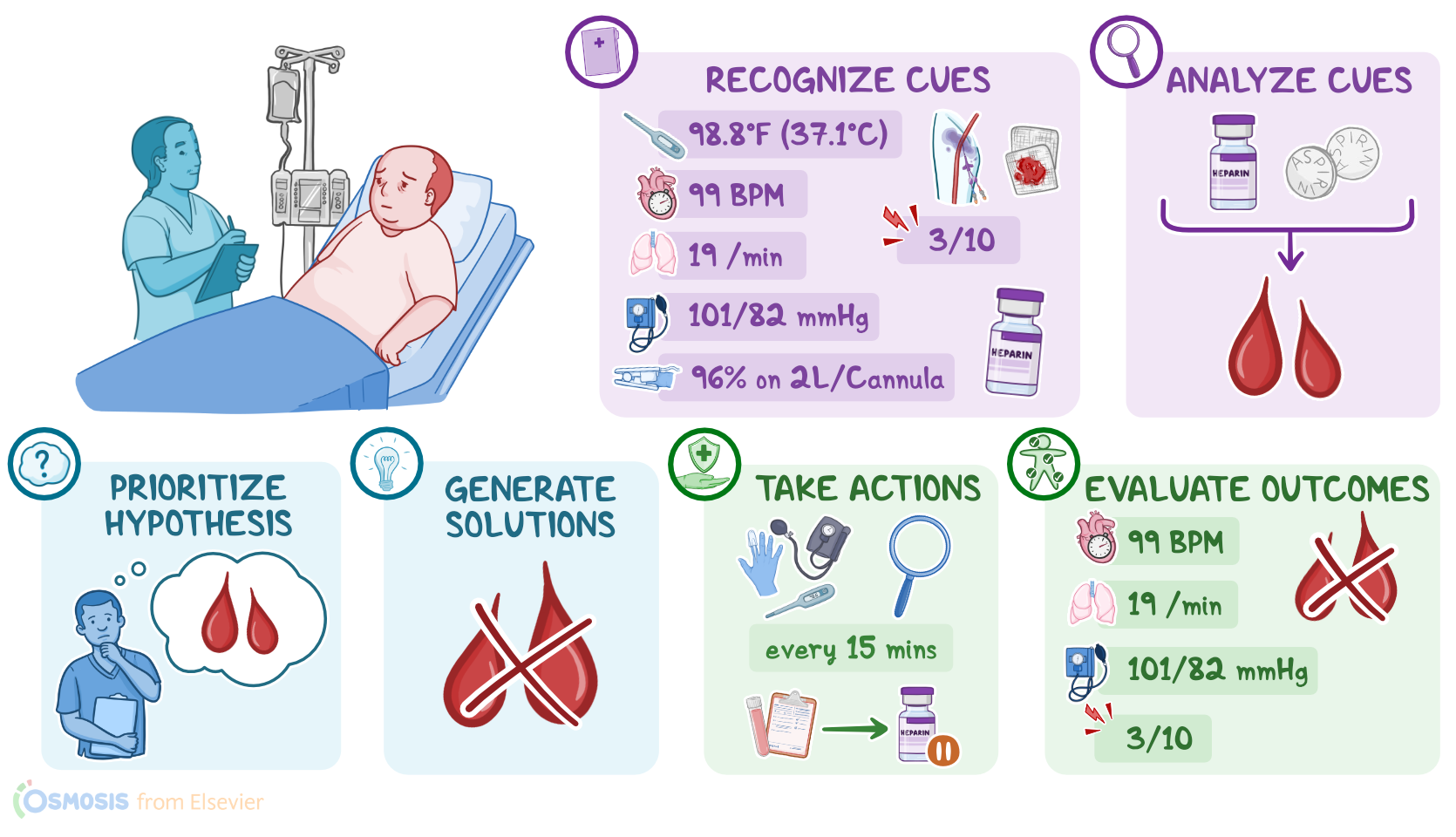
Nurse Cameron works on a cardiovascular care unit, or CCU, and is caring for Kevin, a 55-year-old male with a history of coronary artery disease for which he’s prescribed aspirin at home. He was recently admitted to the CCU after undergoing a percutaneous coronary intervention, or PCI, with placement of one stent to treat an ST-segment elevation myocardial infarction, or STEMI for short. After settling Kevin in his room, Nurse Cameron goes through the steps of the Clinical Judgment Measurement Model to make clinical decisions about Kevin’s care by recognizing and analyzing cues, prioritizing hypotheses, generating solutions, taking action, and evaluating outcomes.
First, Nurse Cameron recognizes important cues including Kevin’s vital signs, which are temperature 98.8 F, or 37.1 C, heart rate 99 beats per minute, respirations 19 breaths per minute and regular, blood pressure 101/82 mmHg, and oxygen saturation 96 percent on 2 liters per nasal cannula.
When asked about pain, Kevin reports a current pain level of 3 out of 10 in his groin incision. Upon assessment Nurse Cameron notes that Kevin has a moderate amount of dried blood on his groin dressing.
Next, Nurse Cameron analyzes these cues. He knows that the PCI procedure involves threading a catheter into a coronary artery and then opening a tiny balloon to compress the plaque against the artery wall, and that a stent can be placed to prevent the artery from closing again. He understands that this procedure can increase the risk of clot formation since the endothelial lining of the coronary artery can be injured, and because the stent can increase the risk of clot formation due to slowing of blood flow and turbulence at the stent site. Nurse Cameron also understands antithrombotic medications like aspirin and heparin are used before the procedure and antiplatelet medications like aspirin and clopidogrel are given after the procedure to reduce the risk of clot formation. Next, he reviews the electronic health record, or EHR, and notes that Kevin is due for his next dose of antiplatelet medications. Nurse Cameron realizes that although Kevin needs antiplatelet medications following stent placement, the medications also increase the risk for bleeding.
Now, using the information he's gathered, along with Kevin’s medical history, Nurse Cameron chooses a priority hypothesis of risk for bleeding.
Then, he generates solutions to address Kevin’s risk for bleeding and he establishes the expected outcome that after intervening, Kevin will not experience bleeding during the shift.
Nurse Cameron then takes action to implement these solutions.
He gathers the necessary supplies and enters Kevin’s room.
Nurse Cameron: Hi Kevin. I’ve got your aspirin and clopidogrel here. They are both antiplatelet medications, so they help prevent your platelets from sticking together so clots are less likely to form in the arteries of your heart. I’m also going to keep a close eye on your incision site to make sure there’s no bleeding.
Kevin: Okay, I don’t want to have any bleeding problems.
Nurse Cameron then administers the prescribed medication according to safe medication administration principles.
Nurse Cameron: It’s also important that you remain lying flat and to keep your leg straight to minimize the risk of bleeding.
| CASE STUDY - ACUTE CORONARY SYNDROME (ACS) | ||
| KEY POINTS | NOTES | |
| INTRODUCTION |
| |
| RECOGNIZING AND ANALYZING CUES |
| |
| PRIORITIZING HYPOTHESES, GENERATING SOLUTIONS, AND TAKING ACTIONS |
| |
| EVALUATING OUTCOMES |
| |
- "Lewis's medical-surgical nursing: Assessment and management of clinical problems. (12th ed.). ISBN: 978-0323792325 " Elsevier. (2022)
- "Medical-surgical nursing: Concepts for interprofessional and collaborative care. (10th ed.). ISBN: 978-0323654050 " Elsevier. (2021)
Aún no hay notas para este video
Intenta agregar una nota a continuación