Case study - Chronic constipation: Nursing
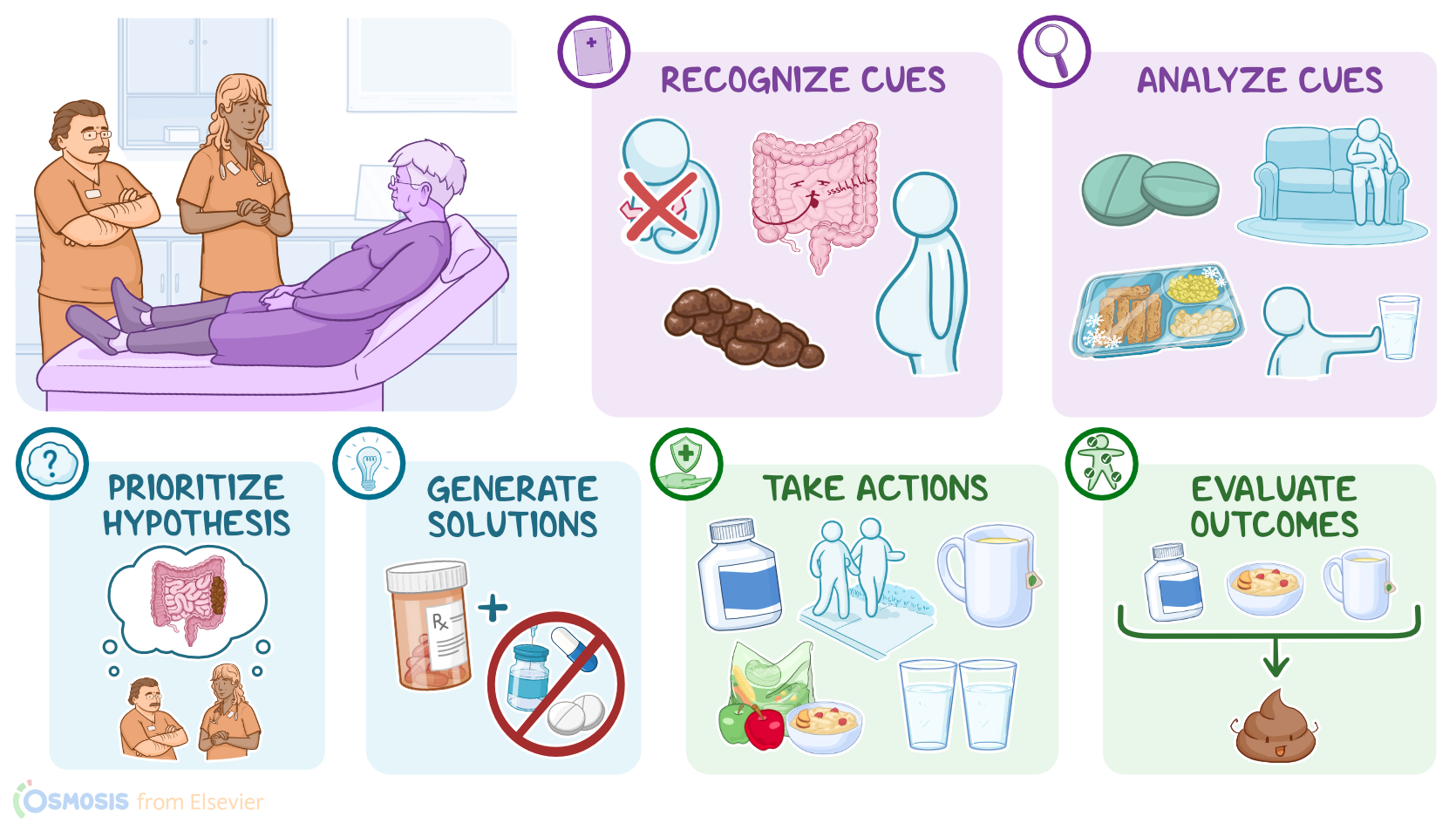
Nurse Kelly works at a primary care office and is caring for Francesca, an 83-year-old who is experiencing constipation. In collaboration with the registered nurse, RN Evan, Nurse Kelly goes through the steps of the Clinical Judgment Measurement Model to make clinical decisions about Francesca’s care by recognizing and analyzing cues, prioritizing hypotheses, generating solutions, taking action, and evaluating outcomes.
First, Nurse Kelly recognizes important cues, including Francesca’s vital signs, which are temperature 98.6 F or 37 C, heart rate 90 beats per minute, respirations 18 breaths per minute, and blood pressure 116/64 mmHg. Francesca denies pain, but states her abdomen feels full and distended.
When asked about her last bowel movement, Francesca replies that she hasn’t had a bowel movement in 3 days, and normally has 2 to 3 hard, lumpy bowel movements each week. Nurse Kelly listens to Francesca’s bowel sounds, which are hypoactive in all four quadrants.
Next, Nurse Kelly analyzes these cues. She reviews the electronic health record, or EHR, and sees that Francesca takes a diuretic which can increase her risk for constipation due to the elimination of excess body fluids.
Then, she gathers information from Francesca about other risk factors for constipation.
Nurse Kelly: Francesca, how would you describe your activity level?
Francesca: I walk around my house, but that’s it. Sometimes, my knees bother me, and I can’t get around that well. So, I guess I sit around a lot.
Nurse Kelly: Okay, and how would you describe your fluid intake and diet?
Francesca: I try not to drink too much water because then I have to go to the bathroom all the time, especially with my water pill. As for my diet, I mostly have my meals delivered. I really like the frozen dinners they send me.
Nurse Kelly realizes that Francesca has several risk factors for constipation. She has a mostly sedentary lifestyle, and because of Francesca’s age, her gastrointestinal motility is slower. Also, Francesca is more prone to dehydration, since she limits her water intake and may not be prompted to drink due to an age-related decrease in thirst sensation. Nurse Kelly realizes that Francesca needs effective bowel elimination.
Now, using the information she has gathered, along with Francesca’s medical history, Nurse Kelly reports her findings to RN Evan, and they choose a priority hypothesis of altered bowel elimination.
They generate solutions to address Francesca’s constipation that will include pharmacologic and nonpharmacologic interventions; and she establishes the expected outcome that after intervening, Francesca will report having a bowel movement within 2 days.
Nurse Kelly then takes action to implement these solutions.
First, RN Evan speaks with the health care provider who orders an osmotic laxative for Francesca. RN Evan teaches Francesca about her diagnosis and medication; and Nurse Kelly reenters the room to review the plan of care.
Nurse Kelly: So, Francesca, I’d like to review the plan for resolving your constipation. What new things will you be doing?
| CASE STUDY - CHRONIC CONSTIPATION | ||
| KEY POINTS | MY NOTES | |
| INTRODUCTION |
| |
| RECOGNIZING AND ANALYZING CUES |
| |
| PRIORITIZING HYPOTHESES, GENERATING SOLUTIONS, AND TAKING ACTION |
| |
| EVALUATING OUTCOMES |
| |
- "Foundations of nursing. (9th ed.). " Elsevier. ISBN: 9780323827119 (2023)
- "Fundamental concepts and skills for nursing. (6th ed.). " Elsevier. ISBN: 9780323694780 (2022)
Aún no hay notas para este video
Intenta agregar una nota a continuación