Case study - Chronic kidney disease (CKD): Nursing
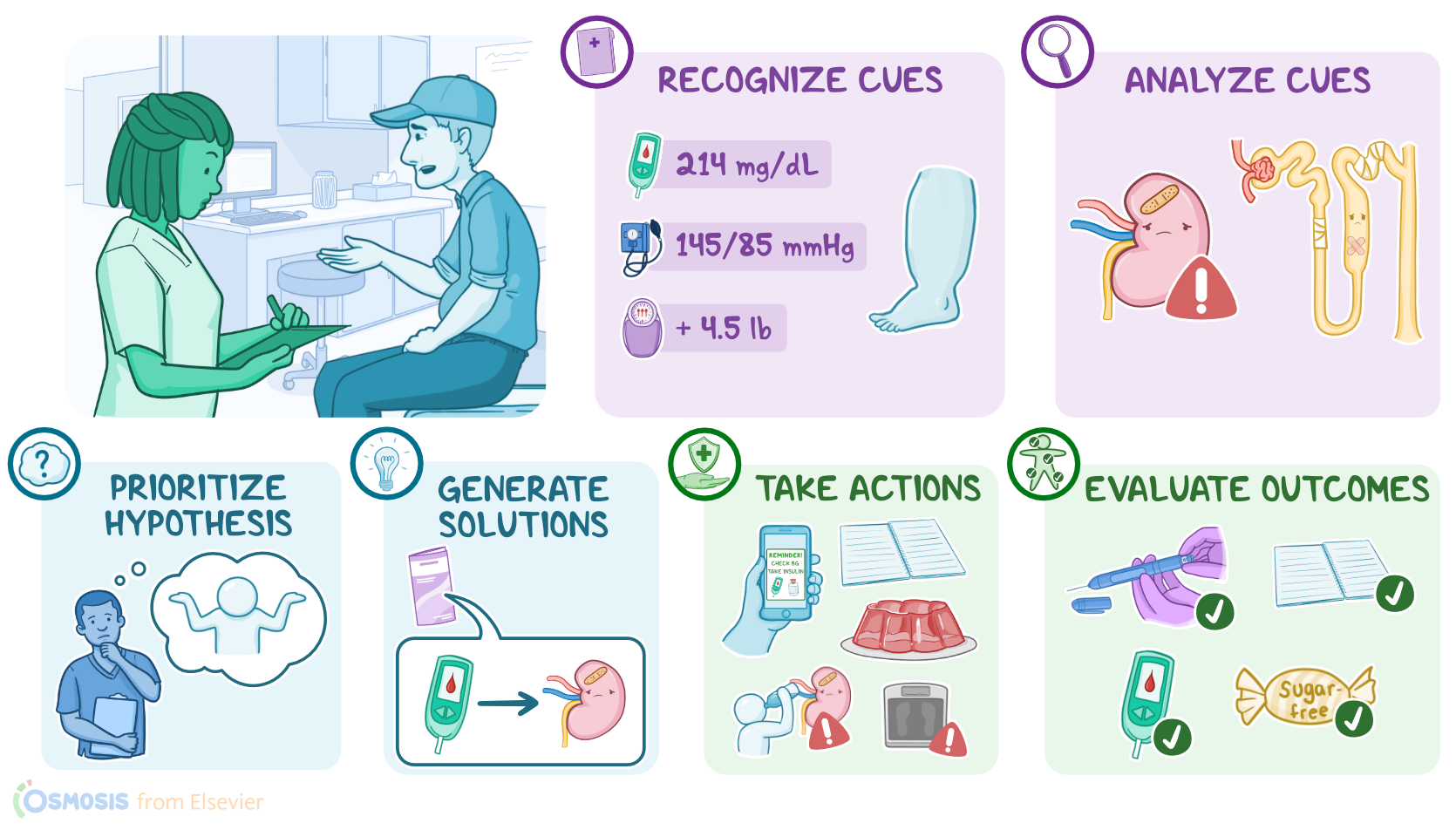
Nurse Marisol works in a family practice office and is caring for Robert, a 55-year-old male with a history of chronic kidney disease and type 2 diabetes, who's arrived for a follow-up appointment. After settling Robert in the exam room, Nurse Marisol goes through the steps of the Clinical Judgment Measurement Model to make clinical decisions about Robert’s care by recognizing cues, analyzing cues, prioritizing hypotheses, generating solutions, taking action, and evaluating outcomes.
First, Nurse Marisol recognizes important cues including mild, pitting edema in Robert’s lower extremities, a blood glucose of 214 mg/dL, blood pressure of 145/85 mmHg, and a weight gain of 4.5 pounds since his last visit.
Nurse Marisol asks about Robert’s insulin management at home.
Nurse Marisol: I see that your blood sugar is higher than your last visit. Have you made any changes to your medications or the foods you eat?
Robert: Yeah, my blood sugar’s been a little high. Sometimes I get tired and forget to take my insulin at night.
Nurse Marisol: I also noticed that your ankles are swollen, too. Can you tell me how much water you’ve been drinking lately?
Robert: Well, I’ve been really thirsty lately, so I’ve been drinking more than usual. Anyway, someone told me that drinking water helps to flush out my kidneys.
Next, Nurse Marisol analyzes these cues. She reviews the electronic health record, or EHR, and notices that Robert is prescribed ten units of long-acting insulin nightly. She also notes that he’s recommended to follow a 1.5-liter fluid restriction daily. She knows that chronic kidney disease is a progressive and irreversible loss of kidney function, and that uncontrolled diabetes can worsen damage to nephrons over time. She also understands that nephron loss reduces the glomerular filtration rate, or GFR, leading to decreased fluid output, increased fluid retention, edema, and increased blood pressure.
| CASE STUDY - CHRONIC KIDNEY DISEASE (CKD) | ||
| KEY POINTS | NOTES | |
| INTRODUCTION |
| |
| RECOGNIZING AND ANALYZING CUES |
| |
| PRIORITIZING HYPOTHESES, GENERATING SOLUTIONS, AND TAKING ACTIONS |
| |
| EVALUATING OUTCOMES |
| |
- "Lewis's medical-surgical nursing: Assessment and management of clinical problems. (12th ed.). ISBN: 978-0323792325 " Elsevier. (2022)
- "Medical-surgical nursing: Concepts for interprofessional and collaborative care. (10th ed.). ISBN: 978-0323654050 " Elsevier. (2021)
- "Lewis’s medical-surgical nursing in Canada: Assessment and management of clinical problems. (5th ed.). ISBN 978-0323791588 " Elsevier. (2023)
Aún no hay notas para este video
Intenta agregar una nota a continuación